Unlock Your Brain's Potential: Why Active Learning is Your Secret Weapon for Supercharged Retention
 Unlocking your brain's full potential through active learning.Image is for illustration purposes only
Ever sat through a lecture, nodded along, felt like you understood everything, only to draw a blank when you tried to recall it later? Or perhaps you’ve read a textbook chapter three times, highlighted every other sentence, yet the information just wouldn’t stick? You’re not alone. This common, frustrating experience highlights the fundamental difference between passive consumption and active engagement in learning. Here’s a little secret: your brain isn’t a passive receptacle; it’s a muscle that needs a good workout to get stronger. And that’s where active learning comes in – it’s your secret weapon for supercharged retention.
In a world overflowing with information, the ability to not just absorb, but genuinely understand and retain what we learn, is more valuable than ever. Whether you’re a student aiming for better grades, a professional upskilling, or simply a curious mind eager to master a new hobby, mastering the art of active learning can transform your educational journey. Forget rote memorization and endless re-reading; this isn't about studying harder, but studying smarter.
What is Active Learning, and Why Does it Matter So Much?
At its core, active learning is exactly what it sounds like: a learning approach where you, the learner, are actively involved in the learning process, rather than passively receiving information. Instead of just listening, watching, or reading, you are doing – thinking, discussing, problem-solving, explaining, and creating. It's a hands-on, minds-on approach that forces your brain to engage deeply with the material. Think of it as the difference between watching a fitness video versus actually doing the workout yourself.
The Science Behind Supercharged Retention
Why is this active engagement so powerful? It all comes down to how our brains naturally process and store information. Our memory isn’t a simple recording device; it’s a complex, reconstructive system. When you actively engage with material, you’re not just loading data; you’re building stronger neural pathways, creating more connections, and integrating new knowledge with what you already know. This deeper processing makes information more accessible and less prone to decay.
- Cognitive Load & Encoding: Passive learning often leads to a high cognitive load (too much information to process at once) without sufficient encoding (the process of converting information into a construct that can be stored in memory). Active strategies, however, optimize encoding by forcing your brain to process information in multiple ways. You’re not just seeing the word 'photosynthesis'; you're explaining it, drawing it, or connecting it to a plant in your garden.
- Retrieval Strength vs. Storage Strength: A key concept in memory science is the distinction between retrieval strength (how easily you can access a memory) and storage strength (how deeply embedded a memory is). Passive re-reading might make you feel like you know something (high retrieval strength in the moment of re-reading), but it doesn’t build lasting storage strength. Active recall, on the other hand, builds both, especially storage strength. It’s like paving a superhighway for your brain to retrieve that information whenever needed.
- The Forgetting Curve: Hermann Ebbinghaus famously described the 'forgetting curve,' demonstrating how quickly we forget new information if we don't actively work to retain it. Active learning techniques are specifically designed to flatten this curve, ensuring that knowledge sticks for the long haul. You're essentially telling your brain, 'This information is important; keep it!'
So, instead of being a mere spectator in your learning journey, active learning transforms you into the lead architect of your own knowledge. It’s a shift from 'information delivery' to 'knowledge construction.' Ready to roll up your sleeves and give your brain the workout it deserves? Let’s dive into five easy yet incredibly effective ways to integrate active learning into your routine and boost retention like never before.
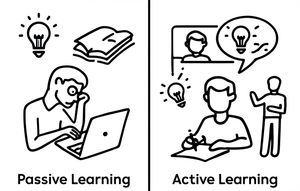 The stark difference: passive consumption vs. active engagement.Image is for illustration purposes only
Your Active Learning Playbook: 5 Easy Ways to Boost Retention
These aren't complex, time-consuming strategies. In fact, many can be integrated into your existing study habits with minimal effort, yielding maximum results. Think of them as simple tweaks that create profound differences in your learning outcomes.
1. Retrieval Practice: The Power of Pulling Information Out
Imagine your brain as a library. Passive learning is like constantly re-filing the same book. Retrieval practice, however, is like trying to find that book without looking at the index – you have to actively search for it. This act of pulling information out of your memory, rather than simply putting it in, is one of the most potent learning strategies known to cognitive science. It’s not just a test; it’s a learning event in itself.
How to Implement Retrieval Practice:
- Self-Quizzing: After reading a chapter or attending a lecture, close your book/notes and try to recall everything you can about the topic. Write it down, say it aloud, or even type it out. Don't worry about getting it perfect; the struggle itself is beneficial. Then, check your notes for accuracy and fill in any gaps.
- Flashcards (The Smart Way): Don't just make flashcards; use them to quiz yourself actively. When you see a term, try to define it fully before flipping the card. Separate cards into 'known' and 'unknown' piles, focusing more on the 'unknowns' until they become 'known.' Better yet, use digital flashcard apps (like Anki or Quizlet) that incorporate spaced repetition (more on that next!).
- Practice Questions: Utilize end-of-chapter questions, practice exams, or create your own questions. Treat these not as assessments, but as opportunities to strengthen your memory retrieval pathways.
- Brain Dumps: Before starting a new study session, take 5-10 minutes to 'brain dump' everything you remember from the previous session on the topic. It's a quick, low-stakes way to kickstart your memory and identify areas that need more attention.
The beauty of retrieval practice lies in its 'desirable difficulty.' It feels harder than re-reading because it truly challenges your brain, but that challenge is precisely what forges stronger, more durable memories.
2. Spaced Repetition: The Art of Timed Review
Remember Ebbinghaus's forgetting curve? Spaced repetition is the ultimate strategy for combating it. Instead of cramming all your studying into one marathon session, spaced repetition involves reviewing material at increasing intervals over time. It leverages the fact that each time you recall information, its memory trace strengthens, and you can go longer before needing to recall it again.
How to Implement Spaced Repetition:
- Schedule Your Reviews: Don't just review when you 'feel like it.' Build review sessions into your calendar. A common pattern is to review new material: 1 day later, 3 days later, 7 days later, 14 days later, 30 days later. Adjust as needed.
- Integrate with Retrieval Practice: Spaced repetition is most effective when combined with retrieval practice. Don't just re-read your notes during a spaced review; actively quiz yourself on the material.
- Use Digital Tools: Apps designed for flashcards (like Anki) often have built-in spaced repetition algorithms that automatically schedule your reviews based on your performance, taking the guesswork out of it. This is a game-changer for long-term retention of factual information or vocabulary.
- Create a 'Master Schedule': For larger topics or courses, map out key concepts and plan when you'll revisit them. This prevents the panic-cramming common before exams and fosters a deep, lasting understanding.
Spaced repetition makes your learning more efficient by ensuring you focus on the information you're most likely to forget, right before you forget it. It's like giving your brain perfectly timed boosts of memory glue.
3. Elaboration: Building Richer Mental Connections
Elaboration is about expanding on new information, connecting it to what you already know, and giving it meaning. Instead of just memorizing facts, you're explaining 'why' and 'how,' creating a richer, more interconnected web of knowledge in your mind. This is where true understanding begins, moving beyond surface-level recall to deep comprehension.
How to Implement Elaboration:
- Explain it to a Child (or a Rubber Duck): The 'Feynman Technique' is a classic elaboration strategy. Try to explain a complex concept in simple terms, as if you were teaching it to someone with no prior knowledge. If you get stuck, that's where your understanding is weak. Go back to your notes, clarify, and try again. A pet, a plant, or even an imaginary friend can be your audience.
- Ask 'Why' and 'How': Don't just accept facts. For every piece of information, ask: 'Why is this true?' 'How does this work?' 'What are the implications?' 'Can I give an example?' These questions force you to dig deeper and integrate the information into a broader context.
- Draw Concept Maps or Mind Maps: Visually represent the relationships between different ideas. Start with a central topic, then branch out to sub-topics, details, and examples. Use lines, arrows, and keywords to show connections. This not only aids in organization but also forces you to think about how everything fits together.
- Analogy & Metaphor Creation: Can you compare this new concept to something you already understand? For instance, if learning about cell membranes, you might compare it to a bouncer at a club, controlling what goes in and out. Analogies make abstract concepts concrete and more memorable.
Elaboration transforms isolated facts into a meaningful narrative, making them easier to recall and apply. It's like adding texture and color to a black-and-white sketch, making it vibrant and unforgettable.
4. Interleaving: Mixing It Up for Better Mastery
Our natural tendency when studying is to 'block' our practice: we focus on one topic, master it, then move to the next. While this feels effective in the short term, research suggests that 'interleaving'—mixing different subjects, skills, or problem types within a single study session—leads to better long-term retention and transfer of learning.
Why does it work? Interleaving forces your brain to constantly discriminate between different problem types, choose the appropriate strategy for each, and switch gears. This mental flexibility builds stronger, more adaptable understanding, rather than a rigid, context-dependent one.
How to Implement Interleaving:
- Mix Problem Types: Instead of doing 20 math problems of the same type, mix in problems from different chapters or concepts. For example, if you're studying geometry, algebra, and calculus, don't dedicate an hour to each separately. Do 15 minutes of geometry, then 15 minutes of algebra, then 15 minutes of calculus, and then cycle back.
- Vary Study Subjects: If you're studying multiple subjects in one day, don't dedicate a full 3-hour block to biology. Break it up with an hour of history and an hour of literature. This gives your brain a chance to refresh and approach each subject with renewed focus.
- Combine Concepts within a Subject: Within a single subject, interleave different sub-topics. For example, when studying anatomy, don't just review bones, then muscles, then organs. Mix them up, perhaps comparing how different systems interact in various scenarios.
- Don't Confuse with Multitasking: Interleaving is NOT multitasking. You're giving full attention to one problem or concept before switching to a different one. It's about varied practice, not simultaneous attention to multiple things.
Interleaving might feel a bit more challenging initially because you're constantly switching contexts. That desirable difficulty, however, is precisely what makes your learning more robust and your knowledge more flexible, preparing you for real-world situations where problems rarely come neatly categorized.
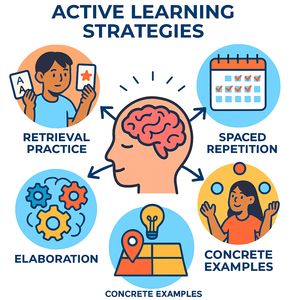 Transform your study routine with these powerful active learning techniques.Image is for illustration purposes only
5. Concrete Examples: Bringing Abstract Ideas to Life
Our brains are wired for stories, images, and tangible experiences. Abstract concepts, while essential, can be elusive and difficult to grasp. By connecting abstract ideas to concrete, real-world examples, you give your brain something to anchor onto, making the information more comprehensible and memorable.
How to Implement Concrete Examples:
- Find or Create Examples: When learning a new theory, principle, or process, actively search for or create your own examples. If a textbook provides an example, try to think of a different one. The act of generating your own example forces deeper processing.
- Visualize: Can you picture the concept in action? If learning about supply and demand, imagine a local farmer's market. If it's about a historical event, try to visualize the scene. The more vivid the mental image, the stronger the memory.
- Relate to Personal Experience: Connect new information to your own life experiences, even if they seem tangential. If learning about psychological biases, think of times you or someone you know exhibited that bias. Personal connections make learning incredibly sticky.
- Use Analogies and Metaphors (Again!): As discussed with elaboration, analogies are fantastic for creating concrete connections. A computer’s RAM is like your short-term memory; its hard drive is your long-term memory. Such comparisons simplify complexity.
Concrete examples act as mental hooks, providing a tangible way for your brain to grab onto abstract concepts. They transform vague notions into solid, understandable pieces of knowledge, making them not just easier to remember, but also easier to apply.
The Cumulative Impact: Beyond Just Remembering
While the primary benefit of active learning is undeniably improved retention, its impact extends far beyond simply remembering facts. When you consistently engage with these strategies, you cultivate a set of powerful meta-cognitive skills that transform you into a more effective learner in every aspect of your life.
- Deeper Understanding: Active learning doesn't just help you recall information; it ensures you truly grasp the underlying principles and connections. You move from knowing 'what' to understanding 'why' and 'how.'
- Enhanced Critical Thinking: Constantly asking 'why,' explaining concepts, and solving varied problems hones your analytical and problem-solving abilities. You learn to dissect information, evaluate arguments, and form your own conclusions.
- Increased Transfer of Knowledge: The flexibility and adaptability fostered by strategies like interleaving and elaboration mean you can apply what you've learned in new, unfamiliar contexts. This is the hallmark of true mastery.
- Greater Learning Efficiency: While active learning might feel more effortful in the moment, it pays off in the long run by reducing the need for constant re-learning. You spend less time re-covering old ground and more time building new knowledge.
- Boosted Confidence: Consistently seeing tangible results from your active learning efforts – remembering more, understanding better, performing stronger – naturally builds self-efficacy and a more positive learning mindset.
- Lifelong Learning Habits: These techniques aren't just for students. They are indispensable tools for professionals, entrepreneurs, and anyone committed to continuous personal and intellectual growth in a rapidly changing world.
The beauty of these active learning strategies is their universality. They are applicable across all subjects and skill sets, from mastering a new language to understanding complex scientific theories, from learning to code to improving your artistic abilities. They empower you to take control of your learning process, moving from a passive recipient to an active constructor of knowledge.
Making the Switch: Your Journey to Active Learning
Shifting from passive to active learning isn't always easy. It requires conscious effort, a willingness to embrace productive struggle, and a re-evaluation of what 'effective studying' truly means. It might feel slower at first, or even a bit frustrating, but resist the urge to revert to familiar, less effective methods. The initial discomfort is a sign that your brain is working harder – and growing stronger.
Start small. Pick one or two of these strategies and try to integrate them into your next study session. Maybe it’s dedicating 10 minutes to self-quizzing after reading, or taking the time to explain a concept aloud to yourself. Gradually, as you experience the tangible benefits of better recall and deeper understanding, these active learning habits will become second nature.
Remember, true learning isn't about how much information you can cram into your head, but how much you can truly understand, retain, and apply. Active learning isn't just a set of techniques; it's a mindset – an empowering approach that transforms you from a learner who simply consumes information into a learner who actively builds, connects, and masters knowledge. Embrace it, and unlock your brain's incredible potential for supercharged retention and lifelong growth.
Disclaimer: This article discusses educational topics for informational purposes only. The content is not intended to serve as professional academic counseling or career guidance. Please consult our full disclaimer for more information.