From Seoul's Streets to São Paulo's Stages: How Cultural Fusion Forges the Next K-Pop Global Sensation
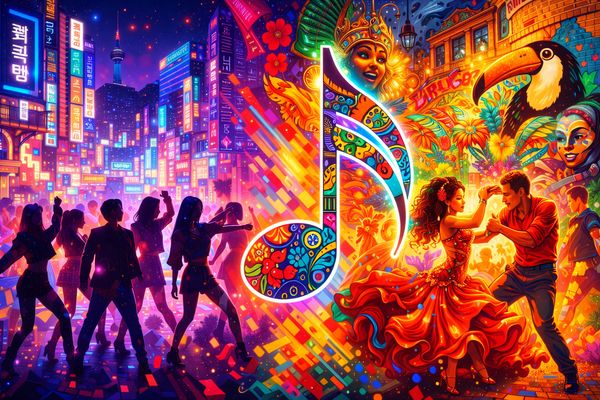 The vibrant blend of K-Pop's meticulous artistry and Latin music's infectious rhythms is creating a new global sound.This image is a conceptual illustration and may not represent actual events, data, or entities.
Imagine a bustling market in Seoul, the air thick with the aroma of street food and the distant throb of a powerful bassline. Now, transport that energy across continents, to a vibrant stadium in São Paulo, where thousands of fans chant lyrics in a language that, just a decade ago, was alien to most. This isn't a mere cultural exchange; it's a profound, energetic fusion that is rapidly redefining the landscape of global music. K-Pop, once a niche South Korean export, has transcended its origins, meticulously crafted by a system dubbed “culture technology” [4], and is now actively shaping, and being shaped by, diverse cultures worldwide, with Latin America emerging as a dynamic new frontier.
The global music industry, currently valued at an astounding $29.6 billion in 2024, has moved far beyond its traditional Western-centric roots [2]. The South Korean cultural phenomenon known as Hallyu, or the Korean Wave, stands as a testament to this shift. Its journey from the electric streets of Seoul to the colossal stadium stages of São Paulo isn't just about music; it's about a sophisticated, multi-polar industrial framework that leverages institutional backing, economic ingenuity, and, most thrillingly, bold musicological fusions [1].
The Architect's Blueprint: How Hallyu Was Engineered
Unlike many Western music movements that often bubble up organically from subcultural scenes, Hallyu’s rise was a deliberate, state-led agenda. It's a story of national resilience and strategic foresight, born from necessity.
From Crisis to Cultural Powerhouse: The 1997 Pivot
The pivotal moment arrived in the wake of the 1997 Asian financial crisis. South Korea faced severe economic contraction, forcing a radical re-evaluation of its national development strategy [5]. The government, with astonishing vision, identified the cultural sector not as a luxury, but as a “second economy” [7]. This nascent industry was seen as capable of generating revenue and burnishing the national brand with the same efficiency as established manufacturing giants like electronics and automobiles.
In 1998, President Kim Dae-jung’s administration launched the “Hallyu Industry Support Development Plan” [7]. This wasn't merely a symbolic gesture; it was backed by a dramatic increase in government spending on culture, skyrocketing from $14 million in 1998 to $84 million by 2001 [7]. This institutional commitment laid the bedrock for the modern K-Pop industry, establishing agencies and legislative frameworks specifically designed to facilitate the global export of Korean media [1].
Key initiatives during this foundational period included:
- Hallyu Industry Support Development Plan (1998): Focused on post-crisis economic recovery, it channeled massive state funding into cultural products [7].
- Basic Law for Culture Industry (1999): Provided the essential legislative framework for state investment in pop culture [1].
- Culture and Content Agency (2001): Streamlined the process of bringing Korean content to international markets [1].
- Online Digital Contents Industry Act (2002): Supported the crucial infrastructure for digital distribution and gaming [1].
The Ministry of Culture, Sports, and Tourism (MCST) continues to be the central administrative body driving this “soft power agenda” [6]. By 2012, they estimated the Korean Wave's value at $83.2 billion, with K-Pop alone contributing approximately $5.26 billion [6]. This state support has only intensified, with recent announcements of a 1 trillion won ($698.5 million) investment to bolster domestic streaming platforms, ensuring Hallyu's content remains competitive in a digital-first world [1].
 Behind every global K-Pop sensation lies a sophisticated system of 'culture technology,' meticulously crafting talent.This image is a conceptual illustration and may not represent actual events, data, or entities.
The Engine Room: Culture Technology and Star Production
At the heart of K-Pop’s economic success lies a distinctive business model known as “culture technology.” This isn't just a catchy phrase; it describes a systematic, almost scientific, process for casting, training, producing, and promoting talent. It treats the creation of a pop group as a finely tuned industrial process [4].
The Trainee System: Forging Idols from Dreams
The “star production system,” pioneered by Lee Soo-man of SM Entertainment in the late 1990s, is the industry’s engine. Young “trainees” undergo rigorous, multi-year instruction before their professional debut [3].
- Casting: Agencies conduct global auditions, seeking not just musical ability, but “hidden potential” and visual appeal [9].
- Training: Trainees immerse themselves in specialized instruction covering vocals, dance, and foreign languages. This “survival-style” training ensures only the most proficient debut [9].
- Synergy: Groups are meticulously assembled, with members assigned specific roles (e.g., main vocal, main dancer, rapper) to create a cohesive, dynamic unit [9].
This systematic approach minimizes the financial risk of launching new talent, contributing significantly to the industry’s sustainability [9]. Today, four major conglomerates—HYBE, SM Entertainment, YG Entertainment, and JYP Entertainment—known as the “Big Four,” largely dominate this landscape [3].
The Big Four's Global Playbook
Each of the Big Four agencies employs distinct strategies for global market penetration and intellectual property (IP) management [10]:
- HYBE (Institutional Power-Building): Known for acts like BTS, HYBE acquires overseas labels (e.g., Ithaca Holdings) and maintains direct IP control, leveraging organic fandom power to bypass traditional Western gatekeepers [10].
- JYP Entertainment (Grassroots Localization): JYP focuses on building groups specifically tailored for local markets, like NiziU for Japan or VCHA for the U.S., often performing in local languages [10].
- YG Entertainment (High-End Branding): YG positions its artists as luxury brands and “It Girls/Boys,” emphasizing media visibility and high-fashion collaborations [10].
- SM Entertainment (Modular & Experimental): SM uses modular systems (e.g., NCT) and high-visibility “supergroup” debuts to experiment with new market approaches [10].
The Digital Wave: Streaming and Shifting Sands
The IFPI Global Music Report 2025 underscores a significant transformation in music consumption and monetization: streaming now accounts for a staggering 69% of the total recorded music market [2].
Revenue Tides and Market Swells (2024–2025)
The global recorded music market soared to $29.6 billion in 2024, a 4.8% increase from 2023, largely fueled by paid subscription streaming, which saw a 9.5% revenue jump and reached 752 million global users [2].
- Asia & Oceania: This region remains a stronghold for physical formats, holding 45.1% of global physical revenues [2].
- Latin America: Witnessed a remarkable 22.5% increase in music revenues in 2024, marking its 15th consecutive year of growth, primarily driven by Brazil and Mexico [11].
- Middle East & North Africa (MENA): Emerged as the fastest-growing region globally in 2024, with a 22.8% revenue increase [2].
However, K-Pop faced a “market correction” in 2024. Physical album sales dipped by 19% (roughly 21.3 million copies), a stark contrast to previous years' explosive growth [13]. This suggests a bursting of the “sales bubble” that formed during the COVID-19 pandemic, prompting agencies to diversify beyond physical product exports [13].
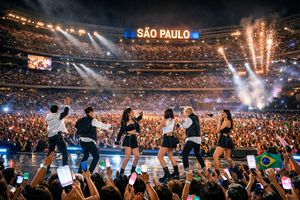 São Paulo erupts in a sea of lightsticks as K-Pop groups command massive stadium stages, marking a new era of global music domination.This image is a conceptual illustration and may not represent actual events, data, or entities.
Rhythm of the Future: K-Pop and Latin Music's Embrace
Perhaps the most electrifying global music trend in 2025 is the organic fusion of K-Pop and Latin music. This isn't just a clever marketing ploy; it’s a deep musicological integration, capitalizing on the rhythmic similarities and immense global popularity of both genres [14].
The Beat That Binds: Dembow and Reggaeton
At the core of the K-Latin crossover is the infectious reggaeton beat, built on the foundational dembow rhythm [16]. Characterized by its signature “boom-ch-boom-chick” pattern and a 3+3+2 cross-rhythm, this highly danceable framework aligns perfectly with K-Pop’s high-energy choreography [16].
- Reggaeton (85–100 BPM): Syncopated drums, simple grooves, and perreo-driven energy [16].
- Dominican Dembow (115–130 BPM): Faster, more aggressive snares, and repetitive hooks [17].
- Moombahton (105–110 BPM): A dynamic fusion of house music and reggaeton, frequently appearing in K-Pop's “tropical” tracks [15].
Cross-Cultural Duets: A New Harmony
Collaborations between K-Pop and Latin artists have evolved from tentative experiments to organic, high-production partnerships. K-Pop brings world-class production and visual styling, while Latin music injects “genre rapport” and that undeniable “everything’s-a-party” vibe [15].
- Super Junior ft. Leslie Grace (“Lo Siento”): This 2018 trilingual track (Korean, Spanish, English) was a groundbreaking moment, becoming the first K-Pop song to chart in the Latin music category [15].
- Chung Ha & Guaynaa (“Demente”): Released in 2021, this collaboration saw Chung Ha singing entirely in Spanish, a powerful demonstration of linguistic commitment [15].
- j-hope ft. Becky G (“Chicken Noodle Soup”): A vibrant remake that celebrated the roots of both artists, emphasizing dance—a core element in both K-Pop and Latin pop cultures [15].
This fusion thrives in a “post-Bad Bunny era,” where English is no longer a prerequisite for global commercial success. Artists are increasingly embracing trilingual tracks, blending languages and cultural references with seamless artistry [15].
São Paulo: The Pulsating Heart of K-Pop in Latin America
Brazil, and specifically the sprawling metropolis of São Paulo, has solidified its position as the most critical hub for K-Pop in Latin America. The region's passion for the genre is reflected in staggering concert attendance and the rapid professionalization of localized K-Pop infrastructure [12].
Record-Breaking Roar: Concert Milestones
Latin America's recorded music revenues surged by 22.5% in 2024, with Brazil leading the charge with a 21.7% rise [12]. This explosive growth has made Brazil the fastest-growing market among the global top ten [12].
April 2025 saw history made as the boy band Stray Kids performed for 120,000 fans over two nights at the Estádio do Morumbi in São Paulo [18]. This monumental event marked the first time a K-Pop act headlined a solo concert at a venue historically reserved for global titans like U2, Metallica, and Madonna [18]. Stray Kids’ “dominATE” tour is projected to draw 2.2 million spectators globally, setting a new record for a single K-Pop tour [20].
Building the Foundation: K-Pop Infrastructure in Brazil
The soaring popularity of K-Pop in Brazil has catalyzed the formalization of training and educational systems. In December 2025, the Korean Cultural Center (KCC) in Brazil held its inaugural graduation ceremony for its K-Dance course [19]. This program has been officially incorporated into the regular curriculum of the CULTSP Project, a Brazilian government initiative [19].
- Official Recognition: Graduates received certificates recognized by the Brazilian government—a first for K-Pop-related training in the country [19].
- Professional Qualification: Nineteen advanced-level students became qualified K-Dance instructors, creating a vital local pool of specialized professionals [19].
- Educational Integration: The program nurtures both technical skills and professional qualifications, ensuring sustainable growth of K-Pop culture within the Brazilian educational framework [19].
Digital infrastructure is also adapting. HYBE’s Weverse platform partnered with fintech company EBANX in 2025 to offer local payment solutions in Mexico and Brazil [12]. This is crucial because many in Latin America remain unbanked; in Mexico, only 26% of the population uses credit or debit cards [12]. By integrating local payment methods like OXXO Pay, Weverse can reach a significantly broader audience of unbanked fans [12].
“Dropping the K”: The Dawn of the Global Group
A significant strategic debate within the industry revolves around whether K-Pop needs to “drop the K” to achieve truly mainstream global status. This vision, championed by HYBE chairman Bang Si-hyuk, advocates for exporting the system of K-Pop rather than solely Korean artists or language [4].
The Blueprint Goes Global: Katseye and VCHA
The emergence of “global groups” represents the cutting edge of Hallyu’s evolution. These acts are meticulously formed using the K-Pop blueprint—intense training, curated narratives, and stunning high-production visuals—but feature multinational members and often perform primarily in English [22].
- Katseye (HYBE x Geffen Records): Born from the audition program “The Debut: Dream Academy,” Katseye comprises members from the Philippines, Switzerland, and the United States, with only one Korean member [4]. Their debut track was in English, yet their rollout mirrored the traditional K-Pop model, complete with “survival-show” drama and cinematic music videos [22].
- VCHA (JYP x Republic Records): Launched via the “A2K” (America2Korea) project, VCHA directly targets the international market [4]. The group includes four Americans and one Canadian, prioritizing global appeal while upholding the rigorous standards of Korean idol training [4].
This model is likened to exporting “not only the dish but also the ingredients and recipe” for K-Pop [4]. By localizing the production process, agencies can dismantle linguistic and cultural barriers that have historically constrained the genre's reach in the West [4].
The Unseen Force: Fandom Dynamics and Digital Communities
The colossal success of K-Pop is intrinsically linked to its passionate global fanbases. These fans have evolved from passive consumers into active, indispensable participants in the genre’s promotion and sustainability [9].
SNS Citizenship: The Power of the Collective
Scholars refer to the voluntary, altruistic actions of K-Pop fans on social media as “SNS citizenship behavior” [9]. These behaviors include:
- Recommendation and Promotion: Fans tirelessly recommend artists and comment on platforms like Instagram and TikTok, providing “maximum publicity at minimal cost” for entertainment agencies [9].
- Information Sharing: Global fans translate lyrics and variety show content in real-time, making K-Pop far more accessible to non-Korean speakers [5].
- Community Organization: Social media platforms empower fans to coordinate streaming campaigns, charity efforts, and massive fan projects for concerts, demonstrating incredible collective power [23].
A Maturing Mosaic: Fandom Demographics
The 2024 Reddit K-Pop Census reveals a maturing fanbase. While the 23–27 age group remains the largest (28.8%), there’s been a notable “aging up,” with the 33–40 group surpassing the 19–22 demographic for the first time [24]. The fanbase is diverse: 51.9% female, 39.8% male, with 52.5% White, 24.5% East Asian, and 13.1% Southeast Asian in the U.S. [24]. A significant 73.5% engage through paid streaming, while 29.4% are physical collectors [24].
In Brazil, the demographic skews slightly younger, with a majority of fans being females under 25 [21]. These fans exhibit exceptionally high levels of digital engagement, accessing social media networks on PCs at a rate 9% higher than the global average, reflecting a deep-seated culture of online participation [21].
Beyond the Music: Hallyu's Global Ripple Effect
The influence of K-Pop extends far beyond catchy tunes, driving substantial growth across beauty, fashion, and tourism sectors. This “Hallyu effect” cultivates a positive national brand image, enhancing the desirability of all Korean products and services [9].
Glamour and Trends: K-Beauty and Fashion's Ascent
Korean entertainment and beauty sectors generated over $52 billion in sales in 2023, with exports exceeding $5.39 billion [25]. K-Pop idols are the ultimate trendsetters, popularizing aesthetics like “glass skin” and bold eyeliner through viral TikTok tutorials [23].
- Luxury Collaborations: Groups like BTS and Blackpink have forged partnerships with high-end brands such as Gucci and Louis Vuitton [23]. These collaborations have propelled K-Pop from a niche interest to the very heart of the global luxury market [23].
- Latin American Market Growth: Beauty exports from South Korea to Latin America reached $70.2 million in 2023, a staggering 4.6-fold increase from 2020 [26]. Brazil stands as the largest importer, accounting for 45% of this total [26].
Wanderlust and Words: Tourism and Language Boom
The MCST’s 2025 Global Hallyu Survey reveals that Korean food (K-Food) and “visiting Korea” are the top desired experiences among international fans [27]. Approximately 64.1% of respondents with Hallyu experience expressed a willingness to visit South Korea for tourism [27].
Furthermore, the Korean language is experiencing a dramatic surge in popularity. The 2024 survey, for the first time, included “Korean language” as a content category, finding it boasted a favorability rating of 75.4%—higher than the average for all other cultural content [27]. This interest translates into tangible economic outcomes: in 2024, Hallyu fans worldwide surpassed 225 million, a monumental 24-fold increase from the 2012 count of 9.26 million [28].
Shadows in the Spotlight: Sustainability and Ethics
Despite its undeniable triumphs, the K-Pop industry faces significant challenges regarding its ethics and long-term sustainability. The rigorous “star production system” has drawn criticism for its intense commercialism and the immense pressure it places on young performers [3].
Echoes of Exploitation: Cultural Appropriation and Labor Practices
As K-Pop’s global footprint expands, it increasingly incorporates elements from diverse cultures, particularly those of African American and Hispanic communities [30].
- Cultural Appropriation: Accusations have arisen against artists for adopting elements of subordinate cultures without proper accreditation [30]. In a Western context, these imbalances are often defined by clear power dynamics between colonizing and colonized countries [30].
- Labor Practices: The industry has been criticized for its “neoliberal” approach to talent, blurring the lines between art and commerce [31]. Scholars have applied Marx’s theories of labor to analyze how K-Pop artists are often treated as highly controlled commodities [29].
A Greener Beat: Environmental and Market Sustainability
The industry's sustainability is also tied to its environmental footprint and its historical reliance on physical album sales. The 2024 decline in album exports—growing a mere 0.55% compared to previous years' double-digit surges—suggests a pressing need for agencies to find more sustainable revenue streams [13]. Some analysts argue that the industry must prioritize “fan economy sustainability” and “cultural adaptability” to ensure long-term growth in Western markets [8].
The Encore: K-Pop's Future in 2025 and Beyond
As 2025 unfolds, the highly anticipated return of titan groups like BTS and Blackpink is expected to ignite a massive resurgence in global interest and revenue [32].
- BTS Reunion: Following their military service, BTS is expected to reunite in 2025. While no official album has been announced, rumors of a world tour have sent ripples of excitement across global fandoms [32].
- Blackpink Comeback: YG Entertainment has confirmed a new album and world tour for Blackpink in 2025, building on their hugely successful 2023 “Born Pink” tour which attracted 1.8 million attendees [32].
- Emerging Acts: Rookie groups like KickFlip (JYP) and BABYMONSTER (YG) are being tailored for the global market from their inception, utilizing multilingual tracks and viral social media strategies to reach diverse audiences [32].
The industry's pivot towards virtual and AI-enhanced entertainment is also accelerating. Groups like PLAVE, a virtual act, have already broken into the Billboard Global 200, while SM Entertainment's virtual artist “naevis” is targeting the North American market with AI-crafted English tracks [32]. This blend of cutting-edge technology and artistic innovation promises to further blur the lines of traditional entertainment.
The Symphony of Tomorrow
The transformation of K-Pop from a localized musical genre into a comprehensive global cultural framework is now complete. By brilliantly integrating South Korean “culture technology” with the exhilarating rhythmic energy of Latin America and the relentless digital engagement of Western audiences, the industry has forged a resilient and highly adaptable model for the future of entertainment. The extraordinary journey from the vibrant streets of Seoul to the colossal, cheering stages of São Paulo is more than a success story; it represents a new era of cultural diplomacy and economic innovation, where the seamless fusion of diverse identities is quite literally forging the next generation of global music trends.
Disclaimer: This article explores entertainment topics for informational purposes only. Interpretations are subjective and may not represent independently verified facts. Please see our full disclaimer for more details.