Acommerce Explained: The Evolution of AI Agents Driving Smarter, Faster Financial Transactions
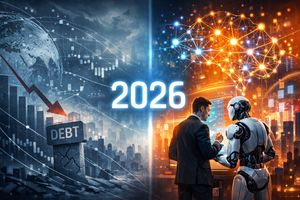
 The future of finance is agentic: AI takes the wheel for smarter, faster transactions.This image is a conceptual illustration created to symbolize AI-driven financial innovation. It does not depict actual institutions, systems, or real-world data.
Imagine a world where financial transactions occur seamlessly, without direct human input. Capital flows across borders with an almost self-correcting autonomy, and intricate negotiations conclude in milliseconds while stakeholders rest.[1] This isn't a futuristic fantasy, but the emerging reality of acommerce—agentic commerce. It marks a profound paradigm shift where the fundamental unit of economic activity moves from a human-initiated click to machine-governed intent.[3]
The financial services sector, with its inherent reliance on structured data, repeatable cycles, and strictly defined decision rules, has become the primary incubator for this transformation.[4] The global AI in finance market is projected to surge from an estimated USD 38.36 billion in 2024 to over USD 190.33 billion by 2030. Within this landscape, the transition from reactive automation to proactive, autonomous agency represents the most significant structural change in the industry since the advent of the internet.[1]
The Comparative Framework: The Logic of Agency in Financial Systems
To truly grasp the significance of acommerce, it's essential to understand its lineage within digital value exchange. The evolution can be viewed through three distinct operational models, each defined by the locus of control and the mechanism of execution. While often used interchangeably, they represent fundamentally different levels of technological maturity and economic impact.[2]
E-commerce: The Human-Centric Storefront
Traditional e-commerce, with roots tracing back to 1971 ARPANET experiments and its commercial explosion in the mid-1990s with pioneers like Netscape, Amazon, and eBay, remains a model where the human is the primary actor.[8] In this paradigm, the digital system serves as a passive interface. The consumer manually searches for products, evaluates options based on subjective criteria, and provides explicit authorization for payment, often through manual data entry or saved credentials.[8] Accounting and settlement processes in traditional retail are frequently delayed, relying on periodic reconciliation and manual audits.[5] While digital formats undeniably simplified transactions, they did not eliminate human time as the primary bottleneck for transaction velocity.
Automated Finance: The Rule-Based Efficiency
Automated finance introduced a layer of efficiency, primarily through Robotic Process Automation (RPA) and early machine learning integrations.[9] This model is inherently defined by the script: a set of predefined 'if-then' instructions that handle repetitive, high-volume tasks such as syncing transactions from a sales platform to a general ledger or processing payroll.[9] However, these systems are fundamentally brittle.[5] They function only within narrow parameters; should a transaction deviate—for example, an invoice in an unrecognized format or a sudden spike in foreign exchange volatility—the automation fails and requires human intervention.[5] Automated finance serves as a tool used by humans to execute a checklist, but it lacks the capacity to reason through ambiguity or adapt to changing market conditions independently.
Acommerce: The Rise of Agentic Autonomy
Acommerce, or agentic commerce, represents the final and most advanced stage of this evolution, where the system is defined by goal-driven collaboration.[4] Unlike traditional automation, AI agents do not follow a fixed checklist.[5] Instead, they are given a high-level objective—such as optimizing a corporate treasury to ensure maximum liquidity while minimizing exposure to volatile currency corridors—and they independently plan, reason, and execute the necessary sub-tasks.[4] These agents can monitor real-time economic signals, interact with other agents to negotiate prices, and autonomously correct errors in the general ledger without human initiation.[2] The shift is profound: from a model of humans using tools to one where humans supervise autonomous digital colleagues.[4]
| Feature | E-commerce | Automated Finance | Acommerce (Agentic) |
|---|---|---|---|
| Primary Actor | Human User | Predefined Script / RPA | Autonomous AI Agent |
| Logic Model | Subjective / Manual | Rigid Rule-Based (If-Then) | Contextual Reasoning / Goal-Oriented |
| Trigger | Manual Human Initiation | Scheduled or Event-Based | Proactive Objective-Based Action |
| Adaptability | Dependent on Human | Low (System breaks on anomalies) | High (Learning and adaptation) |
| Velocity | Human Speed (Seconds/Minutes) | System Latency (Milliseconds) | Machine Speed (Near-Instant) |
| Error Handling | Manual Correction | Exception Flagging for Humans | Autonomous Resolution & Learning |
| Data Usage | Structured Repositories | Relational Databases | Unstructured Real-Time Streams |
| Goal Management | Human-Set & Human-Executed | Human-Set & Script-Executed | Human-Set & Agent-Planned |
The Chronology of Intelligence: A Three-Era Evolution
The journey toward acommerce is the culmination of decades of converging computational logic, statistical learning, and agent-based modeling (ABM). This history is typically categorized into three distinct eras, each representing a leap in the complexity and autonomy of financial systems.[12]
Era 1: Symbolic Logic and Rule-Based Systems (1980s – 1995)
The 1980s were defined by the rise of "Expert Systems," which attempted to encode human expertise into sets of logical rules.[14] In finance, these systems were deployed for credit scoring and early algorithmic trading, using thousands of 'if-then' statements to mimic the decision-making of a senior loan officer or trader.[16] A critical milestone in this period was the commercial success of XCON, a rule-based logic system.[16] This era also saw the conceptual birth of Agent-Oriented Programming (AOP), proposed by Yoav Shoham in 1993, which introduced a societal view of computation where "agents" were defined by mental states like beliefs, capabilities, and commitments.[17] Despite their novelty, these systems were limited by their brittleness; they could not handle uncertainty or data that did not perfectly match their hardcoded rules, contributing to the "Second AI Winter" in the late 1980s.[16]
Era 2: The Machine Learning and Big Data Revolution (1995 – 2020)
The advent of the internet and the subsequent explosion of data transformed AI from a rule-based discipline to a statistical one.[13] Instead of humans writing the rules, machine learning (ML) models began to derive patterns directly from the data.[13] In the financial sector, this era saw the dominance of deep learning and neural networks for high-frequency trading and sophisticated fraud detection.[6] By 2012, AlexNet’s breakthrough in image recognition signaled the power of deep learning, which soon permeated financial risk management and sentiment analysis.[15] However, these systems remained largely reactive; they were exceptional at identifying patterns after they were initiated but could not autonomously plan complex financial strategies across multiple disparate systems without human oversight.[11]
Era 3: The Era of Agentic Autonomy (2020 – Present)
The current era is characterized by "Agentic AI," powered by the reasoning and multi-tasking abilities of Large Language Models (LLMs).[1] These agents no longer just predict text; they use their reasoning capabilities to interface with external tools, such as APIs, calculators, and payment rails.[1] This era is defined by the shift from simple automation to "Multi-Agent Systems" (MAS), where specialized agents—digital colleagues—collaborate to solve complex problems.[11] We are witnessing the introduction of specialized autonomous agents like OpenAI's Operator and Google's Project Jarvis, which can execute multi-step workflows across different software platforms.[16] Gartner predicts that by 2030, agentic AI will make at least 15% of daily financial decisions autonomously, with over 80% of finance functions embedding this autonomy into core processes.[4]
| Timeline | Milestone / Technology | Impact on Financial Transactions |
|---|---|---|
| 1940s-1960s | Von Neumann Machines / Game of Life | Theoretical foundation for autonomous reproduction and cellular automata.[20] |
| 1971 | Schelling’s Segregation Model | First agent-based model showing emergent social patterns from individual rules.[20] |
| 1980s | Expert Systems (XCON) | Commercial viability of rule-based logic in industry problems.[16] |
| 1991-1993 | Shoham's Agent-Oriented Programming | Definition of agents via beliefs, commitments, and mental states.[17] |
| 2006 | IBM Watson | Demonstration of AI processing complex human knowledge in real-time.[15] |
| 2012 | Deep Learning Revolution (AlexNet) | Rapid advancement in pattern recognition and predictive analytics.[15] |
| 2020 | GPT-3 Launch | Emergence of advanced reasoning and conversational agency in AI models.[13] |
| 2024 | EU AI Act Enforcement | First comprehensive global framework for AI accountability and safety.[21] |
| 2025-2026 | Specialized Autonomous Agents | Integration of "digital colleagues" into core banking functions (e.g., BNY, JPMC).[11] |
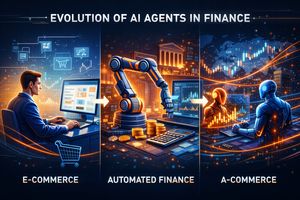 From human clicks to autonomous decisions: the journey of financial transaction technology.This infographic is a conceptual illustration showing the progression from human-operated e-commerce to automated finance and finally to autonomous commerce (Acommerce). It is intended for educational and illustrative purposes only and does not depict actual systems, institutions, or real-world data.
Technical Anatomy: The Formula 1 Analogy of Acommerce
To grasp the intricate mechanics of how an AI agent executes a financial transaction without human intervention, it's helpful to use the analogy of a Formula 1 (F1) racing team. In this ecosystem, the transaction is the race, and its success hinges on the seamless integration of several complex, specialized components.[4]
The Driver: The Reasoning Engine
The AI agent itself is the driver. Just as an F1 driver must synthesize vast amounts of sensory data—engine temperature, tire grip, and the position of competitors—to make split-second decisions, the acommerce agent uses an LLM to "reason" through financial data.[1] The agent does not simply execute a hardcoded command; it evaluates the context. If the goal is to settle a supplier payment, the "driver" checks if the bank integration is healthy, determines the most cost-effective currency corridor, and ensures the payment complies with the company’s internal controls.[5] This reasoning capability is what fundamentally separates an agent from a mere script.
The Engine and Fuel: APIs and Real-Time Data
The "engine" of the agent is the set of APIs and integrations that allow it to interact with the external world.[5] Without "fuel"—high-quality, real-time data from sources like Plaid, Bloomberg, or FactSet—the engine is useless.[19] The agent utilizes "Function Calling" to bridge the gap between its internal logic and external action.[19] When the reasoning engine decides a payment is necessary, it sends a command to a payment API (the engine) to move the capital. This process is iterative: the agent forms a plan, takes control of the interface (often via a browser or direct API), observes the outcome, and decides the next move.[19]
The Pit Crew: Multi-Agent Orchestration
No F1 driver wins alone; they rely on a specialized pit crew. In acommerce, this is represented by Multi-Agent Systems (MAS).[11] While the "driver" agent focuses on the primary transaction goal, other specialized agents (the pit crew) perform critical sub-tasks in parallel:
- The Compliance Agent: Continuously scans the transaction for sanctions risk or money laundering patterns, often utilizing tools like WorkFusion's Tara.[21]
- The Optimization Agent: Monitors global foreign exchange (FX) rates to find the optimal millisecond to execute a currency swap.[10]
- The Auditor Agent: Records every action into an immutable ledger, ensuring the transaction is "audit-ready" from the moment it begins.[5]
The Track and Guardrails: Regulatory Control
The race takes place on a track defined by strict boundaries. In the financial world, these are the regulatory guardrails such as the EU AI Act or KYC/AML laws.[21] If the agent (the driver) attempts to take a turn too wide—for instance, by attempting a transaction that violates a risk limit or a jurisdictional sanction—the "guardrails" (embedded programmatic constraints and safety layers) prevent the action or force an immediate "escalation" to a human supervisor.[4]
The Economic Impact: Market Dynamics and Infographic Statistics
The shift toward acommerce is not merely a technological trend; it is backed by massive capital investment and a rapid adoption curve among global enterprises. The data clearly suggests that the industry is moving beyond the "pilot" phase into full-scale implementation.
Global Market Forecasts and Growth
The financial industry’s investment in AI is accelerating at a compound annual growth rate (CAGR) of 30.6%.[6] While generative AI currently occupies a smaller portion of this market (approximately USD 2.21 billion in 2024), its growth rate is even more aggressive as institutions shift toward autonomous, agentic models.[25]
| Market Metric | 2024 Estimate | 2030 Projection |
|---|---|---|
| Total Global AI in Finance Market | $38.36 Billion | $190.33 Billion |
| Generative AI in Financial Services | $2.21 Billion | $25.71 Billion (2033) |
| Expected CAGR (2024-2030) | -- | 30.6% |
| Decision Autonomy (%) | < 1% | 15% (Gartner Prediction) |
| Finance Functions Embedding AI | 56% (Planned) | 80% (Autonomous) |
Regional and Sectoral Adoption
Asia Pacific is expected to register the highest CAGR during the forecast period due to rapid digital transformation and a surge in fintech startups.[6] North America currently holds the largest market share (over 39.2% in 2024), primarily driven by the automation of compliance and reporting.[25] Retail and e-commerce are poised to hold the largest end-user market share, as AI-driven personalization has the potential to boost sales by 10-30%.[6]
| Category | High-Impact Adoption Statistics |
|---|---|
| Operational Efficiency | AI automation leads to up to a 30% reduction in operational costs.[6] |
| Inventory Management | AI improves inventory accuracy by up to 30%, minimizing overstock risks.[7] |
| Customer Satisfaction | AI-powered assistants drive a 20-30% increase in satisfaction scores.[7] |
| Accounting Automation | AI agents can reduce manual finance workloads by up to 40%.[4] |
| Fraud Prevention | Stripe's AI blocked over $1 billion in fraudulent transactions annually.[18] |
| Transaction Speed | JPMC cut account rejection rates by 15-20% through agentic validation.[26] |
Core Use Case Analysis: Cross-Border Payments and Liquidity
One of the most profound applications of acommerce lies in the resolution of the "liquidity-delay trade-off" in global payments. Traditionally, banks must maintain large buffers of "idle" capital in various currencies to ensure that cross-border payments can be settled instantly.[27] This capital, by its nature, is expensive because it cannot be invested.
Autonomous Intraday Liquidity Management
Experiments conducted by the Bank for International Settlements (BIS) using reasoning models like ChatGPT have demonstrated that AI agents can replicate the decision-making of highly skilled human cash managers.[27] These agents can perform the following:
- Anticipatory Management: By analyzing historical patterns and real-time transaction queues, an agent can predict an incoming payment with high certainty. In one simulation, the agent correctly identified when to delay a non-urgent payment to reserve funds for a potential high-value urgent transaction.[27]
- Liquidity Recycling: If an agent expects a 90% probability of an incoming fund, it can update its priorities to utilize that expected liquidity for pending outgoing transactions, effectively "recycling" capital and reducing the need for costly intraday credit lines.[27]
- Risk-Averse Buffering: The agent can autonomously maintain precautionary buffers. For example, when faced with a $10 liquidity limit and two $1 pending payments, a reasoning agent might choose to delay the smaller payments to ensure the full balance is available for a mission-critical transfer in the next period.[27]
Friction Reduction in Global Sanctions and AML
Acommerce agents are also being deployed to manage sanctions risk in real-time, which has historically been a major source of friction in cross-border payments.[23] Federal Reserve data highlights that compliance with anti-money laundering (AML) and anti-terrorism financing regulations remains one of the most persistent challenges in international value transfer.[23]
- Auto-Adjudication: Agents like WorkFusion’s Tara can automate up to 70% of "false-positive" alert adjudications—where a legitimate transaction is flagged by a rigid rule-based system due to name similarity or messy data.[23]
- Real-Time Traceability: Utilizing Privacy-Enhancing Technologies (PETs) and federated learning, systems like those tested by Swift allow banks to share fraud-related intelligence across borders without exposing sensitive customer data.[28] In one test, this model was twice as effective at spotting known frauds compared to a model trained on a single institution's dataset.[28]
Institutional Frontiers: The Incumbent vs. The Disruptor
The race toward acommerce is being spearheaded by both established banking giants and the next generation of financial infrastructure providers, each leveraging their unique advantages.
JPMorgan Chase: The Scale of Intelligence
JPMorgan Chase has committed to a "data-centric" and "AI-first" approach, underpinned by a technology budget that exceeds USD 12 billion annually.[26]
- COIN (Contract Intelligence): This agent-like platform uses machine learning to review complex commercial loan agreements. A task that previously required 360,000 hours of manual legal review is now handled in seconds, virtually eliminating human error in contract extraction.[18]
- Digital Colleagues (BNY Case): While JPMC uses COIN, other incumbents like BNY (America's oldest bank) have signed multi-year deals with OpenAI to deploy "armies" of AI agents like "Eliza," which manage sales leads and client insights.[11]
- Payment Validation: JPMC has integrated LLM-based agents into its payment screening for over two years, reducing account rejection rates by 15-20% and improving the Straight-Through Processing (STP) rate for global clients.[26]
Stripe: The Infrastructure for Agentic Commerce
Stripe, valued at approximately USD 107 billion, is strategically positioning itself as the "central nervous system" of acommerce.[3]
- The $350 Billion Opportunity: JPMorgan analysts estimate that Stripe could tap into a market opportunity exceeding USD 350 billion by the end of the decade as "agentic commerce"—commerce driven by AI agents—scales.[3]
- Tempo Blockchain: Stripe is incubating "Tempo," a Layer-1 blockchain designed for high-throughput payments.[3] Described as a "payments-oriented L1," Tempo is optimized for financial services, integrating AI agents, programmable money, and stablecoins into global commerce.[3]
- Adaptive Fraud Prevention: Stripe’s agents scan billions of data points in real-time, proactively blocking over $1 billion in fraudulent transactions annually by learning from new attack patterns as they emerge.[18]
 Titans of finance are building the robust infrastructure for the agentic economy.This image is a creative illustration of secure, interconnected financial networks. It’s meant to symbolize innovation and speed in agentic commerce, not to represent any real institutions or infrastructures.
The Rule of Law: Governance, Explainability, and Accountability
As financial transactions increasingly shift from human clicks to machine intent, the question of accountability becomes paramount. The European Union has taken a decisive lead with the EU AI Act, the world's first comprehensive and binding legal framework for AI governance.[21]
The High-Risk Designation in Finance
Under the EU AI Act, the financial sector is explicitly classified as "high risk."[21] Specifically, AI systems used for evaluating creditworthiness (credit scoring) and establishing a person's credit score are designated as high-risk, except when used solely for fraud detection.[21] This designation brings stringent obligations for transparency, governance, and regulatory oversight.[21]
Core Regulatory Requirements for Acommerce
| Regulatory Pillar | Mandate for Financial Institutions |
|---|---|
| Explainability (XAI) | Institutions must provide "clear and meaningful explanations" for any automated decision that affects an individual's rights or economic status.[21] |
| Human Oversight | Systems must be designed and developed to allow for effective human supervision. A human must retain the power to override or interrupt a machine-initiated transaction.[21] |
| Traceability & Logging | Agents must maintain an "automatic recording of events" (logs) throughout their lifecycle, ensuring every decision-making step of the agent is auditable.[5] |
| Data Quality | Training, validation, and testing datasets must be "relevant, representative, and free of errors" to prevent the automation of historical biases in lending and risk pricing.[22] |
| Right to Redress | Individuals affected by AI-driven decisions have a right to obtain clear explanations and seek clarification through a formal complaint mechanism.[29] |
Failure to comply with these regulations can lead to penalties of up to €35 million or 7% of global annual turnover, whichever is higher.[21] This ensures that "responsible innovation" is not merely a choice but a fundamental requirement for modern banking.
Future Frontiers: Web3, Smart Contracts, and Quantum-Safe Cryptography
The final stage of the evolution into acommerce involves the seamless merging of AI agency with the decentralized infrastructure of Web3 and the proactive addressing of the existential threat posed by quantum computing.[24]
Web3 and Decentralized Identity (DIDs)
AI agents are inherently "native" to the digital-first environment of Web3. The integration of AI agents with smart contracts allows for the creation of "Programmable Ownership," where assets are converted into digital tokens on a blockchain.[24]
- Self-Sovereign Identity: Web3-based decentralized identifiers (DIDs) serve as portable credentials that grant individuals and AI agents control over their digital identities without reliance on centralized authorities like traditional banks.[24]
- Web3 Wallets: These are rapidly evolving into digital-identity hubs where AI agents can store and manage not only digital assets but also verifiable reputations, thereby enabling "context-aware trust" across diverse financial platforms.[24]
The Quantum Threat: Post-Quantum Cryptography (PQC)
Quantum computers pose a unique and significant threat because they could potentially break the prime factorization and elliptic curve mathematics that currently secure almost all financial transactions.[30]
- Harvest Now, Decrypt Later (HNDL): Adversaries are currently intercepting and storing encrypted financial data, anticipating that future quantum computers will be able to break the encryption retrospectively.[30]
- NIST Standards: The industry is actively migrating toward "Quantum-Safe" algorithms such as ML-KEM and ML-DSA.[24] JPMorgan is pioneering "Quantum-Safe Threshold Signatures," which distribute signing authority across several participants. This innovative approach ensures that even with a quantum computer, no single party can unilaterally sign a transaction or compromise an asset.[31]
The Convergence of Intelligence and Value
The transition to acommerce marks the end of the "informational" internet and the beginning of the "transactional" agentic economy. We are moving toward a state of "agentic finance," where financial operations are governed by AI that operates continuously, without requiring human initiation.[5] In this new landscape, economic success will be defined not by who has the most human analysts, but by who possesses the most sophisticated, transparent, and resilient multi-agent systems.[1] While this promises unprecedented efficiency and liquidity, the stability of the global financial system will fundamentally depend on our collective ability to build trust—not solely through human promises, but through the rigorous, explainable, and quantum-secure logic of the agents that serve us.[5] The machine-driven economy is no longer a futuristic ideal; it is rapidly becoming the operational model of the 21st-century financial ecosystem.
Disclaimer: This article covers financial topics for informational purposes only. It does not constitute investment advice and should not replace consultation with a licensed financial advisor. Please refer to our full disclaimer for more information.