
Retirement Redefined: Expert Insights on Long-Term Financial Planning in a Changing World
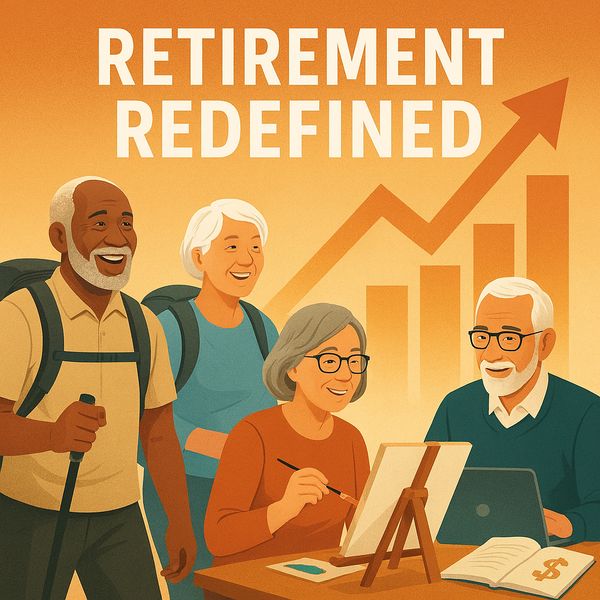 Embrace a vibrant and financially secure future with redefined retirement planning.This image is a conceptual illustration and may not represent actual events, data, or entities.
Introduction: The New Horizon of Retirement
The concept of retirement is undergoing a profound transformation. No longer a static endpoint, it has become a dynamic, multi-stage journey influenced by increasing longevity, shifting work patterns, and a desire for continued purpose. Today’s retirees envision a transition rather than an abrupt cessation of work—a period ripe with new opportunities, personal connections, and sustained well-being.
This redefined landscape demands a fundamental recalibration of long-term financial planning. The old model of simply amassing savings no longer suffices for the complexities of a 20-, 30-, or even 40-year post-career life. From navigating escalating healthcare costs to counteracting inflation, optimizing investment strategies, and creating diversified income streams, the challenges are multifaceted. However, with expert insights and proactive planning, these challenges can become opportunities. A modern retirement plan can be not only financially secure but also personally fulfilling.
This article explores the core tenets of contemporary retirement planning, drawing on authoritative data and expert perspectives. We will examine the critical trends driving this transformation, outline robust financial strategies, and offer practical guidance to help you build a long-term plan resilient to an unpredictable future.
The Evolving Landscape of Retirement: Why Redefinition is Essential
Understanding the forces reshaping retirement is the first step toward effective planning. Several demographic, economic, and societal trends demand a more nuanced and adaptive approach.
Increased Longevity and Its Implications
One of the most significant factors is rising life expectancy. CDC data show U.S. life expectancy at birth was 77.0 years in 2020 but fell to 76.4 years in 2021[1], largely due to the pandemic. However, this still represents a historically high level (roughly 78.4 years as of 2023 [2]). In practical terms, many people today live well into their 80s and 90s. This extended longevity means retirement savings may need to last 20–30 years or more. In other words, longevity risk – the risk of outliving one’s assets – has become a paramount concern.
A longer retirement horizon also creates new lifestyle patterns. Retirement may not be 30 uninterrupted years of leisure, but rather several phases: a period of semi-retirement or part-time work, followed by active leisure, and potentially a final stage requiring more personal care. Each phase has distinct financial implications (for example, continued income vs. higher healthcare spending). Effective planning must account for this prolonged timeline.
Shifting Work Patterns: The Rise of Flexible Retirement
The traditional model of “work until 65, then stop entirely” is less common today. Many older Americans are choosing flexible arrangements. According to recent data, about one in four men and 15% of women aged 65+ were still in the labor force in 2022[3]. Many retirees today embrace options like reduced hours, consulting, gig work, or second “encore” careers—often pursuing passion-driven fields or social-impact roles.
This flexibility offers benefits. Continuing to earn income can supplement retirement savings and allow for delaying withdrawals or Social Security (thereby increasing future benefits). It also provides psychological benefits: many retirees report greater life satisfaction when they remain engaged and purposeful. However, it requires careful tax planning. Working income can affect taxation and Social Security taxation, and coordination between earnings and benefit claiming.
The Persistent Challenge of Healthcare Costs
Healthcare is undeniably one of the largest and most unpredictable retirement expenses. Recent estimates underscore the scale of the challenge. Fidelity’s 2025 analysis finds that a 65-year-old retiring today can expect to spend about $172,500 on healthcare during retirement[4]. Other research suggests an average 65-year-old couple may need on the order of $345,000 (in after-tax dollars) just to cover Medicare Parts A, B, D costs[5]. These figures assume enrollment in Original Medicare (with premiums, co-pays, prescriptions) but exclude long-term care expenses, which can be catastrophic.
Given this, understanding Medicare is critical. Retirees should learn how Parts A, B, and D work together, explore Medigap (supplemental) or Medicare Advantage (Part C) options, and plan for premiums and out-of-pocket costs. Many planners also recommend using Health Savings Accounts (HSAs) when possible. HSAs allow pre-tax contributions, tax-free growth, and tax-free withdrawals for medical expenses[6] – a triple tax advantage that can significantly ease retirement healthcare costs. For potential long-term care (nursing homes, in-home help), some may consider stand-alone long-term care insurance or hybrid life/LTC policies.
Ultimately, the best healthcare expense strategy is often preventive: maintaining a healthy lifestyle (diet, exercise, regular check-ups) can reduce the likelihood and severity of chronic conditions, which in turn can lessen future medical costs.
Inflation’s Erosion of Purchasing Power
A factor sometimes underestimated in retirement planning is inflation. Even modest inflation can erode savings over time. For example, a historical analysis shows that a 2.5% annual inflation rate would cut the purchasing power of your savings in half over 30 years[7]. In practical terms, what costs $100 today could cost roughly $200 three decades later. This means that failing to plan for inflation can drastically reduce your retirement lifestyle.
To mitigate this, retirement plans must include growth-oriented assets that historically outpace inflation (like stocks), consider inflation-adjusted income sources (e.g. Social Security COLAs or inflation-linked annuities), and regularly review the plan against current economic conditions. Failing to do so risks having a shrinking income in real terms as years pass.
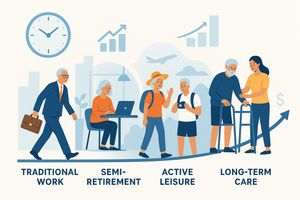 The journey of modern retirement is a dynamic blend of work, leisure, and evolving financial needs.This image is a conceptual illustration and may not represent actual events, data, or entities.
Pillars of Modern Retirement Planning: Strategies for Resilience
In this evolving environment, a robust retirement plan is built on several key pillars, each addressing specific risks and opportunities.
1. Early and Consistent Savings: The Power of Compounding
The adage “time in the market, not timing the market” holds true. Starting early allows compounding to work its full magic, turning even modest contributions into substantial sums. For example, Vanguard illustrates that a 25-year-old who saves $5,000 per year with average market returns could accumulate over $1 million by age 65, whereas a person who starts the same plan at age 35 ends up with less than half that amount[8]. The difference arises entirely from having an extra decade of compounding.
Key actions: Maximize tax-advantaged accounts. Contribute to 401(k)s, 403(b)s, IRAs, and (if eligible) HSAs. At minimum, contribute enough to get your employer’s full match. Automate savings. Set up regular transfers into your retirement accounts so saving becomes a habit. “Pay yourself first.” Treat savings like a mandatory expense – before discretionary spending – to ensure consistency. These behaviors build wealth over time and provide a foundation for your retirement.
2. Diversified Investment Strategies: Balancing Risk and Return
A well-structured investment portfolio is the engine of a retirement plan. Diversification across asset classes – equities, bonds, real estate, and possibly alternatives – helps manage risk and enhance returns. A classic strategy is to start with a more aggressive (stock-heavy) allocation in early career years to maximize growth, then gradually shift to more conservative (income-oriented) investments as retirement nears.
Vanguard emphasizes that a globally diversified portfolio aligned with your personal risk tolerance and time horizon is key to navigating market volatility[9]. By spreading investments across different countries, sectors, and asset types, you reduce the likelihood of large losses from any single market. Periodic rebalancing (realigning to target asset weights) helps maintain discipline. Another critical principle is cost control: high fees and taxes can erode returns significantly over decades[10]. Whenever possible, choose low-expense funds and tax-efficient strategies (e.g. holding tax-inefficient assets in tax deferred accounts).
Above all, maintain a long-term perspective. Economic and market turbulence is inevitable, but history shows broadly diversified portfolios tend to recover and grow over time. Avoid the temptation to make big investment moves based on short-term market swings.
3. Proactive Healthcare Planning: Beyond Medicare
As noted, healthcare costs can derail a retirement budget if unaddressed. Beyond understanding Medicare (Part A hospital, Part B doctor, Part D drugs, and supplements), it’s wise to prepare through savings and insurance. Using an HSA while working is one strategy – after age 65, HSA funds can pay for Medicare premiums as well as medical bills[2=6], providing tax-advantaged savings.
For very long retirements, consider a health-contingent annuity strategy. Qualified Longevity Annuity Contracts (QLACs), for instance, allow you to use retirement savings to buy a deferred annuity that starts paying at an advanced age (up to 85). This can provide a guaranteed income “lifeboat” later in life to offset longevity risk[11]. (QLACs also let you exclude the annuity premium from required minimum distributions, which can be tax-efficient.)
Additionally, maintaining a healthy lifestyle—regular exercise, a balanced diet, routine screenings—pays dividends. The CDC reports that physical activity among older adults helps prevent chronic disease, reduce functional limitations, and improve quality of life . In other words, investing time and effort in health now can both increase the odds of a vigorous retirement and help limit medical bills later.
4. Crafting Diversified Income Streams in Retirement
Relying on a single source of income in retirement is risky. A mix of sources provides stability if one falters. Typical components include:
- Social Security: Understand the claiming rules. Each year you delay claiming Social Security past full retirement age (up to age 70) permanently increases your benefit (by about 8% per year for modern cohorts)[13]. For example, delaying from age 67 to 70 yields roughly a 24% larger benefit. SSA provides calculators to estimate exact amounts[13]. Also remember: Social Security benefits are indexed to inflation and last your entire life[14], so they form a valuable inflation adjusted base.
- Pensions: If you have a defined-benefit pension, decide how to take it (lump-sum vs. annuity) based on longevity assumptions. Some workers are eligible for pension income, which acts like a “personal pension” in retirement. Investment Withdrawals: Withdrawals from retirement savings (IRAs, 401(k)s, taxable accounts) will likely be needed. A common guideline is the “4% rule,” but that should be adjusted for actual portfolio performance and changing needs. Work with a planner or use tools to project sustainable withdrawal rates.
- Annuities: Besides QLACs, some retirees purchase immediate annuities or guaranteed-income products to cover essential expenses. An annuity trades liquidity for certainty: you give up some control over a portion of your savings in exchange for a known income stream. This can be worth considering, especially for covering basic needs (floor of expenses).
- Other Sources: This could include rental income, part-time work, royalties, or reverse mortgages for home-rich individuals. Even expected inheritances can be thought of as potential income.
The goal is a “ladder” of income so that not all cash flow depends on markets. For example, having Social Security and pension cover basics, plus portfolio withdrawals for lifestyle, plus maybe some part time income, is more secure than just one source.
5. Tax-Efficient Withdrawal Strategies
Taxes can significantly affect how long your retirement funds last. The modern tax landscape offers more flexibility. For instance, a Roth IRA can provide tax-free withdrawals in retirement, whereas traditional accounts are taxed at ordinary income rates. Some retirees strategically convert traditional IRA funds to Roth accounts in lower-income years, locking in lower taxes now (paying tax today so future growth is tax-free). Likewise, Social Security benefits may be taxable depending on your other income; deferring withdrawals from accounts can sometimes reduce taxes on benefits.
Hybrid vehicles like HSAs (as above) and I Bonds (inflation-protected bonds) can add tax efficiency. Coordinate withdrawals so as to minimize being pushed into higher tax brackets. Often the advice is to consult a tax-aware financial advisor to plan the sequence of withdrawals from different buckets.
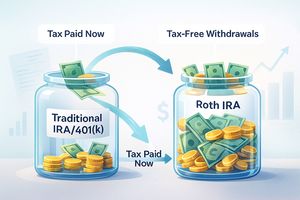 Strategic Roth conversions can unlock significant tax-free growth and withdrawals in retirement.This image is a conceptual illustration and may not represent actual events, data, or entities.
Addressing Key Challenges and Behavioral Insights
No plan is static. Economic conditions, tax laws, and personal situations change. It’s crucial to periodically revisit and adjust your plan. Still, some perennial challenges merit explicit attention:
- Longevity Risk: The fear of outliving assets is real. Social Security and (if available) a pension act as longevity insurance, since they pay for life[14]. Likewise, products like annuities or QLACs explicitly hedge longevity. Establishing a baseline of guaranteed income (from Social Security, pensions, or annuities) that covers essential expenses can give you confidence that basic needs are met, allowing the rest of your portfolio to be invested for growth.
- Market Volatility: Retirees are vulnerable to sequence-of-returns risk (the danger that a market downturn early in retirement forces selling at low prices). To mitigate this: maintain a cash reserve or short-term bond fund covering 1–2 years of expenses. Then you won’t have to sell stocks during market dips. Long-term, diversified equities help preserve purchasing power. History shows missing just a few of the market’s best days can dramatically reduce growth, so long periods out of the market tend to be costly. In other words, stay invested while respecting your risk tolerance.
- Emergency Fund: Even in retirement, an emergency fund is essential. In fact, retirees often should hold more cash than working adults. Unexpected expenses (health crises, home repairs, car replacements) still occur, and without a paycheck, tapping retirement investments could mean selling during a downturn. One guideline suggests that retirees keep at least a year’s worth of essential living expenses liquid[15]. This larger cushion reflects the volatility of expenses (e.g. healthcare) and the lack of earned income.
- Family Obligations (the “Sandwich Generation”): Many retirees help both adult children and aging parents. Common advice in financial planning is: “You can borrow for college, but you can’t borrow for retirement.” In other words, children have access to student loans and financial aid, whereas your retirement funding rests entirely on what you’ve saved. Similarly, elderly parents may qualify for government programs (like Medicaid or veteran’s benefits). Experts generally recommend prioritizing your retirement savings first while offering limited help if affordable. Crucially, have open family discussions: set clear expectations with children about college funding and with parents about care plans.
- Psychological and Health Preparedness: Retirement is not just a financial shift but a lifestyle one. Research suggests retirement can have positive effects on health and well-being[16], especially if individuals remain active and engaged. Success in retirement often involves finding meaningful ways to spend time (volunteering, hobbies, community roles, or part-time work). As one study notes, retirement combined with active social and leisure engagement tends to yield better health outcomes. Thus, alongside your financial plan, invest in your physical and mental health. Regular exercise, healthy eating, social connections, and lifelong learning are all part of this pillar.
No citation can capture personal purpose, but the bottom line is that a fulfilling retirement often requires as much planning on the non-financial side as on the financial side.
Conclusion: A Holistic, Flexible Approach to Retirement
“Retirement redefined” means embracing flexibility, and recognizing that the journey will be longer and more varied than previous generations faced. The landscape is shifting, but so too are the tools and knowledge available. By grounding your plan in verified data and sound principles – such as those from Fidelity, Vanguard, the SSA, and the CDC – you can construct a strategy that is both robust and adaptable.
Key takeaways:
- Plan for longevity: Assume you may live into your late 80s or 90s. Build sufficient savings and income streams to last.
- Save early and wisely: Take full advantage of compounding, employer matches, and tax advantaged accounts.
- Diversify broadly: Your portfolio should balance growth and income, costs and taxes, to weather market swings.
- Prepare for healthcare: Save specifically for medical costs; use tools like HSAs and insurance to cover gaps.
- Claim Social Security smartly: Know your full retirement age and the benefit of delaying. Use the SSA calculators[13] to find the optimal strategy.
- Hold cash for emergencies: Keep significant liquidity to avoid dipping into investments at inopportune times[15]. /li>
- Think holistically: Don’t neglect health, purpose, and family discussions. A satisfied retiree is often one who maintains engagement and a sense of agency.
Above all, revisit your plan regularly. The world changes – inflation rates shift, legislation evolves, your personal health and family situation changes. A plan that is reviewed annually and adjusted when needed is far stronger than a static plan drafted once. By staying informed (with reliable sources) and flexible, you can redefine retirement on your terms. It’s an opportunity to craft the life you want after work, armed with both solid data and the wisdom to adapt.
Disclaimer: This article covers financial topics for informational purposes only. It does not constitute investment advice and should not replace consultation with a licensed financial advisor. Please refer to our full disclaimer for more information.