
Unpacking 2026 Finance: Navigating Global Debt and AI's Workforce Revolution
 Navigating the dual challenges and opportunities of 2026: public debt sustainability and AI's workforce revolution.This image is a conceptual illustration and may not represent actual events, data, or entities.
The global economic landscape in 2026 presents a fascinating, albeit complex, dichotomy. On one side, nations grapple with the enduring legacy of record-high sovereign obligations and the fiscal aftershocks of the pandemic and inflationary pressures. On the other, a technological revolution driven by generative and agentic artificial intelligence promises unprecedented productivity gains, yet simultaneously introduces profound structural shifts in the labor market. This report delves into the empirical realities of public debt, the escalating burden of interest service, and the systemic restructuring of the workforce, all while contextualizing these dynamics within the evolving regulatory frameworks of the European Union and the United States.
The Sovereign Debt Super-Cycle: Sustainability in an Era of High Rates
The global debt landscape in 2026 is marked by a stabilization of total liabilities at an elevated level, masking a significant divergence between public and private sector borrowing [1]. According to the International Monetary Fund (IMF) and the 2025 Global Debt Monitor, total global debt has settled just above 235% of world Gross Domestic Product (GDP), a figure notably higher than the pre-COVID benchmark of 230% [1].
While private sector debt has seen a modest decline, falling to under 143% of GDP as households and non-financial corporations deleverage in response to restrictive monetary policies, public liabilities have surged to nearly 93% of global GDP [1]. This structural rotation from private to public debt is not a recent phenomenon but part of a multi-decade trend; data indicates that the ratio of private to public debt has nearly halved since 1974, underscoring the state's increasing role in absorbing systemic shocks [1].
Comparative Debt-to-GDP Ratios and Fiscal Trajectories (2025–2026)
An overview of general government gross debt as a percentage of GDP for major economies and regions, based on IMF and OECD projections, reveals the scale of these fiscal challenges:
- World Aggregate: 94.7% (2025) to 96.8% (2026) – an annual fiscal change of +2.1% [3]
- Advanced Economies: 111.8% (2025) to 113.2% (2026) – an annual fiscal change of +1.4% [3]
- G7 Economies: 128.0% (2025) to 129.5% (2026) – an annual fiscal change of +1.5% [4]
- United States: 124.0% (2025) to 128.7% (2026) – an annual fiscal change of +4.7% [3]
- China: 84.0% (2025) to 88.0% (2026) – an annual fiscal change of +4.0% [3]
- Japan: 230.0% (2025) to 232.0% (2026) – an annual fiscal change of +2.0% [3]
- Euro Area: 88.9% (2025) to 89.2% (2026) – an annual fiscal change of +0.3% [4]
- United Kingdom: 104.8% (2025) to 106.1% (2026) – an annual fiscal change of +1.3% [4]
- Emerging Markets (EMDEs): 75.8% (2025) to 76.4% (2026) – an annual fiscal change of +0.6% [4]
- India: 81.0% (2025) to 81.5% (2026) – an annual fiscal change of +0.5% [3]
The persistence of high public debt is primarily driven by structural fiscal deficits, which have globally averaged approximately 5% of GDP [1]. These deficits are no longer solely the outcome of emergency spending but are increasingly fueled by the “r-g” differential—the gap between the real interest rate (r) and the real growth rate (g). In 2026, the cost of servicing this burgeoning debt has become a dominant budgetary priority [7].
For instance, in the United States, net interest payments are projected to reach $1.0 trillion annually by the end of the fiscal year, equivalent to 3.2% of GDP [7]. This figure eclipses the previous record high set in 1991. This immense fiscal pressure creates a crowding-out effect, whereby heavy government borrowing limits the availability of credit for private sector innovation and elevates the cost of capital for the very technology investments intended to drive future growth [2].
The Mechanics of Debt Sustainability and the Interest Rate Wall
The sustainability of the 2026 debt profile is increasingly sensitive to interest rate assumptions [10]. Reports from the Congressional Budget Office (CBO) and the U.S. Treasury indicate that as of December 2025, the average interest rate on U.S. federal debt has climbed to 3.36%, a notable increase from 1.9% in 2016 [9]. This surge, combined with a total national debt approaching $38 trillion, means that interest expenses now consume a staggering 19% of total federal spending [7]. The fiscal gap required to stabilize the debt-to-GDP ratio at 2016 levels is estimated at 2.7% of GDP, a target that remains elusive given the political challenges of fiscal consolidation [10].
The OECD Global Debt Report 2025 highlights a similar trend across advanced economies, where the aggregate central government marketable debt-to-GDP ratio has reached 85%, more than 10 percentage points higher than in 2019 [11]. A critical vulnerability in 2026 is the maturity profile of this debt; approximately 40% of sovereign bond debt in OECD countries is set to mature by 2027 [12]. This necessitates governments to refinance liabilities at significantly higher yields than the original issues. This “maturity wall” coincides with a period where central banks have reduced their holdings of domestic sovereign bonds—falling from 29% in 2021 to 19% in 2024—thereby increasing the market's sensitivity to price-sensitive private and foreign investors [12].
 The escalating sovereign debt landscape in 2026, characterized by significant refinancing challenges due to the 'maturity wall.'This image is a conceptual illustration and may not represent actual events, data, or entities.
The dynamics of debt evolution can be expressed through the standard debt accumulation equation:
Debt-to-GDP ratio
Where 'd' is the debt-to-GDP ratio, 'r' is the nominal interest rate, 'g' is the nominal growth rate, and 'pb' is the primary balance as a share of GDP. In 2026, the upward pressure on 'r' and the moderate outlook for 'g' (projected at 3.1% globally) imply that unless primary balances improve significantly, debt ratios will continue to climb [7]. In the UK, the Office for Budget Responsibility (OBR) expects the deficit to fall to 4.5% of national income in 2025-26, down from its pandemic peak, yet still high by historical standards. Net debt is expected to peak at 97.0% of GDP by 2028-29 [6].
AI and the Structural Restructuring of the Global Workforce
As fiscal space narrows, the global economy increasingly looks to artificial intelligence as a primary lever for productivity enhancement [15]. The year 2026 marks the critical transition of AI from an experimental phase to deep workflow integration across the enterprise. However, this technological shift is not a simplistic story of job destruction; rather, it represents a fundamental reorganization of the human-machine division of labor [15].
The Displacement-Creation Duality: WEF and McKinsey Projections
The World Economic Forum (WEF) “Future of Jobs Report 2025” and McKinsey Global Institute have identified a divergent impact on the labor market [18]. While AI is expected to automate routine and cognitive tasks, it is simultaneously a powerful catalyst for the creation of new professional categories. The following table provides a comprehensive outlook on workforce restructuring:
- Financial Services: Very High exposure, with 35% productivity gain and 200,000 roles at risk [17].
- Technology: Very High exposure, with a 10x demand for AI skills and pressure on entry-level positions [18].
- Manufacturing: High exposure, with 2 million jobs impacted and a shift to oversight/robotics [18].
- Retail / Customer Service: High exposure, with 65% of roles facing automation by 2025-26 [18].
- Healthcare: Moderate exposure, with an augmentation focus and 1 million new jobs projected [18].
- Legal / Admin Services: Very High exposure, with 40% of tasks automatable and 6.4% growth in AI-fluent roles [18].
- Construction: Low exposure, marked by lagging adoption and skilled labor shortages [18].
According to the WEF, approximately 170 million new jobs are projected to be created this decade, driven by technological development and the green transition, while 92 million roles will be displaced [22]. This results in a net employment increase of 78 million jobs globally [18]. However, the immediate friction is significant: 32% of companies expect AI to reduce their workforce by at least 3% within the next 12 months, and 41% of organizations anticipate reducing their workforce in roles exposed to AI-induced skills obsolescence [18].
The Evolution of "Agentic AI" and Professional Hierarchy
A defining trend in 2026 is the rise of “agentic AI”—autonomous systems capable of acting in the physical or digital world, planning, and executing multiple steps in a workflow [24]. BCG and McKinsey report that while 62% of organizations are experimenting with AI agents, only 23% are currently scaling these systems enterprise-wide [24]. By 2028, it is predicted that 15% of day-to-day work decisions will be made autonomously [27].
The impact on talent hierarchies is particularly visible in high-cognitive sectors such as banking and consulting. Generative AI is narrowing the performance gap between junior and senior workers, which has profound implications for onboarding and promotion pipelines [28]. In investment banking, Deloitte and Bloomberg Intelligence estimate that global banks could eliminate up to 200,000 positions over the next three to five years [17]. Entry-level analysts face the highest pressure, with firms like Goldman Sachs and Morgan Stanley considering reducing junior hiring by as much as two-thirds as AI handles routine modeling and document synthesis [17].
Conversely, demand for “AI fluency” has grown sevenfold in just two years, leaping from 1 million to 7 million workers in occupations where AI skills are explicitly required [18]. Jobs requiring these skills now command a 56% wage premium, a significant increase from 25% in the previous year [18]. This creates a “Skill Imbalance Index” where advanced economies face shortages in AI-critical skills while simultaneously dealing with overcapacity in legacy roles [23].
Policy Narratives: The Regulatory Showdown of 2026
The year 2026 represents a critical regulatory milestone, as the two largest AI markets—the European Union and the United States—implement vastly different oversight strategies. This divergence is creating a complex compliance environment for multinational corporations.
The EU AI Act: August 2026 Enforcement Phase
The EU AI Act, which entered into force in August 2024, moves into its full enforcement phase on August 2, 2026 [30]. This landmark legislation adopts a risk-based approach, imposing the strictest obligations on “high-risk” AI systems [33]:
- Prohibited Practices: As of February 2, 2025, AI systems that manipulate human behavior, use social scoring, or perform untargeted scraping of facial images are banned [31].
- High-Risk Systems: By August 2, 2026, providers and deployers of high-risk AI—including systems used in credit scoring, recruitment, and critical infrastructure—must comply with rigorous requirements for risk management, data governance, and human oversight [33].
- GPAI Models: Providers of general-purpose AI models must comply by August 2025, with models presenting “systemic risk” facing additional reporting and incident mitigation duties [33].
The enforcement mechanism is robust, with fines for serious infringements reaching up to €35 million or 7% of global annual turnover [34]. However, the implementation process has faced challenges; the European Commission missed a February 2026 deadline for providing specific guidance on high-risk system compliance, leading to calls for a potential 16-month delay for certain provisions [37].
The U.S. Response: December 2025 Executive Order 14365
In the United States, the policy narrative has shifted toward aggressive promotion of innovation and the preemption of state-level regulation. On December 11, 2025, President Trump signed Executive Order 14365, “Ensuring a National Policy Framework for Artificial Intelligence” [39]:
- Federal Preemption: The EO directs the Department of Justice (DOJ) to establish an “AI Litigation Task Force” to challenge “onerous” state AI laws that are inconsistent with federal policy [39]. This includes laws aimed at reducing algorithmic bias or requiring extensive reporting, which the administration views as “ideological bias” that stymies innovation [40].
- Funding Leverage: The EO utilizes federal grants, such as $42 billion in Broadband Equity, Access, and Deployment (BEAD) funding, as leverage to discourage states from enacting or enforcing restrictive AI regulations [39].
- National Standards: The FCC and FTC are directed to establish national reporting and disclosure standards that preempt the growing “patchwork” of state laws in California, Colorado, and Illinois [39].
This centralization of AI policy is designed to ensure the U.S. “wins the AI race” by reducing the compliance burden on developers and startups [40]. However, it sets up a legal showdown between the federal government and state attorneys general who argue that state-level protections are necessary to prevent harm to children, privacy, and labor rights [42].
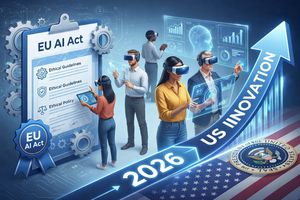 The contrasting regulatory landscapes for AI in the EU and US, shaping the future of innovation and labor in 2026.This image is a conceptual illustration and may not represent actual events, data, or entities.
Productivity and Solvency: The Macro-Financial Outlook
The ultimate question for 2026 is whether AI-driven productivity can materialize fast enough to offset the fiscal drag of sovereign debt [47]. Economic research from Wellington and Goldman Sachs suggests that full adoption of AI could boost U.S. labor productivity by 1.3% annually and increase GDP by $2.9 trillion by 2030 [47].
The AI-Productivity-Debt Feedback Loop
The potential for AI to resolve the debt crisis hinges on its ability to maintain a positive differential between the real growth rate and the real interest rate. If AI adoption reaches a critical threshold—estimated at 50% across industries—it could provide a “productivity bump” of 0.6% to 0.9% in the coming decade [47]. This would theoretically allow the economy to support higher interest rates while simultaneously stabilizing the debt-to-GDP ratio.
However, the “Skill Imbalance Index” and the “Displacement Paradox” remain significant hurdles. While 90% of CEOs believe AI agents will produce measurable returns in 2026, only 40% of organizations currently report meaningful bottom-line impact [49]. This gap exists because many companies are layering AI onto legacy workflows rather than fundamentally redesigning processes for human-AI collaboration [50]. For sovereign governments, the challenge is twofold: they must manage the immediate fiscal pressure of high interest rates while investing in the digital infrastructure and education systems required to capture the AI productivity prize.
Regional Growth Contributions in 2026
The global balance of economic power continues to shift toward the Asia-Pacific region, where AI adoption and optimism are highest [25]:
- China: 26.6% contribution to Global Real GDP Growth, with a 4.5% Real GDP Growth Projection [5].
- India: 17.0% contribution to Global Real GDP Growth, with a 6.5% Real GDP Growth Projection [51].
- Asia-Pacific (Aggregate): Approximately 50.0% contribution to Global Real GDP Growth, with a 4.1% Real GDP Growth Projection [14].
- United States: Approximately 10-15% contribution to Global Real GDP Growth, with a 1.5% Real GDP Growth Projection [52].
- Euro Area: Approximately 5-8% contribution to Global Real GDP Growth, with a 1.0% Real GDP Growth Projection [52].
China and India are projected to contribute nearly half of all global economic expansion in 2026, fueled by technology investment and private sector adaptability [51]. In China, the 15th Five-Year Plan emphasizes a transition to a consumption-led growth model, though the economy faces headwinds from an aging population and elevated debt levels [5]. The U.S. economy, while remaining the global leader in AI innovation, faces a projected growth slowdown to 1.5% in 2026 as the effects of higher tariffs and a drop in net immigration temper investment [52].
Conclusion: Navigating the 2026 Transition
The 2026 financial and technological landscape is defined by a “two-speed” reality. On one track, sovereign governments are managing a delicate balancing act of high debt, rising interest costs, and an urgent need for fiscal discipline. On the other, the private sector is accelerating into an AI-driven reinvention phase that promises to rewrite the rules of productivity and labor.
The success of this transition will depend on the ability of institutions to bridge the gap between technological potential and practical execution. For corporations, this means moving beyond AI experimentation to enterprise-wide scaling of agentic systems. For governments, it requires a stable regulatory environment that fosters innovation while protecting fundamental rights. And for the global workforce, it necessitates a lifelong commitment to reskilling and the development of “human-centric” capabilities—judgment, creativity, and empathy—that remain beyond the reach of the machine [48].
As the August 2026 EU enforcement deadline and the U.S. federal preemption efforts converge, the global economy will enter a new era of “regulated innovation.” Those who can master the interplay between fiscal resilience and technological agility will be the defining leaders of the late 2020s.
Disclaimer: This article covers financial topics for informational purposes only. It does not constitute investment advice and should not replace consultation with a licensed financial advisor. Please refer to our full disclaimer for more information.