The Ultimate Showdown: Story vs. Gameplay – What Truly Defines a Gaming Masterpiece?
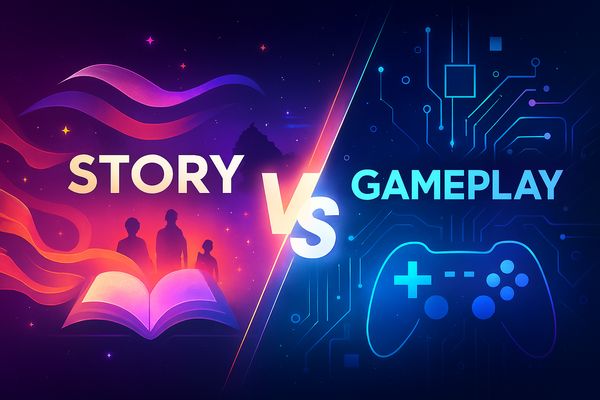 The eternal clash: narrative immersion against mechanical mastery.This image is a conceptual illustration and may not represent actual events, data, or entities.
Alright, gamers, gather 'round! Here’s what’s blowing up in the digital ether this week—a debate as old as the joystick itself, and one that sparks more passionate arguments than a pixelated street brawl: Story vs. Gameplay. Yeah, you heard me. We’re talking about the fundamental pillars of what makes a video game tick, what makes us lose hours, days, even weeks of our lives to a virtual world. But which one truly holds the crown? Is it the heart-wrenching narrative that leaves you thinking about characters long after the credits roll, or the buttery-smooth mechanics that make every button press feel like pure bliss?
It's a question that divides us, unites us, and fuels countless forum threads. From the sprawling, cinematic epics to the tight, addictive arcade loops, the gaming world is a smorgasbord of experiences. But when push comes to shove, when you're looking back at that game that just clicked for you—was it the plot twists that blew your mind, or the perfectly tuned controls that made you feel like a god? Or maybe, just maybe, it’s a bit of both, a delicious digital alchemy?
Let's dive headfirst into this glorious, never-ending argument. We're going to explore both sides, throw out some iconic examples, and maybe, just maybe, come to a conclusion that makes absolutely no one happy. Because, let's be real, that's half the fun, isn't it?
Team Story: When Narrative Takes Center Stage
For some of us, games aren’t just about pressing buttons; they're about experiencing a journey, becoming a character, living another life. We crave the kind of narrative depth that rivals a blockbuster film or a critically acclaimed novel. We want worlds that breathe, characters we care about, and stakes that feel genuinely impactful.
The Power of Emotional Connection and World-Building
Think about it: a truly great story can make you laugh, cry, cheer, and gasp. It can transport you to fantastical realms, gritty dystopias, or heartwarming small towns. It’s the meticulous lore, the intricate character arcs, the unexpected revelations that keep us glued to our screens. When a game's narrative sings, it transcends mere entertainment; it becomes an experience that resonates deep within. It’s not just about what happens, but why it matters, and how it makes us feel.
Consider the raw, brutal beauty of The Last of Us Part II. Say what you will about its narrative choices—and believe me, people have said a lot*—but you cannot deny its ambition and its capacity to evoke intense emotions. The game forces you to grapple with revenge, loss, and the cyclical nature of violence. It’s uncomfortable, challenging, and utterly unforgettable, precisely because its story is so relentlessly compelling.
Or what about the sprawling, melancholic epic of Red Dead Redemption 2? Arthur Morgan's journey from a hardened outlaw to a man seeking redemption is a masterclass in character development. The world-building is so rich, so alive, that every dusty trail and bustling town feels authentic. The narrative isn't just a backdrop for gunfights; it's the very soul of the experience, giving weight and meaning to every action you take. You don't just play as Arthur; you *become Arthur, living out his triumphs and tragedies.
Story as the Driver of Immersion
A strong narrative also acts as an unparalleled immersion tool. When you're invested in the fate of a character or the outcome of a world, every quest feels more urgent, every conversation more meaningful. It’s the reason why games like Final Fantasy VII Remake can spend hours on character interactions and dialogue – because fans are desperate to understand Cloud, Tifa, Aerith, and their plight against Shinra and Sephiroth. The story isn't just something that happens to you; it’s something you’re actively participating in, shaping, and feeling.
These games prove that for a significant chunk of the gaming population, the journey is paramount. The gameplay might be good—even great—but it serves the story. It’s the vehicle for the narrative, allowing us to interact with a tale that would otherwise be passive. Without that compelling hook, that emotional resonance, these worlds would simply be pretty pixels. They wouldn't stick with us. They wouldn't haunt our dreams. They wouldn't earn that hallowed spot in our personal gaming hall of fame.
 When a character's journey becomes your own.This image is a conceptual illustration and may not represent actual events, data, or entities.
Team Gameplay: The Unadulterated Joy of Play
Alright, narrative lovers, step aside for a moment, because for another legion of gamers, the story is merely window dressing—a thin excuse to get to the real meat of the experience: the gameplay. These are the players who live for tight controls, intricate mechanics, satisfying loops, and the sheer thrill of overcoming a challenge through skill and mastery.
Mechanics, Systems, and the Art of the Loop
For Team Gameplay, a game's brilliance lies in its systems. How well does it control? Are the core mechanics intuitive yet deep? Is there a satisfying feedback loop? Can I spend hours just playing it, even without a grand overarching narrative? These are the questions that truly matter. They want to feel the weight of every swing, the precision of every shot, the elegance of every platforming jump.
Think about the monumental success of a game like Elden Ring. Yes, it has lore, and deep lore at that—but for many, the immediate draw is the challenging combat, the sprawling open world encouraging exploration, and the sheer satisfaction of besting a formidable foe after countless attempts. The narrative is often pieced together through item descriptions and environmental storytelling, taking a backseat to the pure, unadulterated gameplay loop of exploration, combat, and progression. It's tough, it's brutal, and it's utterly addictive because its gameplay is meticulously crafted.
Or let's talk about the pure, unadulterated adrenaline rush of DOOM Eternal. Does anyone play DOOM for its nuanced plot? Probably not. You play it to rip and tear through demons with an arsenal of gloriously over-the-top weapons. The gameplay is a symphony of speed, aggression, and tactical glory kills. It’s a masterclass in first-person shooter mechanics, offering an unparalleled feeling of power and flow. The story is just a thin pretext to get you into the next arena of hellish carnage, and frankly, that’s perfectly fine for its fans.
Replayability and Emergent Storytelling
Games heavily focused on gameplay often boast incredible replayability. Take Tetris. Zero story. Yet, it’s one of the most enduring and beloved video games of all time. Why? Because its core mechanic is endlessly engaging, challenging, and satisfying. The pursuit of a higher score, the perfect line clear—it’s a timeless loop that requires pure skill and focus.
Even more complex gameplay-driven titles like roguelikes (e.g., Hades, Dead Cells) or simulation games (e.g., RimWorld, Factorio) prioritize their mechanics above all else. While these games often have emergent narratives—stories that arise naturally from the player's interactions with the systems—they aren't pre-written. Your unique journey through Hades, your colony's struggles in RimWorld, these are your stories, born from the gameplay itself. The systems are so robust, so well-designed, that they generate endless possibilities and personal triumphs.
For these players, the feeling of mastery, the challenge, the tactical depth—that's the ultimate high. A compelling story is a nice bonus, but it's never the reason to play. Give them a perfectly balanced weapon, a challenging boss fight, or a deeply satisfying movement system, and they're happier than a glitch in a speedrun.
The Beautiful Blended Brew: When Story and Gameplay Dance Together
Okay, okay, I hear you. The purists might be squaring up, but let’s be real for a moment: isn't the true magic often found when story and gameplay aren't just co-existing, but actively enhancing each other? When they intertwine so seamlessly that it's impossible to tell where one ends and the other begins?
Synergy: Greater Than the Sum of Its Parts
These are the games that often ascend to legendary status. They understand that gameplay can tell a story, and a story can elevate gameplay. Imagine a narrative twist that fundamentally changes how you approach combat, or a gameplay mechanic that deepens your understanding of a character's motivations. That's the sweet spot, the digital nirvana.
Consider the original BioShock. Its iconic narrative twists—the 'Would you kindly?' reveal, the philosophical debates on free will and objectivism—are intrinsically linked to its gameplay. The choices you make, the plasmids you wield, the splicers you fight—they all feed into the game's unsettling atmosphere and thematic depth. The narrative isn't just told to you; it's experienced through your actions and interactions within the decaying underwater city of Rapture. The environments themselves tell stories, and your traversal through them is a form of active engagement with the plot.
Then there's the recent God of War series. Kratos's journey from vengeful god to a father struggling with his past is a profound narrative arc. But critically, this narrative isn't just delivered via cutscenes. It's woven into the very fabric of the gameplay: the heavy, deliberate combat reflects Kratos's newfound restraint and power, the exploration with Atreus builds their relationship dynamically, and even the puzzles often serve to reveal lore or character insights. The gameplay is the storytelling, and the storytelling informs the gameplay. It’s a masterclass in how to tell an intimate, powerful story through the medium's unique interactive strengths.
And what about Persona 5? A game with literally hundreds of hours of content, balancing a gripping, stylish narrative about rebellion and societal critique with deeply engaging turn-based combat, robust social simulation, and meticulous dungeon crawling. Each element is incredibly strong on its own, but their synergy creates an unforgettable, almost life-altering experience. The bonds you forge with your Confidants strengthen your Personas in combat; your daily life choices influence your ability to tackle the cognitive palaces. It's a cohesive, brilliant whole.
These games don't just have a good story and good gameplay; they fuse them into an inseparable entity. They remind us that video games, unlike any other medium, have the unique ability to let us play through a narrative, making us active participants rather than passive observers. And when that fusion is perfect, it truly is something special.
 The thrill of mastery: pure, unadulterated gameplay.This image is a conceptual illustration and may not represent actual events, data, or entities.
The Player's Lens: Why Our Preferences Differ
So, why are we all so passionate about one side or the other? Why does one gamer drool over a deep narrative while another obsesses over frame rates and control schemes? It's not just about what's 'better'; it's about what resonates with us as individuals. Our gaming preferences are as unique as our fingerprints, shaped by a myriad of factors.
Different Strokes for Different Folks: Player Archetypes
Think about the classic player archetypes: the explorers who want to uncover every secret, the achievers who chase every trophy, the socializers who thrive on multiplayer interaction, and the killers who dominate leaderboards. While these are broad strokes, they hint at underlying motivations. A player primarily driven by achievement might prioritize gameplay that allows for mastery and skill expression. An explorer might lean towards games with rich, discoverable lore and environmental storytelling. Some want escapism, others challenge, others connection. It's a whole psychological puzzle!
Our life experiences also play a massive role. Maybe you grew up reading fantasy novels and crave that epic storytelling in games. Or perhaps you're a competitive athlete who naturally gravitates towards games that demand precision and quick reflexes. Even our current mood can influence what we pick up – sometimes you want a deep, reflective story, and sometimes you just want to turn your brain off and play.
Genre Expectations and Evolution
Genre plays a huge part too. We generally expect a deep story from an RPG, while a competitive fighting game or a rhythm game is almost entirely about its mechanics. But even these lines are blurring! Many RPGs are incorporating more action-oriented combat, and even some fighting games are offering surprisingly engaging single-player narratives. The industry is constantly evolving, pushing the boundaries of what's possible, and in doing so, challenging our preconceived notions of what each genre 'should' prioritize.
Indie games, in particular, are often laboratories for experimentation. With smaller budgets and more creative freedom, developers can lean heavily into unique narrative structures (e.g., visual novels, walking simulators) or ingenious gameplay mechanics (e.g., puzzle platformers, roguelikes) without the pressure of needing a perfect blend of both. This diversity is crucial, offering something for every taste and proving that there's no single 'right' way to make a great game.
Beyond the Binary: Is It Really an Either/Or?
So, after all this digital discourse, are we any closer to declaring a victor in the Story vs. Gameplay showdown? Probably not—and honestly, that's kinda the point. The beauty of video games, as an art form and an entertainment medium, lies in their incredible versatility. To insist that one element always matters more than the other feels like missing the forest for the trees.
The Interconnectedness of Design
Think about it: even the most gameplay-focused titles have some kind of 'story'—whether it's the personal narrative of improvement in a competitive game or the emergent narrative of survival in a sandbox. And even the most story-heavy games still require some level of engaging interaction, or they'd just be interactive movies. The two are inextricably linked, like two sides of the same coveted coin.
A poorly told story can drag down even the most innovative gameplay. Conversely, clunky, frustrating mechanics can utterly sabotage a brilliant narrative. In many ways, they are two critical components of the same intricate machine. When one falters, the whole experience often suffers.
The Spectrum of Greatness
Ultimately, 'what matters most' is a deeply personal, subjective question. For every player who cherishes the narrative depth of a Life is Strange, there's another who finds endless joy in the mechanical mastery of a Celeste. For some, a game's story is the soul; for others, its gameplay is the beating heart. And for a privileged few, the truly transcendent experiences are those where soul and heart beat in perfect, glorious sync.
The gaming world isn't a monolith. It's a vast, diverse ecosystem of experiences designed to cater to every conceivable taste. This debate, while fiery, is a testament to the richness and complexity of our beloved medium. It's a reminder that there's no single formula for a 'masterpiece' and that different games excel in different ways.
The Final Verdict (Kinda): It’s All About You!
So, which one truly matters most? If you’ve made it this far, you probably already know the answer for yourself. And that’s the real takeaway here, isn’t it?
Do you remember the chill down your spine when that plot twist hit? Or the fist-pump triumph after finally beating that impossible boss? Both are powerful, valid, and deeply fulfilling gaming experiences. The best games, regardless of their primary focus, are those that leave a lasting impression, that make you feel something, that challenge you, and that ultimately make you happy you picked up that controller.
Let's celebrate the games that push narrative boundaries, the games that refine mechanics to a razor's edge, and especially those rare gems that manage to do both with breathtaking finesse. The 'Great Gaming Debate' isn't about finding a definitive answer; it's about appreciating the incredible spectrum of creativity and passion that defines our industry.
Now, I wanna hear from you! Which camp do you fall into, and what games show off your preference? Share this post and tag us — let’s take the debate beyond the page. Because honestly, arguing about games is almost as fun as playing them. Almost. 😉
Disclaimer: This article explores gaming topics for informational purposes only. Strategies, opinions, and experiences are subjective and may not apply universally. For additional context, please consult our full disclaimer.