De-Stress Your Life: 5 Mind-Body Health Practices That Truly Work
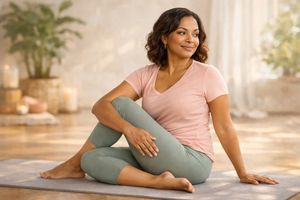
 Find your inner peace through powerful mind-body practices.This image is a conceptual illustration and may not represent actual events, data, or entities.
In our fast-paced, always-on world, stress has become an unwelcome constant. It’s the background hum of modern life, a quiet thief stealing our peace, our focus, and often, our health. You know the feeling – that persistent knot in your stomach, the racing thoughts at 3 AM, the physical tension that just won't quit. While traditional advice often points to external changes, what if the most powerful tools for de-stressing your life are already within you?
Welcome to the transformative world of mind-body health practices. These aren’t just trendy buzzwords; they’re time-tested techniques that leverage the profound connection between your thoughts, emotions, and physical well-being. By consciously engaging this two-way street, you can actively dial down your stress response, cultivate inner calm, and build a more resilient you.
This isn't about eliminating stress entirely – a nearly impossible feat in today's landscape – but rather about changing your relationship with it. It's about empowering you with practical, accessible methods to navigate life’s inevitable challenges with greater ease and presence. Ready to reclaim your calm? Let’s dive into five mind-body practices that truly work.
Understanding Stress: The Modern Epidemic
Before we explore solutions, let’s briefly demystify stress itself. At its core, stress is a natural, physiological response to perceived threats. It’s your body’s ancient alarm system, the 'fight-or-flight' mechanism designed to keep you safe from a saber-toothed tiger. When activated, your adrenal glands pump out hormones like cortisol and adrenaline, increasing heart rate, blood pressure, and muscle tension, preparing you for immediate action.
The problem in modern life? We rarely face saber-toothed tigers. Instead, our alarm system is constantly triggered by emails, deadlines, traffic, financial worries, and social pressures. This chronic, low-grade stress keeps our bodies in a perpetual state of alert, even when there's no immediate physical danger. This isn't just unpleasant; it's genuinely damaging.
The Insidious Impact of Chronic Stress:
- Physical Health: Chronic stress contributes to inflammation, weakens the immune system, impacts digestion (IBS, ulcers), elevates blood pressure, and can lead to weight gain (especially around the belly).
- Mental Health: It exacerbates anxiety, depression, irritability, and can impair memory and concentration, creating a vicious cycle of worry and overwhelm.
- Emotional Well-being: You might find yourself less patient, more reactive, and generally less able to enjoy life’s simple pleasures.
Many traditional coping mechanisms – endless scrolling, comfort eating, excessive drinking – offer only temporary relief, often adding to the problem in the long run. What we need are sustainable, internal tools that address stress at its root, helping us to not just cope, but to truly thrive.
The Mind-Body Connection: Your Inner Pharmacy
This is where the magic happens. The mind-body connection isn't some abstract, New Age concept; it's a scientifically validated reality. Your thoughts and emotions aren't confined to your brain; they ripple through every cell of your being, influencing your hormones, immune system, nervous system, and even your genetic expression. Similarly, your physical state (tension, posture, breathing) profoundly impacts your mental and emotional landscape.
Think of it as a two-way highway:
- Top-Down: Your mind influences your body. A stressful thought can trigger a physical stress response (e.g., imagining a difficult conversation makes your heart race).
- Bottom-Up: Your body influences your mind. Slow, deep breaths can calm a racing mind, and a relaxed posture can signal safety to your brain.
Mind-body practices tap into this inherent intelligence. They teach you to consciously regulate your nervous system, shifting it from the 'fight-or-flight' sympathetic state to the 'rest-and-digest' parasympathetic state. It's like having an inner volume knob for your stress response, and with practice, you learn how to turn it down.
By engaging these practices, you're not just managing symptoms; you're building resilience, improving self-awareness, and quite literally rewiring your brain for greater calm and well-being. You're activating your body's own inner pharmacy, releasing calming neurotransmitters and hormones that counteract the effects of stress. Let's explore five powerful ways to do just that.
 Embracing diverse mind-body practices for collective well-being.This image is a conceptual illustration and may not represent actual events, data, or entities.
The 5 Mind-Body Health Practices That Truly Work
1. Mindfulness Meditation: Cultivating Presence, Calming Chaos
What it is: Mindfulness meditation is the practice of intentionally bringing your attention to the present moment, without judgment. It’s not about emptying your mind or achieving blissful states; it’s about noticing what’s happening, right here, right now – your breath, bodily sensations, sounds, thoughts – and observing them with a gentle curiosity.
How it works: In our stress-driven lives, our minds often get caught in a loop of past regrets or future worries. Mindfulness acts like an anchor, pulling you back to the present. Regular practice has been shown to physically change the brain: it can reduce the size and activity of the amygdala (the brain's fear center) and increase activity in the prefrontal cortex (associated with executive function, decision-making, and emotional regulation). This rewiring helps you respond more thoughtfully to stressors rather than reacting impulsively.
Practical Steps:
- Find a Quiet Space: Sit comfortably, whether on a cushion, a chair, or even lying down.
- Focus on Your Breath: Gently close your eyes or soften your gaze. Bring your attention to the sensations of your breath – the rise and fall of your belly, the air entering and leaving your nostrils.
- Notice, Don’t Judge: Your mind will wander. This is normal. When you notice your thoughts drifting (to your to-do list, a past conversation, etc.), simply acknowledge them without judgment and gently guide your attention back to your breath.
- Body Scan: You can also practice a body scan, bringing your awareness systematically through different parts of your body, noticing any sensations of tension or relaxation.
- Start Small: Begin with just 5-10 minutes a day and gradually increase as you feel comfortable.
Benefits: Reduced rumination, improved emotional regulation, enhanced self-awareness, better focus, and a greater sense of calm and well-being.
Tips for Beginners: Don’t strive for a 'blank mind.' The practice is in noticing when your mind wanders and gently bringing it back. Use guided meditations (apps like Calm, Headspace, Insight Timer are great resources) to help you get started.
2. Yoga and Tai Chi: Harmonizing Movement and Breath
What they are: Yoga and Tai Chi are ancient mind-body practices that integrate physical postures (asanas in yoga, forms in Tai Chi), controlled breathing techniques (pranayama in yoga), and meditation or mindful awareness. They are often described as 'moving meditations.'
How they work: Both practices promote physical flexibility, strength, and balance, but their deeper power lies in their ability to regulate the nervous system. By coordinating movement with breath, you activate the parasympathetic nervous system, lowering heart rate, blood pressure, and cortisol levels. The mindful attention required for postures and movements pulls you into the present moment, much like meditation, helping to break the cycle of anxious thoughts and reducing chronic tension stored in the body.
Yoga: Known for its diverse styles, from vigorous Vinyasa flow to gentle Restorative yoga. It often involves holding poses, flowing between them, and deep stretching.
- Practical Steps: Start with beginner-friendly styles like Hatha or Restorative yoga. Many studios offer introductory classes, and online platforms provide excellent resources. Focus on listening to your body, not pushing beyond your limits.
- Benefits: Increased flexibility and strength, improved posture, enhanced body awareness, better sleep, reduced physical tension, and significant stress relief.
Tai Chi: Often called 'meditation in motion,' Tai Chi consists of slow, deliberate, flowing movements. It's particularly renowned for its emphasis on balance, coordination, and gentle energy cultivation (Qi).
- Practical Steps: Look for introductory Tai Chi classes in your community or follow online tutorials for basic forms. The movements are gentle and low-impact, making it suitable for almost all ages and fitness levels.
- Benefits: Improved balance and flexibility, reduced fall risk (especially for older adults), enhanced focus and concentration, lower blood pressure, and a profound sense of calm and groundedness.
Choosing Your Path: Both are excellent for stress reduction. If you prefer a more physically demanding practice with varied styles, yoga might appeal. If you're looking for something very gentle, flowing, and focused on internal energy, Tai Chi could be your fit. Many people find benefit in exploring both!
3. Deep Breathing Techniques: Instant Relaxation at Your Fingertips
What they are: This might sound too simple, but conscious control over your breath is one of the fastest and most effective ways to de-stress. We often breathe shallowly and rapidly, especially when stressed, which exacerbates the 'fight-or-flight' response. Deep breathing techniques deliberately slow down and deepen your breath, signaling safety to your brain.
How they work: Your breath is a unique bridge between your conscious and autonomic nervous systems. While breathing usually happens automatically, you can also consciously control it. By extending your exhalations and breathing deeply into your diaphragm (your belly), you stimulate the vagus nerve, which activates the parasympathetic nervous system – your body’s 'rest and digest' mode. This immediately lowers heart rate, blood pressure, and muscle tension.
Key Techniques:
- Diaphragmatic Breathing (Belly Breathing):
- Lie down or sit comfortably. Place one hand on your chest and the other on your belly.
- Inhale slowly through your nose, feeling your belly rise (the hand on your chest should remain relatively still).
- Exhale slowly through your mouth, feeling your belly fall.
- Aim for 5-10 minutes, focusing on smooth, deep breaths.
- 4-7-8 Breathing (Relaxing Breath): Developed by Dr. Andrew Weil, this technique is excellent for calming anxiety and aiding sleep.
- Exhale completely through your mouth, making a 'whoosh' sound.
- Close your mouth and inhale quietly through your nose to a mental count of 4.
- Hold your breath for a count of 7.
- Exhale completely through your mouth, making a 'whoosh' sound, to a count of 8.
- This completes one breath. Repeat the cycle three more times for a total of four breaths.
- Box Breathing (Four-Square Breathing): Simple and effective, often used by Navy SEALs for focus and calm.
- Exhale completely for a count of 4.
- Hold your breath for a count of 4.
- Inhale slowly for a count of 4.
- Hold your breath for a count of 4.
- Repeat the cycle.
Benefits: Immediate stress reduction, improved oxygenation, enhanced mental clarity, better sleep, and a sense of control over your body's response to stress.
When to Use Them: Anytime, anywhere! Before a big meeting, during a stressful commute, when you feel anxiety bubbling up, or as part of your nightly wind-down routine.
4. Progressive Muscle Relaxation (PMR): Releasing Physical Tension
What it is: Progressive Muscle Relaxation (PMR) is a technique where you systematically tense and then relax different muscle groups throughout your body. Developed by Dr. Edmund Jacobson, it’s based on the idea that physical relaxation leads to mental relaxation.
How it works: When we're stressed, we often unconsciously clench our muscles – jaw, shoulders, neck, hands. PMR helps you become acutely aware of the difference between tension and relaxation. By deliberately tensing a muscle group intensely for a few seconds and then releasing it, you not only release stored physical tension but also send a powerful signal to your brain that it's safe to relax. This interruption of the stress-tension cycle helps to calm the entire nervous system.
Practical Steps:
- Find a Comfortable Position: Lie down or sit in a relaxed position where you won’t be disturbed. You might want to close your eyes.
- Systematic Tensing and Releasing: Start with your feet and work your way up your body, or begin with your head and move down. The key is to isolate muscle groups.
- Example Sequence (Feet to Head):
- Feet: Curl your toes tightly downwards, hold for 5-7 seconds, then completely release. Notice the difference.
- Calves: Flex your calf muscles, hold, then release.
- Thighs: Tighten your thigh muscles, hold, then release.
- Continue this process for your buttocks, abdomen, hands and forearms (make tight fists), upper arms (tense biceps), shoulders (shrug up to ears), neck (gently push head back), jaw (clench teeth), and face (squint eyes, wrinkle forehead).
- Spend a moment after each release to truly feel the sensation of relaxation.
- Full Body Scan: After going through all groups, take a moment to scan your entire body and notice any remaining tension. Breathe into those areas.
Benefits: Significant release of physical tension, improved body awareness, reduction in anxiety and panic attacks, and a highly effective aid for falling asleep.
How to Integrate: PMR can be done daily, especially before bed to help unwind, or whenever you notice yourself feeling particularly tense. There are many guided PMR audio tracks available online that can walk you through the process.
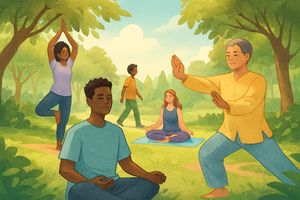 Deep breathing and progressive muscle relaxation are powerful tools for instant calm.This image is a conceptual illustration and may not represent actual events, data, or entities.
5. Nature Therapy (Forest Bathing): Reconnecting with the Earth's Calm
What it is: Nature therapy, often exemplified by the Japanese practice of 'Shinrin-yoku' or 'forest bathing,' is not about hiking or strenuous exercise. It's about mindfully immersing yourself in nature, engaging all your senses, and consciously connecting with the natural world around you.
How it works: Scientific research increasingly validates what many intuitively know: spending time in nature is incredibly healing. Exposure to natural environments has been shown to lower cortisol levels, reduce blood pressure, decrease heart rate, and even boost immune function (due to inhaling phytoncides, airborne chemicals emitted by plants). Beyond the physical benefits, nature provides a break from cognitive overload, reduces mental fatigue, and fosters a sense of awe and connection that can put daily stressors into perspective.
Practical Steps (Shinrin-yoku style):
- Find a Natural Setting: A local park, a wooded trail, even a quiet garden will do. Turn off your phone and leave behind distractions.
- Wander Aimlessly: Forget about your destination or pace. Let your body lead you. Stroll slowly, pausing when something catches your eye.
- Engage Your Senses:
- Sight: Notice the intricate patterns of leaves, the interplay of light and shadow, the vibrant colors of flowers.
- Sound: Listen to the rustle of leaves, the chirping of birds, the distant sound of water.
- Smell: Inhale the earthy scent of the soil, the fragrance of pine needles, the fresh air after rain.
- Touch: Feel the texture of tree bark, a smooth stone, or a soft mossy patch.
- Find a 'Sit Spot': If possible, find a comfortable place to sit quietly for a while. Just observe, breathe, and be present in the environment.
- Duration: Even 20-30 minutes can be beneficial, but aim for longer if you can.
Benefits: Significant reduction in stress and anxiety, improved mood and creativity, enhanced immune function, increased feelings of happiness, and a deeper sense of connection to something larger than oneself.
Making it Accessible: Even if you live in an urban area, seek out green spaces. If going outside isn't an option, spend time near a window with a view of trees, listen to nature sounds, or tend to indoor plants. The principle is to bring mindful connection to nature into your life, however you can.
Integrating Practices into Your Daily Life: Consistency is Key
Learning these mind-body practices is one thing; consistently integrating them into your daily life is another. Here are a few practical tips to make these tools your constant companions in the journey towards a less-stressed, more balanced existence:
- Start Small, Stay Consistent: Don't try to do an hour of meditation, an hour of yoga, and a forest bath all in one day from the get-go. Pick one practice that resonates most with you and commit to 5-10 minutes a day. Consistency, even in small doses, yields far greater results than infrequent, intense sessions.
- Find Your Fit: Not every practice will resonate with everyone. You might love yoga but find Tai Chi less engaging, or vice-versa. Experiment. The 'best' practice is the one you'll actually do.
- Stack Habits: Link a new practice to an existing habit. For example, after your morning coffee, do 5 minutes of deep breathing. Before bed, spend 10 minutes on PMR. This 'habit stacking' makes it easier to remember and stick to your new routine.
- Schedule It: Treat these practices like important appointments. Block out time in your calendar for your 'de-stress' time.
- Listen to Your Body: Pay attention to what your body and mind need on any given day. Some days you might crave movement; other days, quiet stillness. Be flexible and responsive.
- Be Patient and Kind to Yourself: There will be days when your mind is too busy, your body feels stiff, or you just don't feel like practicing. That's perfectly normal. Don't judge yourself; simply acknowledge it and gently recommit the next day. Progress, not perfection, is the goal.
- Create a Sacred Space: Designate a small corner of your home, if possible, as a calm, inviting space for your practice. It doesn't have to be elaborate – just clean, tidy, and free from distractions.
- Leverage Technology Wisely: Use apps for guided meditations, yoga flows, or breathing exercises. However, be mindful not to get lost in endless scrolling; use technology as a tool, not a distraction.
Remember, these practices are not quick fixes, but powerful tools for a lifelong journey of self-care and resilience. The more you practice, the more profound and lasting the benefits will be.
The Lasting Impact: A Life Less Stressed, More Present
Embracing mind-body health practices is an investment in your well-being that pays dividends far beyond just reducing stress. It's about cultivating a more present, purposeful, and peaceful life. Imagine:
- Greater Emotional Agility: Instead of being swept away by intense emotions, you develop the ability to observe them, understand their messages, and choose your response more thoughtfully.
- Enhanced Physical Vitality: With reduced chronic stress, your body functions more optimally – better sleep, stronger immunity, improved digestion, and less persistent tension.
- Sharper Mental Clarity: You’ll find it easier to focus, make decisions, and think creatively, unburdened by the constant chatter of a stressed mind.
- Richer Relationships: Being more present and less reactive allows you to connect more deeply with loved ones and navigate conflicts with greater compassion.
- Increased Resilience: Life will still throw curveballs, but you'll have a stronger internal toolkit to weather the storms, bouncing back with greater ease and learning from challenges rather than being overwhelmed by them.
These practices are not a luxury; they are a necessity in today’s world. They empower you to take an active role in your own health and happiness, recognizing that you hold the keys to your inner calm. It's a continuous journey of self-discovery, offering a profound pathway to living a life that feels more balanced, more joyful, and more authentically you.
Conclusion
Stress is an undeniable part of modern existence, but it doesn't have to control your life. By harnessing the incredible power of your mind-body connection, you can transform your relationship with stress and unlock a deeper sense of well-being. Whether you choose the quiet presence of mindfulness, the flowing movements of yoga or Tai Chi, the immediate calm of deep breathing, the tension release of PMR, or the restorative embrace of nature, each of these practices offers a unique pathway to a more peaceful you.
Start today. Pick one practice, commit to a few minutes, and gently expand as you feel ready. The journey to de-stressing your life isn't about perfection; it's about progress, self-compassion, and the remarkable discovery of your own innate capacity for calm. Your body and mind will thank you.
Disclaimer: This article addresses health-related topics for informational purposes only. It does not constitute medical advice and should not replace consultation with a licensed healthcare professional. For complete guidance, please review our full disclaimer.