
Digital Drama Unpacked: The Wildest Social Buzz of 2024 and Beyond!
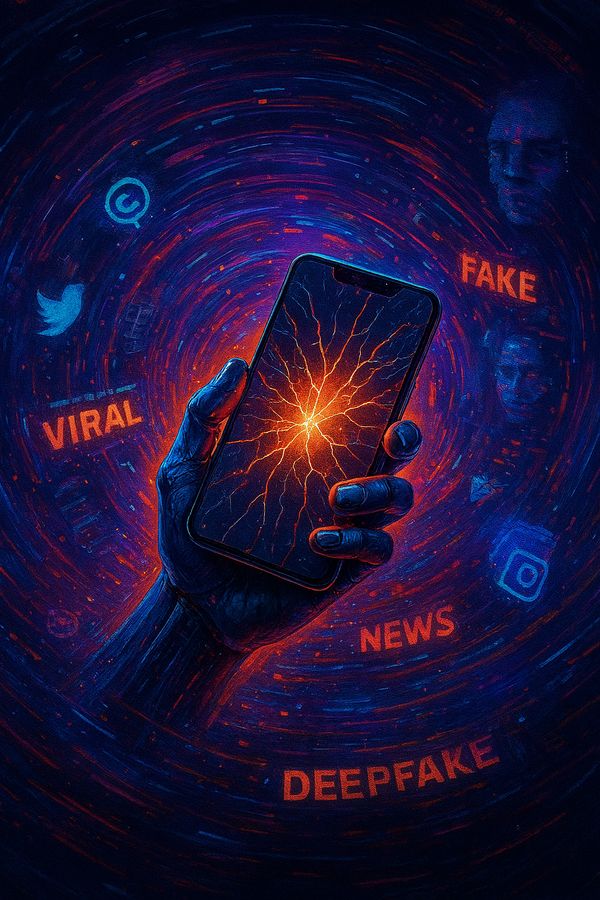 Navigating the turbulent waters of 2024's digital landscape.This image is a conceptual illustration and may not represent actual events, data, or entities.
Here’s what’s blowing up this week in the digital universe – and trust me, it’s not for the faint of heart. If you thought the internet was wild before, buckle up buttercups, because 2024 was a whole new level of digital drama. We’re talking massive data breaches, AI-fueled deception, the creator economy’s chaotic rise, and governments finally dropping the hammer on Big Tech. It’s a maelstrom out there, and we’re here to unpack every juicy bit of the wildest social buzz!
The Digital Inferno: When Your Data Becomes a Billion-Dollar Burn
Let’s kick things off with a stat that’ll make your wallet wince: the average global cost of a data breach hit a whopping $4.88 million in 2024 [1]. That’s a cool 10% jump from the previous year. For our friends in the US, it’s even bleaker – an average of $9.36 million per breach [1]. Yikes!
And who’s behind all this digital chaos? While malicious actors are indeed the main culprits (55% of breaches), a significant chunk – 45% – comes down to internal screw-ups like human error or IT failures [1]. So, next time you accidentally click on that dodgy link, just know you’re part of a multi-million-dollar problem. Even with marginally faster containment times (258 days is a seven-year low, believe it or not), breaches lingering over 200 days will still cost you an average of $5.46 million [1]. This isn’t just about speed, folks; it’s about the sheer value of the data getting snatched. It means we gotta be focusing on hardcore prevention, not just playing catch-up.
 The escalating financial cost of data breaches in the digital age.This image is a conceptual illustration and may not represent actual events, data, or entities.
The kicker? We’re more reliant than ever on these same platforms. It’s a high-risk, high-reliance feedback loop, like a digital Ouroboros eating its own tail. When these systems fail—whether it’s a security snafu or a misinformation wildfire—it's not just corporate bottom lines taking a hit. It's individual privacy, civic discourse, and even our shared sense of reality that takes a beating. Talk about a glow-up gone wrong!
Your Daily Scroll: Social Media Ate the News
Remember when TV was king for news? Well, its reign is looking a little shaky. While 56% still tune in, social media is closing in fast, especially in markets like Australia, where it’s jumped to 49% [3]. But here’s the real tea: nearly two-thirds (60%) of Gen Z are getting their daily dose of reality, filtered or not, straight from social platforms [3]. That’s a 17 percentage point surge from last year. Traditional news outlets? They’re basically background noise now. It’s clear: social is the new town square, for better or worse.
And what are we consuming? Video, baby, video! By 2025, video content is projected to gobble up approximately 82% of all global internet traffic [4]. We’re glued to our screens, spending an average of 100 minutes a day watching online videos [4]. Short-form clips, especially on TikTok and Instagram, are driving 70% higher engagement. So, yeah, it’s not just cat videos anymore—it’s how a whole generation forms its worldview. Wild, right?
Content Cops on Patrol: Platform Politics & Moderation Mayhem
2024 was a year when platform governance went from nerdy policy discussions to full-blown digital brawls. With geopolitical instability and critical global elections, content moderation became a political hot potato. And guess what? Not all platforms are playing by the same rules.
Meta’s Moderation Muddle: Jokes, Awareness, and Algorithms
Meta decided to shake things up, moving towards a more decentralized model that—get this—actually incorporates user feedback. Like, hello, common sense? This was their answer to the outcry over over-censorship. Users can now add context when appealing content removals, and boy, did they use it! In February 2024, Meta got over seven million appeals for hate speech content [6], and eight out of ten users actually provided additional context [6]. The results? One in three said their content was "a joke," and one in five claimed it was "to raise awareness" [6]. So, yeah, over half of these appeals were basically users saying, "You just don't get my humor, AI!" It really highlights the gap between cold, hard algorithms and human nuance.
Meta claims stellar "enforcement precision"—over 90% on Facebook and 87% on Instagram [5]. But here’s the catch: some analysts suggest this might be inflated. If they’re taking down fewer posts overall, especially the tricky ones that need human judgment, the "correct removal" rate is bound to look better, right? It's like only counting the easy shots to boost your free-throw percentage. Sneaky, Meta, very sneaky.
Global Gaps and Election Chaos: Safety for Some, Not for All
With an estimated 2.6 billion people hitting the polls in 2024—a "super election year" if there ever was one—the pressure on platforms to control disinformation was immense [8]. And here's where things get dicey: Meta reportedly put specific ad-related safeguards in place for the US elections, but didn't publish comparable measures for hate content or misinformation in non-Western, non-English speaking markets [8]. It’s a classic case of geopolitical regulatory arbitrage—platforms prioritizing safety where the regulators are breathing down their necks, leaving massive user bases in other regions vulnerable. Basically, your digital safety depends on where you live, and that, my friends, is a problem.
X Marks the Spot (for Controversy): Biometrics, Lawsuits, and Blue Check Chaos
Ah, X (formerly Twitter). The platform has been a hot mess of scrutiny since its rebranding. From viral misinformation to hate speech (yep, antisemitism is still a thing) and even child pornography, X is struggling big time [9]. And just when you thought it couldn’t get wilder, X dropped a new privacy policy allowing it to collect users’ biometric data and access encrypted messages [10]. Amnesty International called it out, warning of severe security and privacy risks, and potential mass surveillance [10]. Oh, and your data? It’s probably being used to train X’s AI models, often without your explicit consent. Fun times!
Adding insult to injury, X Corp. decided to sue non-profit watchdog organizations like Media Matters and the Center for Countering Digital Hate (CCDH) [9]. This move is seen by many as an attempt to shut down critical research and control the narrative around its operational safety. When a platform sues the people trying to hold it accountable, you know the digital drama is hitting peak levels.
TikTok’s Tech Talk: Automated Smarts vs. Human Nuance
TikTok, the reigning champ among younger demographics, is leaning heavily on a blend of automated tech and human review to enforce its Community Guidelines [11]. Their goal? To reduce the "cognitive load" on human moderators by letting AI tackle the obvious, severe violations like graphic violence or nudity [12]. This frees up their human teams to deal with the super-nuanced stuff—think bullying, harassment, misinformation, and hateful behavior [12]. Their automated systems have a reported false positive rate of just 5% [12], and they’ve even improved their in-app notifications to tell users why their video was removed, hoping to reduce repeat offenders. Smart moves, TikTok, smart moves.
The Deepfake Deluge: AI’s Authenticity Crisis is Here
Okay, let’s talk about the biggest mind-bender of 2024: deepfakes. Generative AI went mainstream, and suddenly, hyper-realistic, fabricated content is everywhere. Public trust? It's on life support. A whopping 59% of people globally are worried about what’s real and what’s fake online [15]. In countries facing big political events, that number skyrockets to 72% in the US and 70% in the UK [15]. Even four out of five US adults are sweating about AI spreading misinformation in the 2024 presidential election [16]. This ain't no conspiracy theory—this is real anxiety.
 Distinguishing fact from fiction in an era of advanced AI deception.This image is a conceptual illustration and may not represent actual events, data, or entities.
Fraud on Steroids: The Weaponization of AI
Deepfake fraud has seen an explosive increase—more than 10 times worldwide between 2022 and 2023 [17]. Thanks, readily available deep learning tech! Voice cloning is particularly insidious because it’s so easy and so effective. A staggering 70% of people aren't confident they can tell a real voice from a cloned one [17]. Scammers only need about three seconds of audio to create an 85% match [17]. Searches for "free voice cloning software" shot up 120% between July 2023 and July 2024 [17]. This is personalized fraud on a terrifying scale, like calling your mom with your dad's cloned voice asking for emergency cash. Politically, it’s just as chilling, with fake audio clips like the one depicting a Slovakian party leader discussing election rigging [19]. The threat to democracy is very, very real.
Fighting the Fakes: Platforms and Regulations Step Up (Kinda)
The good news? Platforms are trying to fight back. TikTok rolled out a tool in September 2023 to detect and disclose AI-generated content [20]. Meta followed suit in February 2024, launching detection and labeling across Facebook, Instagram, and Threads, complete with visible markers and invisible watermarks [20]. On the legislative front, the EU’s AI Act officially entered into force in August 2024—the world's first comprehensive legal framework for AI, structuring regulation based on risk levels [20]. It imposes strict transparency obligations on AI users. While these technical fixes are a start, that 59% public anxiety tells us it’s not enough [15]. Trust requires consistent, transparent enforcement, and that’s a whole other ballgame.
Academic Accountability: No Cheating with Chatbots
Even academics and publishers are wrestling with AI. Organizations like Elsevier now mandate that authors maintain ultimate responsibility for their work, even if AI tools were used [22]. Any AI use needs human oversight, and you better cite that AI tool (e.g., OpenAI, 2024) [23]. Basically, if you used a chatbot to write your thesis, you’re still on the hook for its accuracy and originality. No slacking off just yet, folks!
The Creator Economy: Boom, Bust, and Billion-Dollar Scams
The creator economy is a behemoth, estimated at $205.25 billion in 2024 and projected to explode to $1.345 trillion by 2033 [24]. Creators themselves are driving this engine, pulling in 57.2% of the revenue share [24]. Video streaming platforms are still the cash cows, proving that dynamic content is king when it comes to monetization [24].
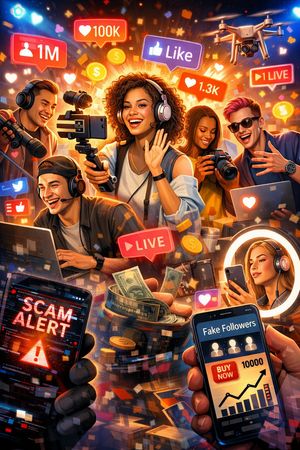 The booming creator economy: innovation meets inevitable pitfalls.This image is a conceptual illustration and may not represent actual events, data, or entities.
But here’s the stark reality: while there are hundreds of millions of creators, only a tiny fraction are actually raking in the big bucks. A mere 4% earn over $100,000 annually, while a whopping 50% pocket less than $15,000 [25]. This massive financial disparity creates a pressure cooker, pushing many to find quick, often shady, ways to make a buck. And that, my friends, leads us straight to… scams.
Scam Central: Identity Theft, Investment Traps, and Faked Fame
Online scams are officially a bigger problem than traditional ones. In 2024, consumers lost over $3 billion to online fraud, compared to $1.9 billion from phone calls or emails [26]. The riskiest place to get scammed? Social media. A shocking 70% of people who reported a loss started their interaction on a social platform, totaling $1.9 billion in losses [26]. And if you’re into crypto, beware: it’s a favorite for scammers, contributing to $1.4 billion in losses [26]. The most financially devastating? Investment scams, which cost victims a mind-boggling $5.7 billion, with a median loss of over $9,000 per victim [26]. Ouch!
Influencer fraud is also rampant. Scammers clone profiles, run fake giveaways, and phishing campaigns, preying on established trust. Australia saw a 43% increase in identity theft cases on social media [27]. Brands are also getting played by creators who fake their engagement metrics. Marketers are now turning to AI (63% plan to) to verify audience authenticity and engagement rates, because they simply can’t trust what they’re seeing [27]. Interestingly, while younger folks report losing money more often, older adults lose significantly larger sums when they do fall victim [26]. High-frequency, low-value scams for the youth; high-value, trust-based scams for the elders. It’s a sad, predictable pattern.
Regulators Step In: No More Shady Endorsements
The Federal Trade Commission (FTC) is finally cracking down, mandating transparency in creator-brand relationships [29]. They even took action against YouTubers Trevor Martin and Thomas Cassell (TmarTn and Syndicate) for deceptively promoting an online gambling site they owned without disclosure [30]. This set a major precedent: influencers are legally and financially responsible for misleading their audience. Authenticity and disclosure? Non-negotiable. Period.
The Regulatory Hammer: Governments Get Real (and Get Fines)
2024 marked a pivotal shift: governments went from hand-wringing to hammer-dropping. Regulators, especially in the EU, started translating legislative intent into cold, hard cash penalties and mandating structural changes for Very Large Online Platforms (VLOPs).
DSA Drops the Hammer: X Gets Hit with a €120 Million Fine
The EU’s Digital Services Act (DSA) is no joke. It bans deceptive design ("dark patterns"), personalized ads based on sensitive data, and forces marketplaces to verify sellers [31]. And in a landmark move, the European Commission slapped X with a €120 million fine for violating the DSA [13]. The reasons? Misleading "blue checkmark" verification (malicious actors were abusing it) [32], failing to provide a searchable ad repository for transparency, and inadequate data access for researchers [13]. This fine is a game-changer: misleading verification isn't just a business decision anymore; it’s a direct threat to informational safety [13]. And with penalties up to 6% of global turnover, other platforms are surely sweating. TikTok also got hit with formal proceedings in February 2024 over protecting minors, ad transparency, and data access [32]. The regulatory hammer is swinging!
 Governments worldwide crack down on Big Tech with fines and new regulations.This image is a conceptual illustration and may not represent actual events, data, or entities.
US Tackles Child Safety: A Bipartisan Breakthrough
Across the pond, the US focused on child safety. The TAKE IT DOWN Act became law, mandating that social media platforms remove real and digitally altered sexually exploitative content involving children, including deepfakes [33]. This is a crucial step in closing legal loopholes. In a rare display of bipartisan unity, CEOs from Discord, Meta, Snap, TikTok, and X were hauled before the Senate Judiciary Committee to testify about their failures to protect kids online [34]. It was an "unforgettable" hearing, leading to commitments for new legislation like the Kids Online Safety Act. Protecting minors? That’s a hill everyone's willing to die on.
Meanwhile, the Supreme Court case Murthy v. Missouri tackled the sticky issue of government influence on content moderation [35]. It’s all about finding that fine line between government action and platform autonomy. Complex, much?
Age Verification Nation: Are You Old Enough to Scroll?
Governments globally are moving towards strict age verification for social media access. Australia is banning accounts for minors under 16 by December 2025, with fines up to $49.5 million for non-compliance [37]. Malaysia is going even further, planning to prohibit under-16s from holding accounts entirely by 2026, relying on mandatory eKYC checks with official IDs [38]. Singapore also adopted a Code of Practice for app stores, enforcing age checks and content filtering [38]. This raises a massive privacy question: to protect kids, platforms will become repositories of sensitive ID documents, escalating data breach risks. It’s a tightrope walk between child protection and data privacy, and platforms are going to have to get creative (and secure!) to navigate it.
The DSA, with its global turnover-based fines, is effectively setting a high-level governance standard for US-headquartered tech companies operating internationally [39]. What happens in Brussels doesn't stay in Brussels; it impacts platform operations worldwide. The future of digital accountability is here, and it’s European.
The Human Algorithm: Social Media’s Mental Toll
Beyond the tech and the laws, there’s a massive human cost to all this digital drama. The engagement-maximizing algorithms that drive our daily scrolls are contributing to a mental health crisis, social fragmentation, and general societal havoc.
Teen Trouble: The Rise of Problematic Use
Social media platforms are designed to keep us hooked, and it’s working—especially on our youth. The World Health Organization (WHO) found a sharp increase in problematic social media use among adolescents (11, 13, and 15-year-olds), jumping from 7% in 2018 to 11% in 2022 across 44 countries [41]. We’re talking addiction-like symptoms: inability to control usage, withdrawal, neglecting life for social media, and negative consequences [41]. Girls are hit harder, with 13% reporting problematic use compared to 9% of boys [41]. This constant stream of notifications, driven by algorithms, fuels anxiety, stress, and that dreaded FOMO [42]. It messes with sleep, increases depression, and in severe cases, even suicidal ideation [42]. It's a harsh truth: platform profit and user well-being are often at odds.
 The silent cost: Algorithms and their toll on our well-being.This image is a conceptual illustration and may not represent actual events, data, or entities.
Cyberbullying’s Shadow: Who’s Getting Hit Hardest?
Cyberbullying is still a huge problem. Approximately 30% of surveyed US teens have been cyberbullied at some point in their lives [43], and 13% reported it in the last 30 days [43]. Girls are just as likely, if not more, to be both victims and offenders [43]. Guess which platform leads the pack for cyberbullying? YouTube, with a staggering 79% incidence rate, followed by Snapchat (69%) and TikTok (64%) [44]. This highlights the challenge of moderating real-time, visual content compared to text. Socioeconomic factors also play a role: kids from households earning under $75,000 are twice as likely to be cyberbullied (22% vs. 11%) [44]. Digital safety, it turns out, is an equity issue.
Echo Chambers Exploding: The Architects of Polarization
Beyond individual harm, social media’s architecture is tearing society apart. Studies show that societal polarization directly correlates with the mass advent of smartphones and social media [45]. Just look at the political landscape in Western countries: voters are digging in deeper into their ideological trenches [45]. Why? Algorithms. They feed us content based on our past preferences, keeping us engaged longer, but also creating impenetrable echo chambers. We see less diverse viewpoints, our own biases are reinforced, and suddenly, everyone on the other side is "the enemy." This commitment to "engagement maximization" is a double-edged sword, driving both individual addiction and societal fragmentation [42]. Talk about a plot twist!
Conclusion: Navigating the Next Era of Digital Drama
So, there you have it—the digital drama of 2024 in a nutshell. It was a year defined by a high-stakes tension: mind-blowing technological advancements and unchecked commercial growth slamming head-first into a wall of regulatory intervention and consumer crisis. The digital sphere is rapidly, and often painfully, maturing. The creator economy is still surging, projected to hit over a trillion dollars by 2033 [24], but it’s inextricably linked to eye-watering levels of fraud—we’re talking $5.7 billion lost to investment scams [26] and a record-high average data breach cost of $4.88 million [1]. The AI authenticity crisis, with deepfake fraud increasing over tenfold, has fundamentally shattered digital trust, forcing platforms like Meta and TikTok to slap labels on AI-generated content [17], [20].
But here’s the silver lining: governments are finally stepping up. The EU’s €120 million fine on X [13] isn't just pocket change; it's a global precedent. It shouts loud and clear that corporate resistance to transparency, especially concerning account authenticity and informational integrity during elections, will hit where it hurts—the bank account. Platform design choices are now officially under external regulatory control, particularly when they monetize confusion or societal risk. It’s a new era of digital accountability, and it’s about bloody time.
There's also a growing global consensus around protecting minors. The US TAKE IT DOWN Act [33] and mandatory age verification in Australia and Malaysia [37], [38] mean platforms will have to fundamentally re-engineer their identity management systems. The days of 'move fast and break things' are over. Moving forward, we need to prioritize the human element over algorithmic efficiency. We need platforms to understand the true cost of context-driven moderation and to acknowledge the nuances of human intent, as revealed by user appeal data [6]. Regulators need to pivot from just mitigating harm to mandating proactive architectural changes, demanding greater transparency in the algorithms that fuel both psychological distress and civic division [41], [45]. Platforms, listen up: rigorous accountability, transparency, and user safety aren't optional extras; they're the non-negotiable costs of operating at a scale that impacts billions of citizens worldwide. The digital drama isn't going anywhere, but with smarter tech, tougher laws, and a renewed focus on human well-being, maybe, just maybe, we can navigate the next era without completely losing our minds.
Disclaimer: This article highlights social buzz and online trends for informational purposes only. Content may reflect public commentary or opinion rather than verified information. For additional context, please refer to our full disclaimer.