From Despair to Glory: The Craziest Last-Minute Wins That Rewrote Sports History
 From the brink of defeat to the pinnacle of triumph: these last-minute victories define sporting legend.This image is a conceptual illustration and may not represent actual events, data, or entities. It is an artistic representation of the theme.
In the grand theater of professional sports, where narratives unfold with gripping intensity, few moments captivate the collective imagination quite like the last-minute victory. These aren't just wins; they are seismic shifts, moments when the scales of probability tip violently, transforming impending despair into an eruption of glory. Measured in milliseconds, centimeters, or the final ticks of a clock, these events transcend mere competition, etching themselves into the annals of history and forever altering the legacies of teams, athletes, and even entire cities.
The Architecture of the Improbable: Understanding Clutch Performance
The consistent recurrence of last-minute victories isn't merely a statistical anomaly; it points to a distinct psychological state known as 'clutch performance' [1]. Academic research delineates between 'clutch moments'—brief, intense episodes of peak performance—and 'clutch states,' the underlying psychological experience that underpins success under immense pressure [1].
Clutch vs. Flow: A Critical Distinction
While a 'flow state' is often characterized by effortless action and a lack of self-awareness, clutch performance demands heightened awareness, deliberate concentration, and intense effort [2]. Athletes in a clutch state are acutely aware of the stakes and the absolute necessity of flawless execution [1]. This awareness of pressure is not a hindrance but a prerequisite, allowing athletes to tap into the elevated physiological and psychological resources required for a clutch outcome [1].
The Shadow of Choking: Performance Under Pressure
Conversely, the inverse of clutch performance is 'choking,' defined as a significant decrease in skill performance compared to expected standards, driven by increased anxiety under pressure [3]. Two primary models explain this decline:
- Self-Focus Models (Explicit Monitoring): Pressure can lead athletes to over-analyze the step-by-step mechanics of skills they would normally perform automatically. This 'reinvestment' of conscious attention disrupts natural execution, leading to errors [4].
- Distraction Models: Anxiety can divert an athlete’s focus to irrelevant cues, such as crowd noise or the consequences of failure, diminishing the working memory available for the task at hand [1].
Interestingly, experts are often more susceptible to choking when they explicitly monitor their movements, as their proficiency relies on implicit motor programs [5]. Clutch performers, however, maintain 'perceived control,' allowing them to resist over-analysis and instead focus on critical outcomes [6].
Let's examine some of the most iconic last-minute turnarounds across various sports, dissecting not just what happened, but the immense impact they had.
The Stoppage-Time Paradigm: Soccer’s Miraculous Conclusions
In association football, 'stoppage time' is a realm of extreme volatility, often witnessing improbable shifts in fortune.
The 1999 UEFA Champions League Final: Manchester United vs. Bayern Munich
The final on May 26, 1999, at Camp Nou, remains a testament to late-game reversal [7]. Bayern Munich took an early lead in the 6th minute via a Mario Basler free-kick and held tactical control for the subsequent 84 minutes [7]. Manchester United's attack struggled against a disciplined German defense [7].
Sir Alex Ferguson's substitutions—Teddy Sheringham in the 67th minute and Ole Gunnar Solskjær in the 81st—fundamentally altered the game's dynamic [8]. As injury time began, Bayern players were already celebrating. However, in the 91st minute, a corner led to a scuffed shot from Ryan Giggs, which Sheringham directed into the net for the equalizer [7]. Less than 30 seconds after the restart, United won another corner. David Beckham's delivery was flicked on by Sheringham to Solskjær, who poked the ball into the roof of the net in the 93rd minute, securing a 2-1 victory [7].
Manchester United’s statistical profile showed persistent pressure, with 53% possession and 15 shots, 9 on target [7]. This win completed the first 'Treble' in English football history, securing the Premier League, FA Cup, and Champions League in one season [7].
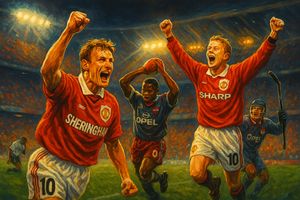 Manchester United's dramatic double strike in stoppage time against Bayern Munich, sealing their historic Treble.This image is a conceptual illustration and may not represent actual events, data, or entities. It is an artistic representation of the theme.
The '93:20' Phenomenon: Manchester City’s First Premier League Title
May 13, 2012, saw Manchester City facing Queens Park Rangers (QPR) in a match that would decide the Premier League title [9]. Needing a win to secure their first top-flight title in 44 years, City led 1-0 at halftime. However, QPR, despite playing with ten men, took a 2-1 lead by the 66th minute [9].
As the game entered five minutes of stoppage time, rival Manchester United had already won their match, meaning City were minutes away from losing the title [9]. In the 92nd minute (91:15), Edin Džeko scored a header to tie the match at 2-2 [9]. Then, at 93:20, Sergio Agüero played a one-two, navigated the QPR defense, and fired the winning goal past Paddy Kenny [9]. Manchester City's statistical dominance was historic, with 81.3% possession, a Premier League record that stood until 2018 [10].
The economic legacy of this win is profound; Manchester City transformed from a regional club with £87 million in revenue to a global brand generating record revenues of $903 million (£715 million) in the 2023–24 fiscal year [11].
American Football's Defining Moments
In the high-stakes world of American football, last-second plays can define entire franchises.
The 'Immaculate Reception': A Franchise Transformed
The 1972 AFC Divisional Playoff between the Pittsburgh Steelers and the Oakland Raiders witnessed arguably the most significant single play in NFL history: the 'Immaculate Reception' [12]. On December 23, 1972, with 22 seconds left, the Steelers trailed 7-6 [13]. Quarterback Terry Bradshaw, under pressure, threw a desperate fourth-and-10 pass that ricocheted off Raiders defender Jack Tatum [14]. Rookie running back Franco Harris, who had been blocking, tracked the ball and caught it inches above the turf at full stride, running 60 yards for a touchdown [14].
It took officials nearly 15 minutes to confirm the score due to ambiguous rules at the time [14], but Referee Fred Swearingen ultimately signaled the touchdown, sealing a 13-7 Steelers victory [13]. Before 1972, the Steelers were perennial underachievers. The 'Immaculate Reception' is credited with fundamentally shifting their identity, catalyzing a decade of dominance that included four Super Bowl titles in six years and solidifying Pittsburgh’s 'City of Champions' moniker [14].
Super Bowl LI: The Anatomy of a 28-3 Inversion
Super Bowl LI, on February 5, 2017, between the New England Patriots and the Atlanta Falcons, provided the most dramatic comeback in Super Bowl history [15]. Midway through the third quarter, the Falcons led 28-3 [15]. At this juncture, ESPN’s Win Probability Chart estimated the Falcons’ chances of winning at an astounding 99.8% [16]. Analytically, the Patriots' situation was akin to a poker player needing a 'runner-runner' sequence to win a hand where they were 0.4% to succeed after the flop [17].
The Patriots' comeback was a relentless sequence of incremental scoring and defensive stops. After reducing the lead to 28-20, a pivotal Matt Ryan fumble forced by the Patriots' defense allowed them to tie the game at 28-28. In the final minutes of regulation, a spectacular sideline catch by Julio Jones seemingly put the Falcons in field goal range. However, a sack and a holding penalty pushed them out, forcing a punt [15]. The Patriots then marched 91 yards, aided by a miraculous, multi-deflected 'catch' by Julian Edelman, to tie the game with 57 seconds left [15]. In the first Super Bowl overtime, the Patriots won the coin toss and James White scored the winning touchdown [15].
Hardwood Immortality: The Greatest Shots in Basketball History
Basketball’s inherent game clock structure ensures that some of its most iconic victories unfold in the closing seconds.
Three Seconds in Munich: USA vs. USSR, 1972 Olympics
The 1972 Olympic men's basketball final between the United States and the Soviet Union remains one of the most controversial games in sports history [18]. The U.S. had never lost a gold medal match and held a 50-49 lead with three seconds remaining after Doug Collins made two free throws [19].
The final three seconds were replayed three separate times due to administrative confusion [18]. After two failed attempts and controversial intervention by FIBA Secretary General R. William Jones, the clock was reset to three seconds for a third time. The Soviets completed a full-court pass to Alexander Belov, who scored a layup as time expired to win 51-50 [20]. The U.S. team unanimously refused their silver medals, which remain uncollected [20]. The game intensified Cold War tensions, with American media characterizing it as a 'robbery' [20].
Christian Laettner and 'The Shot': 1992 NCAA Regional Final
Often hailed as the greatest college basketball game ever played, the 1992 Elite Eight saw Duke face Kentucky [21]. With 2.1 seconds left in overtime, Kentucky took a 103-102 lead. Duke had no timeouts [21]. Grant Hill launched a 75-foot full-court pass to Christian Laettner. Laettner caught the ball, took a single dribble, turned, and released a jumper as the buzzer sounded [23]. The ball swished through the net, giving Duke a 104-103 victory [21]. Laettner finished a perfect 10-for-10 from the field and 10-for-10 from the free-throw line [22].
LeBron James and the 3-1 Comeback: 2016 NBA Finals
The 2016 NBA Finals provided a rare long-form 'last-minute' victory: a team overcoming a 3-1 series deficit for the first time in Finals history [24]. The Golden State Warriors, after a record 73-win regular season, held a commanding series lead [25]. Led by LeBron James and Kyrie Irving, the Cleveland Cavaliers won three straight elimination games [26]. Game 7 was decided in the final two minutes. With the score tied 89-89, LeBron James executed his iconic 'The Block' on Andre Iguodala [26]. Moments later, Kyrie Irving hit a step-back three-pointer over Stephen Curry to secure Cleveland’s lead [27]. LeBron James earned unanimous Finals MVP honors, leading all players in the series in points, rebounds, assists, steals, and blocks [24].
Baseball’s Post-Season Magic: Curses and Strikeouts
In baseball, the 'last minute' translates to the bottom of the ninth inning, where the absence of a game clock can extend dramatic tension indefinitely.
The 2004 ALCS: Dave Roberts and 'The Steal'
Down three games to none against the New York Yankees, the Boston Red Sox faced elimination in Game 4 of the 2004 ALCS [28]. Trailing 4-3 in the bottom of the ninth against Mariano Rivera, a leadoff walk to Kevin Millar led to manager Terry Francona inserting Dave Roberts as a pinch-runner [31]. Knowing Roberts would steal second, Rivera attempted three pick-offs. On the first pitch to Bill Mueller, Roberts stole second, beating Jorge Posada’s throw by a fraction of a second [30]. Mueller then singled to score Roberts, tying the game [30]. David Ortiz eventually won the game in the 12th inning with a home run [29]. The Red Sox went on to win the series, becoming the only MLB team to overcome a 3-0 deficit, and subsequently ended an 86-year championship drought [29].
2011 World Series Game 6: Two Strikes Away
In October 2011, the St. Louis Cardinals were twice down to their final strike in Game 6 against the Texas Rangers [32]. Trailing 7-5 in the bottom of the ninth with two outs and two runners on, David Freese hit a two-run triple on a 1-2 count to tie the game [32]. In the 10th inning, after the Rangers scored two more, Lance Berkman hit a two-out, two-strike RBI single to tie the game at 9-9 [32]. Freese then hit a walk-off home run in the 11th inning to force a Game 7, which the Cardinals won [33].
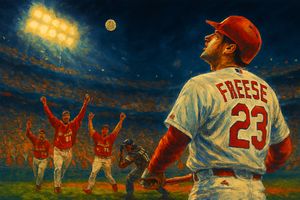 David Freese's heroics in Game 6 of the 2011 World Series, twice saving the Cardinals from elimination and ultimately winning it.This image is a conceptual illustration and may not represent actual events, data, or entities. It is an artistic representation of the theme.
The Miracle on Ice: Sports as Cold War Propaganda
The 1980 'Miracle on Ice' remains the most culturally significant upset in American sports history [34]. The U.S. Olympic hockey team, composed primarily of amateur college players, faced a Soviet Union team that had won four consecutive gold medals and was comprised of seasoned professionals [34].
The Upset at Lake Placid
On February 22, 1980, the young Americans, coached by Herb Brooks, fell behind early but stayed within striking distance [35]. In the final period, Mark Johnson tied the game 3-3, and Mike Eruzione scored with ten minutes remaining to give the U.S. a 4-3 lead [34]. The Americans withstood a frantic Soviet offensive to secure the win, leading to broadcaster Al Michaels' famous call: 'Do you believe in miracles? Yes!' [35].
Socio-Political Context
This game occurred during a peak of Cold War tension, following the Soviet invasion of Afghanistan and the U.S. boycott of the Moscow Olympics [36]. The victory symbolized American resilience and 'unity against a powerful adversary,' shifting sports journalism toward 'fairytale' underdog narratives emphasizing nationalistic virtue [34].
The Global Odds: Longshot Wins That Shook the World
Beyond individual games, 'last-minute' wins can also encompass seasonal outcomes that defy astronomical odds.
- Leicester City’s 5,000-1 Premier League Title: At the start of the 2015-16 English Premier League season, Leicester City, having narrowly avoided relegation the previous year, was listed at 5,000-1 odds to win the title [35]. They clinched the title, an achievement that remains the greatest 'longshot' win in professional sports betting history [37].
- Buster Douglas vs. Mike Tyson: 42-1: In 1990, James 'Buster' Douglas faced the undefeated Mike Tyson, a 42-1 favorite [37]. Despite being knocked down, Douglas rallied to knock out Tyson in the tenth round, shattering the myth of Tyson’s invincibility [35].
- Rulon Gardner: The 2,000-1 Grappler: At the 2000 Sydney Olympics, American wrestler Rulon Gardner, a 2,000-1 underdog, faced the legendary Alexander Karelin, who hadn't lost a match in 13 years [37]. Gardner defeated Karelin 1-0 in the Greco-Roman super heavyweight final, an upset that shocked the wrestling world [37].
Conclusion: The Enduring Power of the Improbable
The study of last-minute victories reveals them as a profound alignment of elite psychological preparedness and statistical opportunity. The 'clutch state' enables athletes to achieve peak performance by maintaining perceived control and sidestepping the cognitive pitfalls of explicit self-monitoring [1]. Economically, these victories can be transformative, providing the commercial momentum to propel franchises into the elite tier of global brand valuations, as seen with Manchester City [11].
Culturally, these moments become enduring symbols of national resilience or local identity. Whether it's the 17 seconds that defined a Stanley Cup victory or the '93:20' timestamp that underpins Manchester City's modern era, the last-minute win remains sports' most potent narrative. It serves as a definitive refutation of the 'inevitable,' a powerful reminder that in professional athletics, the distance between despair and glory is often measured by the final tick of the clock.
Disclaimer: This article covers sports-related topics for informational purposes only. Statistics, commentary, and opinions may not be independently verified and should not be considered professional coaching or training advice. See our full disclaimer for details.