
Game-Changers: How VAR, Hawk-Eye, and Smart Wearables Are Redefining Modern Sports
 Technology is revolutionizing sports, ensuring fairness and boosting performance.Image is for illustration purposes only
In an era defined by rapid technological advancement, the world of sports, once considered a bastion of tradition and human endeavor, has found itself at the forefront of innovation. From the thunderous roars of a stadium crowd to the quiet intensity of an athlete's training regimen, technology is no longer a peripheral tool but a central protagonist, reshaping outcomes, enhancing performances, and fundamentally altering how we experience and understand the games we love. The introduction of tools like Video Assistant Referee (VAR) in football, Hawk-Eye in tennis and cricket, and the proliferation of smart wearables across almost every discipline, marks a profound paradigm shift. These aren't mere incremental updates; they are bona fide game-changers, each with its own story of disruption, debate, and undeniable impact.
The journey towards a technologically augmented sports landscape has been a gradual one, rooted in a desire for greater fairness, precision, and a deeper understanding of human potential. Historically, sports have grappled with the inherent fallibility of human judgment – the offside call missed, the line ball wrongly awarded, the foul unseen. While these moments were often part of the 'drama' of sports, they also fueled endless controversies and, at times, undermined the very integrity of competition. Simultaneously, as athletic performance pushed the boundaries of human physiology, coaches and athletes sought objective data to optimize training, prevent injuries, and gain a competitive edge. This confluence of needs paved the way for the digital revolution now unfolding on pitches, courts, and tracks worldwide.
This article delves into the transformative power of three specific technological pillars: VAR, Hawk-Eye, and smart wearables. We will explore their mechanics, their widespread applications, the often-heated debates they spark, and the indelible mark they are leaving on the fabric of modern sports. Prepare to witness how silicon and algorithms are challenging centuries of tradition, striving for a future where sport is simultaneously more fair, more data-driven, and perhaps, even more thrilling.
The VAR Revolution: Scrutiny on the Pitch
Football, or soccer as it's known in some parts, is arguably the world's most popular sport, steeped in history and tradition. For decades, refereeing decisions – and the inevitable controversies they generated – were an intrinsic, if often infuriating, part of the game's narrative. Then came VAR, the Video Assistant Referee, a system designed to mitigate 'clear and obvious errors' and 'serious missed incidents' through video replays. Its introduction, initially trialed in the early 2010s and officially rolled out in major leagues and tournaments like the FIFA World Cup and the Premier League, ignited a firestorm of debate that continues to rage.
How VAR Works and Its Core Philosophy
At its heart, VAR involves a team of video assistant referees who review incidents using multiple camera angles in a dedicated control room, communicating with the on-field referee. The types of decisions that can be reviewed are limited to four game-changing scenarios: goals and infringements leading up to a goal, penalty incidents, direct red card incidents, and mistaken identity (e.g., booking the wrong player). The core philosophy is not to re-referee the game but to catch errors that are 'clear and obvious,' preserving the flow of the game as much as possible.
When a potentially reviewable incident occurs, the VAR can recommend a review, or the on-field referee can request one. The referee then has three options: accept the VAR's advice, review the incident themselves on a pitch-side monitor (often called an 'on-field review' or OFR), or simply ignore the advice if they are confident in their original decision. This latter point is crucial; the final decision always rests with the on-field referee, maintaining the human element of officiating.
Impact and Controversies in Football
Since its inception, VAR's impact has been undeniable, and polarizing. On one hand, it has demonstrably increased the accuracy of crucial decisions. According to FIFA's own data and analyses by organizations like the International Football Association Board (IFAB), VAR has helped improve decision-making accuracy in reviewed incidents significantly, often upwards of 95-98%. Goals disallowed for offside that were initially given, penalties awarded for fouls missed in real-time, and red cards correctly rescinded have all become common occurrences. This, proponents argue, upholds the fairness and integrity of the competition, ensuring that the outcome of a match is determined by skill and strategy, not by human error.
However, VAR has also introduced a new layer of complexity and controversy. The primary critiques often revolve around:
- Game Flow Interruption: Reviews can be lengthy, leading to significant stoppages that disrupt the rhythm and excitement of a match. This is particularly noticeable when fans in the stadium are left in the dark, awaiting a decision they can't see unfolding.
- Subjectivity of 'Clear and Obvious': Despite the stated objective, what constitutes a 'clear and obvious error' remains subjective, leading to inconsistent application across different referees and leagues. Lines drawn for offside calls, often to the millimeter, have sparked debates about whether the technology is being overused to find errors that aren't truly 'clear.'
- Loss of Spontaneity: The delayed celebration of a goal, awaiting a potential VAR check, has been cited by many as a detriment to the emotional essence of football.
- Fan Engagement: A lack of transparent communication during reviews can frustrate fans, both in the stadium and watching at home.
 The referee utilizes VAR to ensure crucial decisions are accurate, minimizing human error in football.Image is for illustration purposes only
A statistical analysis of VAR's first few seasons in the Premier League, for instance, showed a significant increase in penalty awards and a slight decrease in overall scoring due to offside calls, demonstrating its tangible effect on gameplay dynamics. Coaches and players, while generally supportive of the principle of fairness, often express frustration with the implementation, particularly regarding the time taken and the precision applied to marginal decisions. "It's about getting the big decisions right, not dissecting every single frame," remarked a prominent manager recently, encapsulating a widespread sentiment.
Despite its detractors, VAR is here to stay, and its evolution continues. There's a push for greater transparency, perhaps with real-time audio from VAR rooms, and a constant refinement of protocols to minimize stoppages while maximizing accuracy. The goal remains to strike a delicate balance: leveraging technology to achieve fairness without eroding the intrinsic human drama and flow that defines the beautiful game.
Hawk-Eye's Unblinking Gaze: Precision on the Line
Before Hawk-Eye, the world of tennis and cricket was regularly embroiled in disputes over line calls. Was that ball in or out? Did that delivery just nick the bat? The answer often depended on the split-second judgment of an umpire or linesperson, leading to highly contentious moments that could shift the momentum of a match. Enter Hawk-Eye, an optical ball-tracking system that brought an unprecedented level of precision and objectivity to these critical decisions.
How Hawk-Eye Works and Its Diverse Applications
Developed by Paul Hawkins, Hawk-Eye Innovations was first implemented in cricket in 2001 and tennis in 2006. The system works by triangulating the position of the ball using multiple high-speed cameras positioned around the playing area. Each camera captures images of the ball from a different angle, and sophisticated software processes this data to predict the ball's trajectory, speed, and point of impact with astonishing accuracy – often to within a few millimeters. The result is a visually compelling, animated replay that shows exactly where the ball landed or if it made contact with a bat or stump.
Hawk-Eye's primary applications are:
- Tennis: The 'Hawk-Eye Challenge' allows players to dispute line calls. If the system shows the original call was incorrect, the player wins the challenge. Each player typically gets a limited number of incorrect challenges per set, adding a strategic element to its use.
- Cricket: Integral to the Decision Review System (DRS), Hawk-Eye is used to determine LBW (Leg Before Wicket) decisions by predicting the ball's path into the stumps and to confirm nicks or edges using 'UltraEdge' sound technology.
- Other Sports: Its underlying technology has found applications in badminton, snooker, volleyball (for net and line calls), and even in broadcast graphics to provide deeper match analysis.
Impact on Fair Play and Fan Experience
The introduction of Hawk-Eye has been overwhelmingly positive, particularly in sports like tennis. The system has drastically reduced the number of disputed line calls, virtually eliminating one of the most frustrating aspects of the game for players and fans alike. "It removes doubt, which is essential for fair play," stated a Grand Slam champion, highlighting the system's role in maintaining integrity. While initial adoption saw some resistance from traditionalists concerned about replacing human judgment, the sheer accuracy and transparency of Hawk-Eye quickly won over the vast majority.
Key impacts include:
- Enhanced Fairness: Errors are virtually eliminated for reviewable decisions, ensuring matches are decided by skill, not officials' mistakes. According to ATP and WTA tour data, Hawk-Eye's accuracy rate for line calls is consistently over 99.9%, far surpassing human capability.
- Increased Transparency: The visual replay of the ball's trajectory provides clear evidence, which is instantly broadcast, engaging fans and educating them about the intricacies of the game.
- Strategic Depth: In tennis, the 'challenge' system adds a layer of strategy, as players must decide when to use their limited challenges.
- Pace of Play: Unlike VAR, Hawk-Eye reviews are generally quick, minimally disrupting the flow of the game.
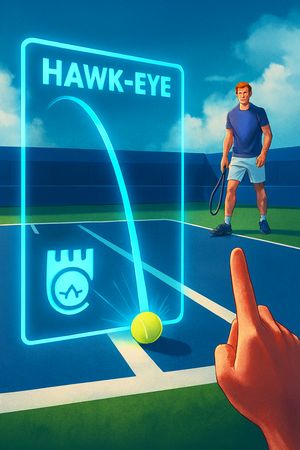 Hawk-Eye provides millimeter-perfect accuracy for line calls, bringing fairness and transparency to tennis.Image is for illustration purposes only
In cricket, the DRS, heavily reliant on Hawk-Eye, has fundamentally changed umpiring. While still generating debate around 'umpire's call' in LBW decisions, it has undeniably improved the accuracy of critical dismissals and appeals, adding another tactical dimension to the game for captains. The technology allows for unprecedented statistical analysis, showing exactly where pitches land, where balls make contact, and the precise angles involved, enriching commentary and fan understanding.
The success of Hawk-Eye stands as a testament to how technology, when applied judiciously and transparently, can elevate the fairness and enjoyment of sports without sacrificing its core appeal. It represents a gold standard for integrating high-tech solutions into fast-paced competition, demonstrating that human emotion and machine precision can coexist harmoniously.
Smart Wearables: The Quantified Athlete
Beyond the critical in-game decision-making tools, another profound technological shift has occurred away from the public gaze, within training facilities and during live play: the rise of smart wearables. These devices, ranging from GPS trackers and heart rate monitors to smart vests and sophisticated sensor-embedded equipment, have ushered in an era of the 'quantified athlete,' transforming how performance is measured, optimized, and understood.
The Technology Behind the Performance Edge
Smart wearables leverage a variety of sensors and communication technologies:
- GPS and Accelerometers: Track player movement, distance covered, speed, acceleration, deceleration, and changes in direction. This data is crucial for understanding work rate and tactical positioning in team sports.
- Heart Rate Monitors (HRM): Often integrated into chest straps or optical sensors, HRMs provide real-time physiological data, indicating exertion levels, cardiovascular load, and recovery status.
- Gyroscopes and Magnetometers: Measure orientation and angular velocity, providing insights into limb movement, biomechanics, and technique.
- Biometric Sensors: Advanced wearables can measure skin temperature, sweat rate, sleep patterns, and even biomarkers through non-invasive means, offering a holistic view of an athlete's health and readiness.
- Smart Clothing and Equipment: Jerseys with integrated sensors, smart insoles that analyze foot strike and pressure, and even intelligent balls that track spin and speed are becoming more common.
The data collected from these devices is aggregated, processed through sophisticated analytics platforms, and presented to coaches, sports scientists, and medical staff. This data-driven approach moves beyond subjective observation, providing objective, quantifiable metrics for every aspect of an athlete's physical output and recovery.
Transforming Training, Performance, and Injury Prevention
The impact of smart wearables is multifaceted, revolutionizing several key areas:
1. Optimized Training Regimens
Coaches can now tailor training loads with unprecedented precision. By monitoring heart rate zones, sprint distances, and explosive movements, they can ensure athletes are training at optimal intensities, preventing under-training or over-training. For example, a football coach can compare a player's high-intensity running meters in training to their game-day output, adjusting drills to match competitive demands. "We don't guess anymore; we know," a strength and conditioning coach highlighted, emphasizing the shift from intuition to evidence-based practice.
2. Enhanced Game Day Performance
During matches, real-time data from wearables can inform tactical decisions. Coaches might see a player's fatigue levels rise significantly (e.g., heart rate persistently high, drop in sprint capacity), prompting a substitution or a change in role. Post-match analysis provides invaluable insights into individual and team performance, identifying areas for improvement and confirming effective strategies. The ability to quantify the physical contribution of each player has changed how performance is evaluated and rewarded.
3. Proactive Injury Prevention and Recovery
Perhaps one of the most significant benefits is in injury mitigation. By tracking chronic load, sudden spikes in intensity, and biomechanical deviations, sports scientists can identify early warning signs of potential injuries. A sudden drop in power output or an asymmetry in movement patterns, revealed by sensor data, can trigger intervention before a full-blown injury occurs. Furthermore, wearables assist in monitoring recovery by tracking sleep quality, heart rate variability (HRV), and other biometric markers, ensuring athletes are adequately rested and rehabilitated before returning to play. This proactive approach not only extends careers but also protects athletes' long-term health.
4. Personalized Athlete Development
The granular data allows for highly personalized development plans. Young athletes can track their progress against benchmarks, identify weaknesses, and work on specific areas of their game, whether it's improving agility, endurance, or shot power. For example, a basketball player using smart insoles can analyze their jump height, landing mechanics, and court coverage to refine their movement patterns.
Ethical Considerations and the Future
While the benefits are clear, the proliferation of smart wearables also raises ethical questions. Data privacy is paramount; who owns the athlete's biometric data, and how is it secured? There's also the potential for an 'over-quantification' of athletes, where reliance on data might overshadow intuitive coaching or the athlete's own bodily feedback. The balance between maximizing performance and preserving the human element, including the mental and emotional aspects of sport, remains a critical discussion point.
Looking ahead, smart wearables will become even more integrated and predictive. AI will play a larger role in analyzing vast datasets to predict injury risks with greater accuracy, recommend optimal training and nutrition, and even suggest in-game tactical adjustments. The future of sports will undoubtedly feature athletes who are not just highly trained, but also hyper-monitored and digitally optimized.
The Broader Implications for Modern Sports
The individual impacts of VAR, Hawk-Eye, and smart wearables coalesce to create a broader transformation across the entire sporting ecosystem. These technologies aren't isolated tools; they represent a fundamental shift in philosophy, governance, and experience.
Elevating Fairness and Integrity
At the core of this technological revolution is the pursuit of fairness. By minimizing human error in critical decisions (VAR, Hawk-Eye) and providing objective performance metrics (wearables), the integrity of competition is significantly bolstered. No longer can a major championship be definitively said to have been decided by a 'bad call.' This increased impartiality is crucial for maintaining public trust in sports, particularly as betting markets and global viewership amplify the stakes.
However, fairness is a nuanced concept. While technology ensures 'objective' correctness, it also forces a re-evaluation of the 'spirit of the game.' For instance, should offside calls be measured by millimeters, even if the player gains no tangible advantage? This tension between absolute accuracy and common-sense interpretation will continue to shape discussions around technological integration.
Enhanced Fan Engagement and Broadcast Experience
Technology has profoundly enriched the fan experience, both for those in the stadium and watching at home. Instant replays, augmented reality graphics showcasing Hawk-Eye trajectories, real-time player stats from wearables, and even VAR explanations on broadcast are now standard. This data-rich environment offers a deeper understanding of the game, empowering fans with information previously only available to coaches. "It's like having a sports scientist and an analyst sitting next to you," remarked a delighted viewer, highlighting the enhanced analytical depth. Broadcasters leverage these tools to create more compelling narratives, translating complex data into engaging visual stories.
The Evolution of Coaching and Strategy
Coaching has evolved from an art form based on intuition and experience to a science heavily influenced by data analytics. Smart wearables provide coaches with an unprecedented amount of information about their players' physical condition, allowing for highly individualized training plans and load management. Game analysis is no longer limited to video; it's complemented by spatial tracking, physiological data, and predictive models. This allows for more granular tactical adjustments, better opponent analysis, and a more scientific approach to player development across all levels of sport.
Commercial Opportunities and Challenges
The integration of technology also opens up significant commercial avenues. Data collected from wearables can be anonymized and aggregated for market research, equipment development, and even personalized fan experiences. Sponsorship opportunities for technology providers are abundant, and the enhanced broadcast product attracts larger advertising revenues. However, the cost of implementing and maintaining these sophisticated systems is substantial, posing a challenge for smaller leagues and sports organizations. This creates a potential 'technology gap' between resource-rich and less affluent entities.
Challenges and Future Outlook: The Ever-Evolving Game
Despite the immense benefits, the journey of sports technology is not without its hurdles. The debates surrounding VAR highlight the difficulty in balancing precision with the emotional flow of the game. The cost of advanced systems like Hawk-Eye can be prohibitive, limiting their widespread adoption in amateur and lower-tier professional sports. Furthermore, issues of data security, privacy, and the potential for over-reliance on technology by athletes and coaches remain ongoing concerns.
Looking ahead, the integration of technology into sports will only deepen. We can anticipate:
- Artificial Intelligence (AI) and Machine Learning: AI will move beyond data aggregation to predictive analytics, forecasting injury risks, optimizing individual performance curves, and even suggesting real-time tactical adjustments during games.
- Virtual Reality (VR) and Augmented Reality (AR): VR training environments will allow athletes to practice scenarios in highly realistic simulations, while AR will further enhance the live and broadcast fan experience, overlaying complex data seamlessly onto the action.
- Integrated Sensor Networks: Pitches and courts themselves may become 'smart,' embedded with sensors to track ball and player movement more comprehensively, eliminating the need for external camera arrays in some instances.
- Personalized Health and Wellness: Wearables will become even more sophisticated, offering real-time biometric feedback and personalized recommendations for nutrition, sleep, and mental well-being, pushing the boundaries of human performance beyond current understanding.
The central challenge will always be to harness the power of technology to improve the game without dehumanizing it. Sport's enduring appeal lies in its unpredictability, its raw emotion, and the narrative of human striving. The ultimate goal of VAR, Hawk-Eye, and smart wearables isn't to replace the human element but to augment it, ensuring fairness, unlocking potential, and making the 'game' itself more compelling and transparent for everyone involved.
Conclusion: A New Era of Athleticism and Integrity
The transformative impact of VAR, Hawk-Eye, and smart wearables on modern sports is undeniable. These technologies have moved beyond novelty to become indispensable tools that dictate fairness, optimize performance, and redefine how fans engage with their favorite games. From the contentious decisions rectified by VAR in the high-stakes world of football to the millimeter-perfect precision of Hawk-Eye settling disputes in tennis, and the relentless data stream from smart wearables empowering athletes to push the boundaries of human capability – technology is fundamentally rewriting the rules of engagement.
We are living through a new era of athleticism, one where raw talent and rigorous training are complemented, and often elevated, by sophisticated data and objective analysis. While debates about the 'spirit of the game' and the balance between human judgment and algorithmic truth will continue, the trajectory is clear: the future of sports is inextricably linked with technological innovation. As these tools become more refined, more integrated, and more intelligent, they promise a future where sport is not only fairer and more efficient but also more spectacular and deeply understood than ever before. The game, truly, has changed – for the better.
Disclaimer: This article covers sports-related topics for informational purposes only. Statistics, commentary, and opinions may not be independently verified and should not be considered professional coaching or training advice. See our full disclaimer for details.