
5G vs. Satellite Internet: Benchmarking Performance and Adoption in the $1.1 Trillion Connectivity Race
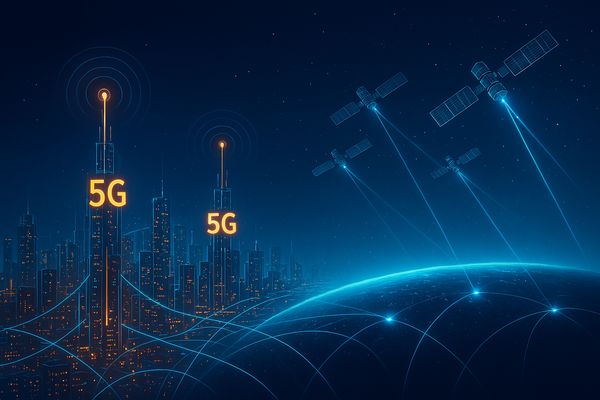 Bridging the gap: 5G and Satellite Internet sculpt the future of global connectivity.This image is a conceptual illustration and may not represent actual network infrastructure or coverage.
The landscape of global connectivity is undergoing a profound transformation, spearheaded by two parallel, yet distinct, technological revolutions: the terrestrial expansion of Fifth Generation (5G) cellular networks and the ambitious deployment of Low-Earth Orbit (LEO) satellite mega-constellations [1]. These formidable infrastructure programs represent the dual pillars of modern telecommunications, each demanding colossal capital investment and leveraging fundamentally different physics to achieve their global reach. The competition between them is not necessarily a zero-sum game; rather, it’s a strategic partitioning of the market, driven by the contrasting demands of density versus distance [3].
Global telecom operators are channeling staggering financial commitments into 5G, with projections indicating a total global spend exceeding $1.1 trillion by the end of 2025 [1]. This investment aims to deliver ultra-fast speeds and ultra-low latency, primarily to densely populated urban areas [1]. Simultaneously, LEO constellation operators such as SpaceX’s Starlink, OneWeb, and Amazon’s Project Kuiper are revolutionizing space-based communications. They are fundamentally altering performance benchmarks for service in remote and underserved territories [2]. The core analytical challenge lies in discerning how carriers, enterprises, and end-users will optimize their connectivity choices, weighing the high-capacity needs of urban centers against the pervasive, wide-area coverage mandates of global commerce and rural access [5].
This expert-level report provides a rigorous technical and economic benchmarking analysis of 5G terrestrial networks and LEO satellite internet systems, focusing on deployment status through the first three quarters of 2025. It synthesizes performance data, including metrics from industry leaders like Ookla and Opensignal [6], alongside market forecasts from entities such as Ericsson and GSA [8]. A particular emphasis is placed on defining the architectural differences, contrasting the shift from 5G Non-Standalone (NSA) to Standalone (SA) architecture with the physical constraints and advantages conferred by orbital mechanics in LEO and Medium Earth Orbit (MEO) systems [10]. This structured approach ensures a comprehensive comparison of how each technology addresses the distinct connectivity challenges of the contemporary digital ecosystem.
Technological Deep Dive: Architectural Frameworks and the Physics of Latency
Understanding the fundamental architectural differences between 5G and satellite internet is crucial to appreciating their respective performance capabilities and strategic market positions. Their core designs are dictated by distinct physics and deployment philosophies.
The 5G Imperative: From Non-Standalone (NSA) to Core-Native SA
The evolution of 5G has been characterized by a strategic, measured architectural migration, transitioning from initial integration with legacy networks to a fully native network core [10].
The NSA/EPC Compromise
Initial 5G deployments often adopted Non-Standalone (NSA) architectures, such as Option 3. This allowed service providers a cost-effective and expeditious path to launch basic 5G services [10]. These deployments utilized the existing 4G Evolved Packet Core (EPC) network for control plane functions while introducing New Radio (NR) access technology [12]. This architecture facilitated Enhanced Mobile Broadband (eMBB) features and higher throughput through Multi-RAT Dual Connectivity (MR-DC), effectively leveraging the existing 4G infrastructure [12]. However, the continued reliance on the legacy EPC inherently limited the potential for advanced 5G services, particularly those requiring precise Quality-of-Service (QoS) management.
The Foundational Shift to SA
The industry is now strategically transitioning toward the Standalone (SA) architecture, specifically Option 2, which integrates the native 5G Core (5GC) [10]. While requiring a longer deployment time and potentially a major upgrade to the LTE base stations (ng-eNBs) [10], SA is essential for unlocking the full potential of 5G [13]. The 5GC is the platform that enables the three core pillars of the 5G standard, as defined by the International Telecommunication Union (ITU): eMBB, Massive Machine-Type Communications (mMTC), and Ultra-Reliable Low Latency Communications (URLLC) [14]. URLLC, in particular, is critical for mission-critical use cases in Industrial IoT (IIoT) that demand extreme reliability and responsiveness [14].
The adoption of SA architecture is recognized as the single most critical technical factor driving 5G’s strategic value beyond simple speed enhancement [13]. Opensignal’s real-world measurements demonstrate that markets with active 5G SA deployments yield 20–30% lower latency and "far tighter jitter ranges" compared to NSA networks [13]. This profound improvement in responsiveness is not merely a quantitative increase in speed, but a qualitative change in network capability, transforming 5G into a platform capable of supporting the next wave of interactive, real-time consumer and industrial services, such as enhanced Extended Reality (XR) and multi-player cloud gaming [13]. Without the 5GC, crucial features like network slicing and true URLLC remain confined to theoretical models.
The Spectrum Split
5G network performance relies heavily on spectrum utilization. The sub-6GHz region (450MHz to 6GHz) is widely used due to its ease of deployment, long transmission distance, and wide coverage area [12]. Conversely, the millimeter Wave (mmWave) spectrum offers much greater bandwidth and substantially lower latency but necessitates significantly greater network densification due to its shorter wavelength and limited penetration [12].
Satellite Connectivity: The Orbital Hierarchy and LEO’s Design Advantage
Satellite connectivity is fundamentally constrained by the physics of orbital altitude and the speed of light. However, the LEO revolution has systematically dismantled historical performance barriers.
The Latency Constraint of GEO and MEO
Traditional communication systems employing Geostationary Orbit (GEO) satellites, situated approximately 35,786 km above the Earth's equator [16], introduce an inherent, unavoidable time delay. A single-hop communication path in a GEO system, covering nearly 84,000 km for a round trip between two terrestrial endpoints, results in an end-to-end delay approaching 280 milliseconds (ms) [11]. This significant delay has historically rendered GEO systems unsuitable for latency-sensitive applications like real-time communications or interactive gaming [17].
Medium Earth Orbit (MEO) constellations, such as SES’s O3b mPOWER, operate at lower altitudes, exemplified by O3b’s 8,062 km orbit [11]. This lower altitude results in substantially reduced latency, with claims of better than 150 ms round trip delay [11]. MEO satellites are still subject to atmospheric drag, necessitating onboard propulsion for orbital adjustments, though less frequently than LEO systems [19].
LEO Mitigation and the Constellation Challenge
The LEO revolution, epitomized by Starlink and Kuiper, positions satellites between approximately 500 and 1,200 km in altitude [2]. This dramatic reduction in distance successfully lowers latency into the "tens of milliseconds" range [2]. By achieving this level of responsiveness, LEO technology transitions from being a last-resort service to a viable, low-latency broadband alternative for global and remote coverage [2]. This performance shift allows LEO systems to support real-time applications such as video conferencing and, to some extent, online gaming [2].
To maintain continuous global coverage at low altitudes, LEO operations require massive constellations, demanding precision orbital management [19]. The sheer volume of satellites allows for continuous signal handoff and the efficient use of inter-satellite links (ISLs) to route traffic across the constellation before descending to a ground station, potentially offering a faster path than terrestrial fiber in certain cross-continental scenarios [11]. The need to counteract atmospheric drag and potential orbital decay necessitates the use of propulsion systems for occasional adjustments to maintain correct orbital positions [19]. LEO’s successful achievement of latency in the tens of milliseconds fundamentally transforms the technology's market strategy, allowing operators to focus on providing high-quality service, including robust Service Level Agreements (SLAs) for enterprise customers, approaching the reliability and performance guarantees expected of many terrestrial networks [20].
 The strategic partitioning of global connectivity: 5G optimizes for urban density, while LEO satellites conquer vast distances.This image is a conceptual illustration and may not represent actual network infrastructure or coverage.
Benchmarking Performance: Speed, Latency, and the Consistency Metric
A direct comparison between 5G and LEO satellite performance reveals that while 5G dominates on peak theoretical throughput and latency in dense coverage areas, LEO establishes a robust, globally pervasive level of performance.
Raw Throughput: Capacity versus Coverage
5G Peak and Median Performance
5G’s capacity advantage is undeniable where coverage exists. Under optimal conditions, typically involving mmWave spectrum deployment in dense urban cells, 5G can achieve peak speeds of up to 20 Gbps [21]. This capacity often surpasses that of many existing fiber-optic connections [21].
However, the real-world user experience is best captured by median speeds. Data from the first half of 2025 (H1 2025) in the United States shows leading mobile providers achieving substantial 5G median download speeds. T-Mobile, the fastest provider in H1 2025, recorded a 5G median download speed of 299.36 Mbps. The second and third fastest providers, Verizon and AT&T, recorded median 5G download speeds of 214.58 Mbps and 158.56 Mbps, respectively [6].
LEO Satellite Performance Trend
LEO satellite networks, exemplified by Starlink, generally deliver download speeds in the range of 50 to 250 Mbps, sometimes exceeding this range with newer technology [5]. While speeds vary significantly based on user density and constellation size, performance has shown a marked upward trend. Ookla data reflects network optimization, reporting that median Starlink speeds increased from 53.95 Mbps in Q3 2022 to 104.71 Mbps in Q1 2025 in sampled markets [22]. This increase suggests that the aggressive deployment of new satellites, including the Gen 2 constellation, is successfully mitigating early congestion issues and enhancing overall capacity [23].
The comparative performance is best summarized in the context of latency and median throughput differences:
| Metric | 5G (Leading Mobile Provider Median, Urban/Suburban) | LEO Satellite (Starlink Median, Q3 2025) | Key Driver/Limitation |
|---|---|---|---|
| Peak Theoretical Download Speed | Up to 20 Gbps (mmWave, ideal conditions) [21] | Up to 500+ Mbps (Constellation Capacity) | 5G utilizes short-range, high-frequency spectrum; LEO limited by total satellite bandwidth and user density. |
| Median Download Speed (US/LATAM) | ~299.36 Mbps (T-Mobile 5G Median H1 2025) [6] | 55.01 – 106.38 Mbps (Ookla Q3 2025 range) [7] | Network densification and fiber backhaul (5G) vs. Satellite launch cadence and capacity optimization (LEO). |
| Median Latency | 10 – 20 ms (Overall) [21] | 20 – 40 ms (LEO) [21] | Distance to cell site (5G) vs. Orbital altitude (LEO ~1,200 km) [2]. |
| SA Latency Reduction | 20–30% lower latency (compared to NSA) [13] | N/A (Inherently LEO/MEO provides consistent path length) | Enabled by 5G Core Network (5GC) for responsiveness [13]. |
Latency Analysis: The True Test for Next-Gen Services
Latency remains the definitive separator for mission-critical and highly interactive services. 5G generally offers lower latency than LEO, typically falling between 10 and 20 milliseconds [21]. This responsiveness is significantly improved in Standalone deployments, where the 5GC enables a 20–30% reduction in latency and much tighter jitter ranges, crucial for delivering stronger gaming performance and fast response times, as demonstrated in deployments in Singapore and Japan [13].
LEO satellite latency, ranging from 20 to 40 ms, is a transformative improvement over GEO systems and is adequate for streaming, video calls, and general use [2]. However, current LEO performance generally struggles to consistently meet the sub-10ms target required for the most stringent URLLC applications, such as mission-critical Industrial IoT [15]. Therefore, for professional environments demanding stability and ultra-low responsiveness, 5G SA maintains a distinct technical superiority.
Performance and the Digital Divide: The Competitive Floor
The relative competitiveness of LEO satellite performance is entirely context-dependent, directly reflecting the maturity of existing terrestrial infrastructure [7]. This disparity highlights LEO’s strategic role in establishing a baseline competitive floor for connectivity globally.
For example, Ookla data from Q3 2025 in Latin America illustrates this dynamic: in Chile, a market where 5G and fiber deployments are robust and 50 Gbps service plans are emerging, Starlink’s median download speed (106.38 Mbps) trailed the country’s fixed internet median (354.53 Mbps) significantly [7]. Conversely, in the Dominican Republic, where fixed internet median speeds were 53.71 Mbps, Starlink’s median download speed (55.01 Mbps) was instantly competitive, offering a comparable or superior experience [7].
This performance context confirms that LEO’s core strategic function is not to surpass peak 5G speeds in dense urban markets, but to establish a globally competitive minimum standard for broadband access [17]. LEO systems directly address the digital divide by delivering speeds that meet or exceed the Federal Communications Commission (FCC) definition of broadband (100 Mbps download and 20 Mbps upload) in remote and rural areas that are deemed uneconomical for the $1.1 trillion 5G terrestrial investment [1].
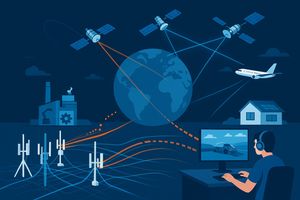 Analyzing the data flow: 5G's speed and low latency for critical applications versus LEO satellite's ubiquitous, transformative access.This image is a conceptual illustration and may not represent actual network performance metrics or infrastructure.
The Economics of Connectivity: CapEx, Subscriptions, and Business Models
The financial models underlying 5G and LEO networks differ dramatically, reflecting their core missions: 5G aims for density and high average revenue per user (ARPU) through volume, while LEO targets ubiquity through high capital investment in space assets.
The $1.1 Trillion Investment: Financing 5G Densification
The scale of the global commitment to 5G is staggering. Total global spending on 5G rollout is projected to exceed $1.1 trillion by the end of 2025 [1]. This enormous Capital Expenditure (CapEx) encompasses spectrum license acquisition, network hardware, software upgrades, and the essential deployment of fiber-optic backhaul necessary for network densification [1].
The deployment strategy is inherently pragmatic and financially driven. Telecom companies must prioritize locations with high data demand, focusing initially on urban and densely populated areas where the massive CapEx can be quickly offset by subscriber volume and high ARPU [1]. This focused investment explains the high projected 5G subscription penetration rates observed in leading markets: North America is anticipated to reach 79 percent 5G subscription penetration by the end of 2025, followed closely by North East Asia at 61 percent [8].
The economic trade-off inherent in this model is crucial: 5G CapEx is largely a recurring, operational investment dedicated to continuous densification and capacity maintenance. While highly effective in cities, this model naturally disfavors investment in sparsely populated, rural areas, creating the gap that LEO systems are designed to fill.
LEO Satellite Investment and Subscriber Scaling
LEO constellation economics are front-loaded, dominated by the cost of manufacturing and launching space assets. Satellite and launch costs constitute a sizeable part of the total CapEx, potentially amounting to over 50% across the constellation's operational lifetime [24]. Constellations require thousands of satellites, necessitating high-volume, streamlined production processes to bring the cost per satellite below $1 million [24]. Given that satellite lifecycles typically run 5-7 years, the total number of manufactured satellites over the 20+ year business lifecycle of the constellation is three to four times the size of the active constellation, underscoring the critical importance of achieving economies of scale in manufacturing [24].
Despite the high initial CapEx, LEO systems have demonstrated rapid subscriber growth. Starlink, pursuing aggressive consumer adoption since its commercial launch, currently serves over 2.7 million subscribers globally, primarily residential customers in remote areas [20]. Based on a weighted average of fees across various markets, the average retail subscriber fee is estimated at approximately $104.29 per month [25].
| Metric | 5G Terrestrial Network | LEO Satellite Constellations (Starlink) | Strategic Implication |
|---|---|---|---|
| Global Subscriber Base (EOP 2025) | ~2.9 Billion Subscriptions (33% of all mobile subs) [8] | >2.7 Million Subscribers (Residential and Enterprise) [20] | 5G is a mass-market utility defined by volume; LEO is a high-value niche defined by global access. |
| Projected Global CapEx (Through 2025) | >$1.1 Trillion [1] | Tens of Billions (Initial constellation launch and replacement) [24] | Highlights 5G’s dependence on continuous ground infrastructure vs. LEO’s orbital manufacturing scale. |
| Highest Penetration Region (EOP 2025) | North America (79% mobile penetration) [9] | Concentrated in rural areas lacking high-speed terrestrial alternatives [3] | 5G success defined by population density; LEO success defined by addressing remoteness. |
| Market Focus | eMBB, URLLC, mMTC (Mass Mobile, IIoT, Fixed Wireless Access) [9] | Fixed Residential (Rural), Global Mobility (Maritime, Aviation), Enterprise SLA [4] | Clear differentiation in core business objectives and target vertical markets. |
Market Segmentation and Pricing Evolution
LEO providers are increasingly pivoting to secure high-margin, enterprise-level vertical markets. OneWeb, for instance, focuses on clients requiring guaranteed service commitments. Their enterprise contracts include robust Service Level Agreements (SLAs) defining minimum uptime and committed data rates, making the service suitable for mission-critical operations such as offshore energy platforms and regulated government communications [20]. This approach contrasts with the mass-market, "best-effort" service often offered to residential users.
In the consumer and mobile segment, Starlink has adjusted its pricing strategy to manage network resources and prioritize commercial traffic. As of April 2025, mobile priority internet services transitioned to a consumption-based model, charging approximately $2 per GB, alongside a new $150 monthly terminal access fee for global priority use [4]. This dynamic pricing model is crucial for managing network congestion and ensuring performance for high-paying users, particularly in areas where capacity is constrained or "sold out" [7]. This financial strategy, focusing on consumption-based pricing and enterprise SLAs, indicates a maturation of the LEO industry aimed at maximizing revenue from high-value segments, contrasting sharply with the volume-driven mass-market model of 5G.
Strategic Positioning: Coverage, Regulation, and Use Cases
The future of connectivity is not merely a contest of speed, but a matter of strategic positioning: 5G for dense, reliable, private networks, and LEO for expansive, ubiquitous coverage and global mobility.
The Critical Role in Closing the Digital Divide
A primary driver for LEO satellite adoption is its capability to rapidly and economically solve the global digital divide. The FCC’s standard for broadband service is defined as 100 Mbps download and 20 Mbps upload [17]. Terrestrial technologies, such as fiber or cable, struggle to meet this requirement economically in rural and remote areas due to insurmountable build-out challenges relating to terrain and high cost [17].
LEO satellite internet offers a uniquely promising solution to this structural gap [17]. By providing robust speeds and low-latency connectivity globally, LEO systems bypass the physical limitations of terrestrial infrastructure deployment [5]. The ability of LEO to deliver, for example, 106 Mbps in a remote market demonstrates its capacity to instantaneously establish the FCC-defined broadband speeds in vast geographies that would otherwise wait years for subsidized fiber deployment [7]. This reality positions LEO constellations as essential technological partners in achieving universal service obligations worldwide.
Specialized Vertical Integration and Mobility
Both 5G and satellite internet excel in distinct vertical markets that capitalize on their core strengths.
5G IIoT and Private Networks
5G excels in the deployment of secure, localized private networks (P5G), which are critical for Industrial IoT (IIoT) and enterprise applications. In aviation, for example, private 5G networks provide reliable, secure, and scalable connectivity for complex environments like airports [26]. These networks support camera surveillance and security systems, allowing for the flexible deployment and relocation of cameras and bodycams that are not constrained by fixed fiber cables [26]. Furthermore, 5G supports high-volume transaction points like retail Point-of-Sale (POS) tools, enabling new revenue streams through enhanced customer experiences such as cashier-less stores and AR/VR applications [26].
In the maritime sector, multi-hop 5G network extensions implemented using vessel-to-vessel relaying and strategic floating base stations are demonstrating significant cost reductions. Studies suggest that such implementations can achieve 80–90% coverage in major corridors like the Baltic Sea and Mediterranean, potentially reducing connectivity costs by up to 40% compared to reliance on traditional satellite solutions [27].
Satellite Global Mobility
Conversely, satellite connectivity is essential for true global mobility and continuity of service outside 5G footprints. Services tailored for sectors like RV, marine, and aviation ensure users retain continuous high-speed service even when they move into areas where 5G cellular coverage is unavailable or unreliable [4]. For nomadic users, optimizing connectivity often involves combining 5G as the primary connection in urban/suburban settings (where speeds can reach up to 3.3 Gbps with low latency) and seamlessly switching to the satellite link when terrestrial coverage drops, managed by dual-WAN routers [4].
The Regulatory Landscape and Synchronization
The rapid deployment of LEO constellations operates under significant international regulatory oversight, primarily managed by the International Telecommunication Union (ITU). The ITU is responsible for standardizing Information and Communication Technology (ICT) and harmonizing the use of radio-frequency spectrum and satellite orbits [28].
Orbital Governance and Milestones
To prevent "radio-frequency spectrum warehousing" and encourage timely deployment, the ITU mandated a milestone-based process for non-Geostationary Orbit (non-GSO) satellite constellations at WRC-19 [29]. This framework requires operators to achieve 10% constellation deployment within two years, 50% within five years, and complete constellation deployment within seven years [29]. This stringent time constraint acts as a powerful acceleration factor, compelling LEO operators like Starlink and Kuiper to maintain aggressive launch and CapEx schedules to comply with international regulations and maintain spectrum rights [23].
Spectrum Sharing and WRC-23
Recent World Radiocommunication Conferences (WRC) have focused on developing regulatory frameworks to facilitate LEO operations while protecting existing services. WRC-23 agenda items included enabling the use of millimeter wave frequency bands (such as 47.2-50.2 GHz and 51.4-52.4 GHz) for NGSO Fixed-Satellite Service (FSS) Earth-to-space gateways [30]. Crucially, the United States, in its views presented at WRC-23, consistently supported studies to develop regulatory provisions that facilitate new allocations for satellite services while simultaneously ensuring the protection of existing primary services, including terrestrial mobile and fixed services [30]. The protection of spectrum and the integrity of the space environment is paramount, promoting a balanced approach to competition and resource management [32].
Conclusion: The Convergence and Future Roadmaps
Synthesis: A Hybrid Future of Optimal Selection
The exhaustive benchmarking analysis confirms that the future of connectivity will be defined by strategic complementarity, not outright competition. For latency-critical applications, high throughput, and robust consistency in dense environments, 5G—particularly the low-latency, 5GC-enabled Standalone architecture—is the unequivocally superior choice [13]. However, LEO satellite constellations provide the necessary technological answer for global mobility, establishing a high-quality broadband baseline, and overcoming the economic and topographical barriers that impede terrestrial expansion into remote regions [3].
The technological reality is that the end-user connectivity experience is increasingly managed by hybrid systems, utilizing automated routers that switch seamlessly between high-capacity 5G and ubiquitous LEO satellite links based on real-time performance and availability [4].
The Next Generation of Terrestrial: 5G Advanced and 6G
The terrestrial roadmap is focused on continuous evolution to enhance performance beyond current eMBB capabilities. 3GPP Release 18 (Rel-18), branded as 5G Advanced, aims to introduce significant enhancements in Artificial Intelligence (AI) integration and Extended Reality (XR) support, with specification freezes anticipated to extend through 2027 [33]. These upgrades necessitate the reliable, low-latency foundation established by 5G SA networks [13].
Looking ahead, research efforts for the Sixth Generation (6G) are rapidly accelerating globally, targeting commercial deployment around 2030 [15]. The 3GPP roadmap includes the 6G RAN Study (part I: ITU focused) being underway, with the Stage 3 freeze for 6G scheduled for March 2027 [34]. A critical element in the emerging 6G vision is the native integration of Non-Terrestrial Networks (NTN). The explicit design to support LEO/MEO satellite systems within the core mobile standard signifies the permanent and strategic role of satellite assets in the global connectivity infrastructure [2].
The Next Generation of Satellite: Direct-to-Cell and Massive Scaling
The LEO segment is simultaneously advancing, with operators aggressively scaling their second-generation capabilities. Amazon’s Project Kuiper is actively deploying platforms throughout 2025 [23]. Starlink has secured partial regulatory permissions from the FCC for its Gen 2 network, which is designed to enhance capacity and features [32].
The most significant development signaling the convergence of these two technologies is the push toward direct-to-cell services. Partnerships, such as the initiative between T-Mobile US and SpaceX, promise to integrate LEO satellite networks directly into the mobile consumer ecosystem, initially targeting universal text coverage across the United States [32].
This move toward direct-to-cell connectivity, coupled with 6G’s native support for NTN, confirms that the strategic evolution of global connectivity is centered on seamless technological integration. Connectivity will be intelligently routed between terrestrial and orbital assets based on immediate service requirements, guaranteeing optimal performance whether defined by 5G’s capacity in dense areas or LEO’s ubiquity across vast distances, ultimately maximizing both density and universal access.
Disclaimer: This article discusses technology-related subjects for general informational purposes only. Data, insights, or figures presented may be incomplete or subject to error. For further information, please consult our full disclaimer.