From AI-First to Truly AI-Native: Gartner's 2026 Vision for Next-Gen Development Platforms Unveiled
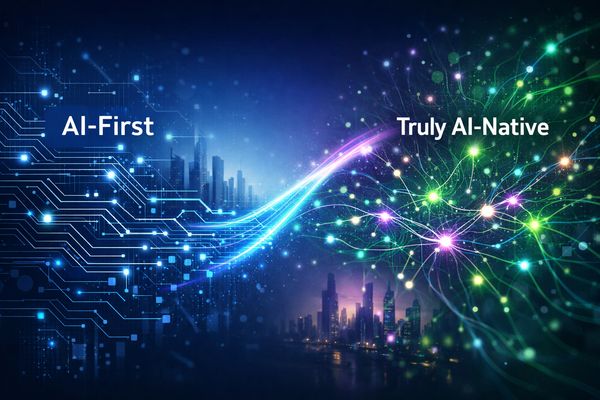 Gartner's 2026 Vision: The evolution from AI-First integration to a truly AI-Native architectural foundation.This image is a conceptual illustration of technological evolution and may not represent actual products or data.
The global technological infrastructure is currently traversing a critical inflection point, where the prioritization of artificial intelligence is transitioning from a modular enhancement strategy to a foundational architectural requirement. By 2026, the distinction between organizations that simply adopt AI and those that are architecturally AI-native will define the parameters of competitive viability [1]. Gartner’s 2026 vision identifies a significant move away from "AI-first"—a stage characterized by retrofitting intelligent tools into existing digital frameworks—toward a "truly AI-native" paradigm, where the development platform itself is built on a baseline of autonomous agency and context-aware intelligence [2].
This structural shift is underpinned by a massive expansion in capital allocation. Total AI-related expenditures are projected to reach $2.52 trillion by 2026 [4]. Within this substantial budget, AI application development platforms are expected to command $8.4 billion, representing a significant increase from $6.6 billion in 2025 [4]. This article delves into Gartner's comprehensive 2026 vision, dissecting the strategic transition, the thematic pillars driving innovation, the evolving workforce, and the inherent challenges and risks that enterprises must navigate to thrive in this AI-native future.
The Strategic Transition from AI-First to AI-Native Architectures
To appreciate the scale of the 2026 vision, one must analyze the technical and philosophical divergence between AI-first and AI-native organizations. AI-first describes a mindset where organizations prioritize embedding AI across existing processes to enhance operations, yet these enhancements often sit atop legacy infrastructures [3]. In stark contrast, AI-native refers to systems fundamentally built from the ground up with artificial intelligence woven into the core architectural fabric [3]. This transition is not merely a matter of upgrading software; it is a "radically different blueprint" for enterprise design that moves beyond the interfaces changed by digital-first strategies to change the actual "operating system" of the business [2].
The necessity of this shift is highlighted by the limitations inherent in the AI-first model. Traditional organizations often struggle with the "hidden costs" of retrofitting, where legacy systems fail to support continuous learning, contextual intelligence, or autonomous action [2]. These systems frequently suffer from latency, data silos, and a reliance on "GPT wrappers" that, according to Gartner, offer no real competitive advantage [2]. AI-native systems, conversely, are designed as "autonomous organisms" with machine learning models, data pipelines, and real-time decision-making loops integrated into their initial architecture [2].
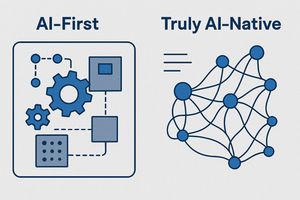 A visual dichotomy: AI-First systems as layered additions versus AI-Native systems as inherently intelligent frameworks.This image is a conceptual illustration and serves to visualize the architectural differences discussed in the text.
Gartner's analysis indicates that by 2026, the chasm between retrofitted companies and architected ones will become stark [1]. AI-native organizations demonstrate systems-level thinking in application design, orchestrating sequences of model interactions to optimize outputs rather than simply testing single models in isolation [1]. This architectural difference is what Gartner identifies as the primary driver for achieving business value at scale, moving from experimentation to enterprise-wide adoption with built-in agility and oversight [2].
Key Differences: AI-First vs. Truly AI-Native
| Architectural Attribute | AI-First (Traditional/Retrofit) | Truly AI-Native (Next-Gen Platform) |
|---|---|---|
| Philosophical Base | Prioritizes embedding AI into existing workflows. | Fundamental reimagining of business around AI. |
| Integration Method | Retrofits AI tools into legacy, static systems. | Architecture-first integration from day one. |
| Workflow Dynamic | Static, predictable, and manually optimized. | Dynamic, adaptive, and self-optimizing systems. |
| Decision Making | Intuition-driven or siloed data analysis. | Data-centric and AI-informed feedback loops. |
| Development Role | Human-led coding with AI as a secondary tool. | AI as a collaborative partner in the SDLC. |
| Competitive Edge | Efficiency through automation of manual tasks. | Future-ready architecture and maximum leverage. |
| Risk Profile | Integration complexity and technical debt. | Higher initial complexity and specialized talent. |
The Architect Theme: Building the Next-Gen Foundation
Gartner’s 2026 strategic technology trends are organized into three thematic pillars: The Architect, The Synthesist, and The Sentinel [6]. The Architect theme focuses on the foundational technologies essential for creating secure, scalable, and adaptive digital value [5]. Central to this pillar are AI-native development platforms, AI supercomputing platforms, and confidential computing [5].
AI-Native Development Platforms and the Democratization of Code
AI-native development platforms utilize generative AI to radically accelerate and simplify software creation [7]. Unlike traditional coding, where teams of programmers fix bugs and write thousands of lines of code manually, these platforms allow for deep collaboration between humans and AI [8]. A key prediction for this trend is that by 2030, 80% of organizations will have evolved their large software engineering teams into smaller, AI-augmented groups [6].
This shift is not merely about developer speed; it is about the accessibility of innovation. Organizations are increasingly establishing "tiny platform teams" that equip non-technical domain experts to build applications themselves within secure and governed environments [9]. By embedding AI directly into the development process, engineers can collaborate with intelligent agents to write, test, and optimize code in real-time, effectively moving from "delivering code" to "delivering capability" [7].
AI Supercomputing Platforms: The Engines of Innovation
The complexity of next-generation AI models necessitates a departure from traditional data center architectures. AI supercomputing platforms represent the integration of CPUs, GPUs, AI-specific ASICs, and neuromorphic computing paradigms [9]. These systems combine powerful processors, massive memory, and specialized hardware with intelligent orchestration software to tackle data-intensive workloads in areas such as machine learning, biotech simulation, and financial market analytics [9].
Gartner predicts that by 2028, over 40% of leading enterprises will have integrated hybrid computing architectures into their critical workflows, a massive jump from the 8% reported in late 2025 [9]. The real-world impact of these platforms is already visible in healthcare, where biotech firms are modeling new drugs in weeks rather than years, and in utilities, where extreme weather simulations are used to optimize grid performance [9].
Confidential Computing: Protecting Data in Use
As organizations scale AI across hybrid and multicloud environments, protecting sensitive data becomes a primary hurdle. Confidential computing provides a solution by isolating workloads within hardware-based Trusted Execution Environments (TEEs) [7]. This ensures that sensitive data and processes remain private even from the infrastructure owners or cloud providers [9]. This approach is particularly critical for regulated industries like financial services and healthcare [9]. Gartner projects that by 2029, over 75% of operations processed on untrusted infrastructure will be secured in-use by confidential computing [9].
The Synthesist Theme: Orchestrating Intelligent Systems
The Synthesist pillar focuses on combining AI models, agents, and real-world intelligence to drive operational delivery [7]. This theme encompasses multiagent systems (MAS), domain-specific language models (DSLMs), and physical AI [6].
Multiagent Systems: Moving Toward Autonomous Workflows
Multiagent systems (MAS) are collections of specialized AI agents that interact to achieve complex goals [9]. Unlike simple chatbots, MAS handle complex, long-running operations like supply chain optimization, which requires simultaneous coordination across logistics, demand forecasting, and inventory management [10]. By 2026, 40% of enterprise applications are expected to feature task-specific agents [10].
Gartner identifies a four-stage evolution for agentic AI [15]:
- Stage 1 (2025): AI Assistants that simplify tasks but still require human input.
- Stage 2 (2026): Task-Specific Agents capable of performing end-to-end tasks independently.
- Stage 3 (2027): Collaborative Agents that manage complex tasks by interacting with other agents.
- Stage 4 (2028): AI Agent Ecosystems where specialized agents collaborate dynamically across multiple applications and business functions.
By 2028, a third of user experiences are expected to shift from native applications to agentic front ends, fundamentally changing how humans interact with technology [15].
Domain-Specific Language Models (DSLMs)
While generic large language models (LLMs) have demonstrated significant power, they often fall short in specialized enterprise tasks due to a lack of industry-specific accuracy and compliance [9]. DSLMs are models fine-tuned on specialized data for a particular industry or process, offering higher reliability and lower costs [6]. Gartner predicts that by 2028, more than half of the generative AI models used by enterprises will be domain-specific [12]. These models are essential for high-stakes environments like fraud detection, clinical documentation, and regulatory compliance, where accuracy and explainability are non-negotiable [2].
Physical AI: Intelligence in the Material World
Physical AI brings intelligence into machines that sense, decide, and act in the physical world [6]. This trend integrates AI into robots, drones, and smart manufacturing equipment to enhance safety and productivity [6]. As adoption grows, organizations will require new cross-disciplinary skills bridging IT, operations, and engineering [7]. By 2026, physical AI will be a top strategic priority for industries where automation and adaptability are essential for maintaining a competitive edge [10].
The Sentinel Theme: Safeguarding Reputation and Trust
The Sentinel pillar focuses on protecting enterprise value through preemptive cybersecurity, digital provenance, and unified AI security platforms [5].
Preemptive Cybersecurity and AI Security Platforms
Preemptive cybersecurity leverages AI-powered analytics and deception technologies to neutralize threats before they impact operations [6]. This represents a move toward a world where "prediction equals protection" [7]. Parallel to this, AI security platforms provide centralized visibility and control over both in-house and third-party AI applications [7]. These platforms protect against unique AI risks such as prompt injection, data leakage, and rogue agent behavior [7]. Gartner predicts that by 2028, over 50% of enterprises will use these security platforms to safeguard their AI investments [7].
Digital Provenance: Authenticating in an Era of Deepfakes
As AI-generated content becomes ubiquitous, trust is becoming the primary currency of digital interactions. Digital provenance tools verify the origin and integrity of software, data, and content [7]. This is essential for maintaining compliance and protecting against impersonation and intellectual property theft [6]. Gartner warns that by 2029, organizations that fail to invest in digital provenance face significant reputational and financial risks [7].
The Workforce Evolution: From Coders to Orchestrators
The shift toward AI-native platforms is fundamentally altering the role of the software engineer. By 2026, the demand for traditional manual coding skills will evolve into a requirement for "vibe engineering" and systemic thinking [16].
Forward-Deployed Engineers and the Multi-Agent Workforce
A prominent emerging model is the Forward-Deployed Engineer (FDE), a role that combines engineering expertise with business strategy [11]. FDEs embed themselves directly within customer environments to deliver outcomes measured by business KPIs rather than simple code delivery [17]. This model is seeing explosive growth, with an 800% surge in job postings for these roles [19].
Furthermore, the concept of a "Multi-Agent Workforce" is emerging, where teams of humans and AI agents work in parallel inside client operations [18]. This model addresses the common failure points of AI initiatives—process fragmentation and lack of accountability—by redesigning how work gets done rather than just the code that enables it [18]. The "magentIQ Method" is one such approach, utilizing a "Living Lab" to prototype agentic future-states before assembling and optimizing a hybrid workforce [18].
The Skill Gap and Education Shift
The impact on talent is dual-sided. While AI handles routine tasks, the time to fill senior developer positions is expected to double as organizations seek talent with deep system architecture skills [16]. Conversely, traditional computer science enrollment is predicted to drop by 20% as students are dissuaded by the automation of junior-level coding roles [16]. For 2026, organizations must prioritize upskilling internal talent to handle AI orchestration and prompt engineering, which are becoming as fundamental as spreadsheet proficiency was for previous generations [14].
Challenges and Risks in the AI-Native Era
Despite the operational gains, the transition to AI-native platforms is fraught with technical and financial risks that require careful management.
The Software Quality and Reliability Crisis
Gartner warns of a "hidden crisis" in software engineering. By 2028, the use of "prompt-to-app" approaches by non-technical creators is predicted to increase software defects by 2500% [22]. These defects are often "context-deficient"—meaning the code is syntactically correct but lacks an understanding of broader system architecture or nuanced business rules [22]. Such flaws are exponentially more expensive to fix than simple coding errors and could consume a significant portion of innovation budgets [22].
AI Agent Cost Overruns
IT executives are increasingly concerned about cost overruns associated with AI agents. These overruns are primarily attributed to consumption-based pricing models where increased autonomous activity leads to unpredictable billing [22]. Consequently, 25% of planned AI spend in 2026 is expected to be deferred to 2027 as CEOs and CFOs demand more rigorous proof of ROI before proceeding with large-scale deployments [20].
The Environmental Balance Sheet
The sustainability of AI is a growing point of contention. Data center electricity consumption is projected to skyrocket, potentially equaling the entire power usage of Japan by 2030 [23]. This has given rise to Green Software Engineering, a discipline focused on minimizing the carbon footprint of digital systems [24]. Developers in 2026 will be tasked with optimizing "watts per token" and aligning workloads with cleaner power generation periods [23].
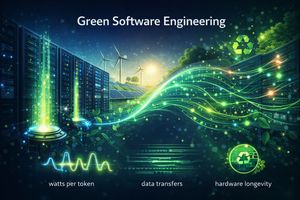 Optimizing AI's environmental footprint through Green Software Engineering practices and energy efficiency.This image is a conceptual illustration of green software engineering principles and does not represent specific energy consumption figures.
Green Engineering Metrics and Potential Reductions
| Green Engineering Metric | Target Action | Potential Reduction |
|---|---|---|
| CPU Utilization | Optimize algorithms per transaction. | 15% reduction in energy. |
| Data Transfers | Cut unnecessary reads/writes and polling. | 25% reduction in bandwidth usage. |
| Idle Server Time | Efficient workload orchestration. | 30% reduction in waste. |
| Hardware Longevity | Design software for older/existing stacks. | Significant reduction in e-waste. |
Regional and Industry Specifics: 2026 Market Dynamics
The adoption of these trends is not uniform across the globe. Gartner notes significant regional variations in technology priorities [5]. In the EMEA (Europe, Middle East, and Africa) region, the focus is heavily on digital sovereignty and geopatriation—moving workloads back to regional or sovereign clouds to mitigate geopolitical risks and comply with regulations like the EU AI Act [5]. In contrast, the APAC (Asia-Pacific) region is prioritizing citizen-centric innovation and scalable platforms [5].
Industries are also seeing varying impacts:
- Financial Services: Extensive use of AI-native platforms for real-time credit risk analysis and global market simulation [2].
- Healthcare/Biotech: Accelerated drug discovery leveraging supercomputing and DSLMs [2].
- Supply Chain: Massive efficiency gains through multiagent orchestration of logistics and demand forecasting [13].
- Manufacturing: Adoption of physical AI to reduce labor gaps and increase operational resilience [10].
Conclusion: Orchestrating a Resilient AI-Native Future
Gartner’s 2026 vision for AI-native development platforms represents a fundamental shift in how organizations create and protect digital value. As AI moves from an "add-on" to the bedrock of enterprise architecture, the successful organization will be defined by its ability to orchestrate complex intelligent systems while maintaining digital trust [7]. For CIOs, the mandate is clear: modernize with purpose, invest in AI-native skills, and adapt governance to keep pace with an accelerating rate of change [5].
Those who successfully navigate this transition will unlock measurable competitive advantages, including faster delivery cycles, improved operational efficiency, and the ability to turn disruption into a durable advantage [5]. However, the path forward requires rigorous attention to software quality, cost management, and environmental sustainability to ensure that the AI-native era remains both profitable and responsible [7]. The organizations that thrive in 2026 will be those that view AI not merely as a technology shift, but as a catalyst for continuous reinvention [21].
Disclaimer: This article discusses technology-related subjects for general informational purposes only. Data, insights, or figures presented may be incomplete or subject to error. For further information, please consult our full disclaimer.