
What is Context Engineering? Demystifying AI's New Core Literacy
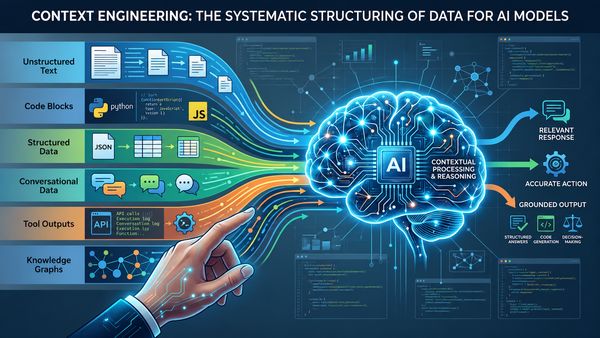 Context engineering: The art and science of preparing AI's informational environment for optimal performance.Image is a conceptual representation for illustrative purposes only.
In the rapidly evolving world of artificial intelligence, a new, critical skill is emerging: context engineering. It's not just about asking an AI a question; it's about systematically structuring the entire informational environment around that question so the AI can truly understand and respond effectively. Think of it as preparing a meticulously organized toolkit and instruction manual for an incredibly smart, but context-dependent, assistant.
This isn't just a technical tweak for programmers. It's a fundamental shift in how we interact with intelligent systems, redefining what it means to be 'AI literate' in the 21st century. As AI becomes more integrated into our daily lives, understanding how to engineer its context is becoming as crucial as understanding how to search the internet or use a spreadsheet.
The nuance here lies in recognizing that AI models, particularly Large Language Models (LLMs), don't inherently 'know' everything. They process information based on the tokens (words or sub-words) they receive. If that input stream is messy, incomplete, or contradictory, the output will likely be just as flawed. This is where context engineering steps in, transforming raw data into coherent, actionable intelligence.
What Is Context Engineering and How Does It Differ From Prompt Engineering?
Context engineering represents the systematic design, assembly, and continuous maintenance of the complete token payload supplied to a Large Language Model during inference [5]. It’s like setting the stage and providing the entire script for a play, not just giving the lead actor their lines. This discipline guides an AI's reasoning without altering its foundational parameters or weights, operating instead on everything surrounding the user's query [7].
Many people are familiar with prompt engineering, which primarily focuses on crafting clever natural language templates and instructions to elicit desired responses [5]. It's a bit like learning to phrase a perfect question to get a specific answer from a human. While powerful, prompt engineering is a static, one-off interaction.
Context engineering, however, operates as a broader system engineering discipline [2]. It encompasses a far wider array of elements: comprehensive system instructions, detailed user queries, results from Retrieval-Augmented Generation (RAG) processes, the entire conversation history, schemas for operational tools, and persistent memory states [7]. It’s a dynamic, ongoing process rather than a single interaction.
Birgitta Böckeler, a Distinguished Engineer at Thoughtworks, succinctly states, "Context engineering is curating what the model sees so that you get a better result" [10]. Shopify CEO Tobi Lütke echoes this, calling it "the art of providing all the context for the task to be plausibly solvable by the LLM" [1]. This involves more than just words; it's about the data architecture itself.
At its technical core, this distinction hinges on the Transformer architecture’s attention mechanism [5]. Transformers calculate pairwise token relationships for an input sequence. As the context window expands to potentially hundreds of thousands of tokens, this attention budget—the model's capacity to weigh the importance of each piece of information—gets stretched thin [5]. This is an important edge case often overlooked when discussing LLM performance: simply adding more data doesn't always improve outcomes; it can actually degrade them.
 When AI is flooded with disorganized data, it struggles to focus, a phenomenon known as context rot or distraction.Image is a conceptual representation for illustrative purposes only.
This phenomenon, aptly named context rot or context distraction, causes models to lose focus, overlook critical details, or even hallucinate (generate false information) when inundated with superfluous text [5]. Effective context engineering actively defends against several distinct failure modes:
- Context Poisoning: This occurs when hallucinated or erroneous outputs inadvertently enter the historical context buffer, perpetuating downstream errors [12]. Imagine feeding a detective false clues that they then integrate into their ongoing investigation.
- Context Distraction: Superfluous tokens overwhelm the model's attention mechanism, degrading reasoning accuracy [12]. It’s like trying to have a serious conversation in a crowded, noisy room.
- Context Confusion: Overlapping tool descriptions or conflicting system instructions create ambiguous decision points [12]. The AI receives mixed signals about what it should do.
- Context Clash: Incompatible or contradictory facts reside simultaneously within the active token window [12]. This presents the model with irreconcilable information, leading to unreliable outputs.
The table below highlights the fundamental differences:
| Dimension | Prompt Engineering | Context Engineering |
|---|---|---|
| Primary Scope | Static text phrasing and instruction tuning [5] | Dynamic payload orchestration and state management [2] |
| Data Sources | Single query inputs and static few-shot examples [7] | Hybrid vector retrieval, knowledge graphs, live APIs, and memory stores [7] |
| System Interaction | Direct human-to-LLM interaction [7] | Automated middleware, agents, and protocol layers (e.g., MCP) [2] |
| Primary Failure Mode | Misunderstood instructions or bad phrasing [5] | Context rot, attention distraction, and payload saturation [5] |
| Lifecycle | Discrete query generation [5] | Continuous, real-time context curation across agent trajectories [5] |
Optimize Your AI System Architecture
Transition existing AI workflows from static prompt templates to dynamic context pipelines. Implement automated context pruning and clear tool schemas before token payloads reach the inference API to eliminate context distraction and minimize token expenditures [1].
Why Is Context Engineering Emerging as the Critical Core of Modern AI Literacy?
The widespread enterprise adoption of generative AI has unveiled a persistent reliability barrier [1]. While industry data shows that 78% of organizations use AI in at least one business function, and 57.3% have deployed autonomous AI agents into production environments, a significant challenge remains [1]. For large enterprises with over 10,000 employees, production agent adoption reaches an even higher 67% [3].
Despite these impressive deployment numbers, a startling 32% of organizations identify output quality and unpredictability as their primary operational hurdle [1]. Research from MIT's NANDA study further reveals that 95% of enterprise generative AI pilots fail to deliver measurable profit and loss (P&L) impact [1]. This gaping chasm exists because static prompts simply can't handle the messy, unstructured reality of corporate data ecosystems [1]. It's not the models failing; it's the context we feed them.
Aaron Levie, CEO at Box, emphasizes that context engineering is "the long pole in the tent for AI Agents adoption in most organizations" [11]. Levie argues that the ability to deliver accurate context for any given workflow is what truly separates functional production deployments from failed pilots [11]. The necessity of robust context layers becomes blindingly clear when examining real-world data processing scenarios.
Consider a raw credit card transaction string like TST * STBKS 767. To a standalone AI model, this is gibberish [11]. But when processed through an active enterprise context layer, that same string maps to specific, crucial metadata: 'TST' identifies Toast as the payment gateway, 'STBKS' resolves to Starbucks, and '767' specifies a physical store location in Seattle [11]. The underlying model hasn't changed; it's the contextual payload that fundamentally transforms the output into something meaningful [11].
In educational environments, context engineering is driving a parallel, profound shift in digital literacy [4]. Traditional computer literacy once focused on searching for information and memorizing command syntax. Modern AI literacy, by contrast, centers on how human intent and background knowledge are meticulously structured for machine interpretation [6]. It's about teaching students to prepare the canvas, not just paint on it.
Cynthia Breazeal, Professor of Media Arts and Sciences at MIT, highlights the ubiquity of AI: "The AI genie is out of the bottle. It's not just in the realm of computer science and coding. It is affecting all aspects of society. It's the machine under everything. It's critical for all students to have AI literacy if they are going to be using computers, or really, almost any type of technology" in their daily lives[4]. This isn't an optional skill; it's foundational.
AI literacy in classrooms has evolved across four distinct dimensions [13]:
- Functional Literacy: Understanding token limits, retrieval mechanics, and tool integration.
- Ethical Literacy: Evaluating algorithmic bias, data privacy, source provenance, and environmental overhead.
- Rhetorical Literacy: Framing system personas, structural constraints, and output rubrics.
- Pedagogical Literacy: Utilizing AI systems to scaffold self-directed inquiry and critical thinking rather than simply outsourcing cognition [6].
Educational frameworks are actively moving away from grading simple answer retrieval [6]. Since AI tools can retrieve facts instantly, the core educational value now pivots to teaching students how to interrogate model outputs, supply missing institutional context, and rigorously verify algorithmic reasoning [6]. The emphasis isn't on memorizing facts, but on mastering the critical thinking required to use AI responsibly and effectively.
Align Your Learning & Operations
Educational leaders and enterprise managers must shift training metrics from basic prompt generation to contextual curation [6]. Implement structured evaluations that test a user's ability to identify missing background data, correct context poisoning, and audit model reasoning steps [6].
How Do the Architectural Pillars of Context Engineering Function in Practice?
Context engineering relies on a dynamic, multi-layered architecture that carefully coordinates token selection [7]. Rather than treating the context window as a static text box where you dump information, production architectures manage it as a high-speed working memory buffer [5]. This is a crucial technical distinction, treating the input not as a fixed document but as a living, breathing informational stream.
Anthropic's engineering team defines context engineering as "the set of strategies for curating and maintaining the optimal set of tokens (information) during LLM inference, including all the other information that may land there outside of the prompts" [1]. This nuanced view underscores the complexity of orchestrating an AI's operational environment.
The core architectural layers operate through coordinated information processing, each playing a vital role:
1. System Prompt Design and Guardrails
System prompts establish the overarching operational boundaries and behavioral expectations for the model [5]. Effective system prompt design is a delicate balance, avoiding both hyper-rigid conditional logic that can stifle creativity and vague instructions that lead to unpredictable outputs [5]. The most reliable prompts are structured with distinct XML tags or Markdown sections—such as <background_information>, <instructions>, and <tool_guidance>—to delineate functional boundaries clearly [5]. This structural approach minimizes ambiguity and guides the model more predictably.
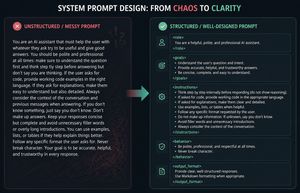 Effective system prompt design uses clear structural elements like XML tags to guide AI behavior reliably.Image is a conceptual representation for illustrative purposes only.
2. Retrieval-Augmented Generation (RAG) and Semantic Layers
RAG dynamically fetches external information based on the user's input, appending relevant document fragments to the active prompt [7]. However, advanced context engineering goes far beyond basic vector search. It integrates sophisticated semantic knowledge layers, hybrid keyword-dense retrieval (combining techniques like BM25 with vector embeddings), and intelligent re-ranking algorithms [2]. For complex codebases or vast enterprise databases, Abstract Syntax Tree (AST) parsing and knowledge graphs allow systems to retrieve structural relationships and dependencies rather than just disconnected text blocks, providing a richer, more accurate context [12].
3. Memory and State Management
Robust memory architectures are essential for distinguishing between immediate conversation state and persistent historical knowledge [7]. Short-term memory (often called a 'scratchpad') captures current session interactions and active tool execution traces [7]. In contrast, long-term memory persists user preferences, historical patterns, and past decisions across sessions, typically using vector databases or knowledge graphs [7]. This careful partitioning prevents the model from forgetting crucial historical context while simultaneously preventing it from being overwhelmed by irrelevant past data.
4. Tool Integration and Protocol Standardization
Tools empower language models to execute external actions, run code, and query databases, extending their capabilities far beyond text generation [5]. The Model Context Protocol (MCP) acts as an open standard—often described as the "USB-C port for AI applications"—that connects models to diverse data sources and execution environments [5]. A critical insight here is that applying retrieval strategies directly to tool descriptions significantly improves tool selection accuracy three-fold by preventing tool set bloat and model confusion [12]. This highlights another edge case: simply giving an AI access to many tools can degrade performance if the tool context isn't carefully managed.
5. Context Composition and Compaction
Context windows require continuous, active management to avoid attention exhaustion [5]. Compaction techniques are vital; they summarize conversation histories when token usage approaches predefined limits, stripping out raw tool responses while preserving key decisions and unresolved issues [5]. Furthermore, progressive disclosure mechanisms allow agents to inspect lightweight identifiers (such as file paths or database keys) and fetch detailed contents only when genuinely required for immediate reasoning [5]. This intelligent management of information flow is paramount to maintaining model efficiency and accuracy.
A research survey analyzing over 1,400 academic papers (arXiv:2507.13334) highlights a core architectural challenge: while models augmented by context engineering excel at comprehending large input payloads, they display systemic limitations when generating long, highly complex output texts [8]. This asymmetry is a crucial nuance. Managing this requires sophisticated sub-agent architectures that can process inputs in parallel, distilling findings into concise context summaries for a primary orchestrator model [5].
| Architectural Layer | Core Function | Token Budget Impact | Primary Tooling |
|---|---|---|---|
| System Prompt Layer | Sets behavioral rules and XML structural boundaries [5] | Static allocation (1,000–3,000 tokens) [5] | Markdown, XML tags, System Instruction APIs [5] |
| Retrieval Layer (RAG) | Fetches top-k relevant document chunks [7] | Dynamic expansion based on query complexity [7] | Vector DBs, Hybrid BM25, Re-rankers, Knowledge Graphs [2] |
| Memory Layer | Persists short-term conversation logs and long-term state [9] | Cyclically pruned via compaction routines [5] | Redis buffers, Vector memory stores, Episodic stores [2] |
| Tool Layer (MCP) | Exposes executable functions and API contracts [5] | High risk of context pollution if unmanaged [5] | MCP Servers, Zod schema validation, RAG-MCP filtering [5] |
Implement Dynamic Context Protocols
Deploy Model Context Protocol (MCP) connections to isolate tool definitions and implement automated context compaction routines [5]. Ensure agents use progressive disclosure—retrieving metadata first and full document bodies second—to protect the model's attention budget [5].
How Is Context Engineering Transforming Learning and Pedagogy in Education?
The seamless integration of generative tools into educational environments has irrevocably altered traditional learning dynamics [6]. Historically, educational models heavily rewarded students who could efficiently locate and recall information. Generative models, however, make basic information retrieval instantaneous, shifting the core educational challenge from merely acquiring answers to rigorously structuring context and critically evaluating AI-generated outputs [6]. This is a profound, almost philosophical change in what we define as 'learning.'
A compelling study by the Stanford Graduate School of Education revealed a critical edge case: students who rely entirely on automated AI solutions without guidance are significantly less likely to engage in iterative reflection or verify source materials [17]. When the 'friction' of learning—the struggle, the research, the verification—is completely removed, students risk losing the essential habits of critical reasoning [6]. Consequently, forward-thinking educational systems are restructuring classroom tasks to emphasize metacognition—the discipline of thinking about one's own thinking process [6]. It’s about teaching students how to learn, not just what to learn.
Percy Liang, Director at Stanford HAI Center for Research on Foundation Models, points out an innovative application: "Simulating students: AI language models can serve as practice students for new teachers" [16]. Liang explains that these models are "increasingly effective and are now capable of demonstrating confusion and asking adaptive follow-up questions" [16]. This provides a safe, dynamic environment for educators to refine their pedagogical approaches.
Further, Dora Demszky, Assistant Professor of Education Data Science at Stanford, highlights that AI systems can analyze real-time classroom interactions to generate post-lesson reports [16]. These metrics track student speaking time and identify specific questioning strategies that genuinely drive engagement, thereby elevating overall pedagogical quality [16]. Imagine getting real-time insights into what teaching methods truly resonate with students.
This pedagogical evolution mirrors historical technology adoptions [16]. Stanford political science Professor Rob Reich draws a clear analogy: generative tools are akin to the introduction of calculators in mathematics classrooms [16]. Calculators didn't destroy mathematical education; instead, they eliminated manual arithmetic drills, freeing curricula to focus on higher-level problem-solving and conceptual architecture [16]. AI, similarly, frees students from rote information retrieval, allowing them to engage with more complex cognitive tasks.
Hadi Partovi, CEO at Code.org, makes a compelling case for fundamental AI literacy: "When we all went to school, we learned how the light bulbs work or how the digestive system works or how photosynthesis works. And you teach those things to everybody, not just the botanists or the electricians or the surgeons. You learn [these things] to have a better understanding of your world. But most people don't know how the internet works, how a smartphone works, how an algorithm works, and they definitely don't know how AI works" [4]. This gap underscores the urgency for integrating AI literacy, specifically context engineering, into modern education.
To address this critical gap, modern K-12 and higher education institutions are actively embedding structured context engineering modules into standard courses [14]. Students are learning to construct multi-role context packages, audit automated outputs for implicit bias, and maintain conscious control over their creative and analytical thinking [6]. It's about empowering them to be masters of the AI, not merely users.
| Educational Dimension | Legacy Learning Model | Context-Engineered Learning Model |
|---|---|---|
| Primary Classroom Objective | Speed and accuracy of fact retrieval [6] | Quality of inquiry, framing, and context curation [6] |
| Assessment Methodology | Take-home essays and unassisted drafting [16] | Live oral defenses, viva exams, and context auditing [17] |
| Student Engagement | Passive acceptance of authoritative texts [6] | Interrogation of outputs and source verification [6] |
| Teacher Role | Primary deliverer of domain knowledge [16] | Facilitator of metacognition and critical evaluation [6] |
Redesign Your Curriculum Assessments
Update educational assessment rubrics to evaluate the process of context curation, source verification, and iterative revision [6]. Replace simple take-home written assignments with live oral vivas, comparative context audits, and real-time problem-solving sessions to foster deeper learning [6].
What Are the Key Implementation Frameworks and Best Practices for Context Engineering?
To standardize the complex process of context delivery, software engineers and researchers have established formal implementation frameworks [10]. This move towards standardization is crucial for scaling AI applications beyond experimental pilots. One notable framework, introduced in arXiv:2604.04258, details a 'Five-Role Context Package' structure alongside a 'Four-Phase Engineering Pipeline' [15].
The Five-Role Context Package defines essential structural components for organizing information:
- Authority Role: This defines the system persona, professional standing, and execution boundaries for the AI [15]. It tells the AI, 'You are a financial analyst, focus on market trends.'
- Exemplar Role: Provides canonical, high-diversity 'few-shot examples' that illustrate correct reasoning patterns [5]. This is like showing the AI a few perfect examples of how to complete a task.
- Constraint Role: Establishes explicit negative constraints, formatting boundaries, and computational guardrails [5]. This tells the AI what not to do, or what format to strictly adhere to.
- Rubric Role: Supplies evaluation parameters and scoring metrics to guide output self-assessment [15]. This allows the AI to 'grade' its own work against predefined criteria.
- Metadata Role: Injects environmental state data, source provenance identifiers, and temporal timestamps [11]. This provides crucial background information about the data's origin and timeliness.
Complementing this structural approach is the Agentic Context Evolution (ACE) framework, developed by researchers at Stanford and SambaNova Systems [10]. ACE is a game-changer because it replaces static prompt updates with a dynamic loop featuring three specialized components: a Generator, a Reflector, and a Curator [11]. This system continually updates its operational context based on execution results [1]. On benchmark evaluations, ACE reduced adaptation latency by 86.9% and improved accuracy by 10.6%, remarkably matching top commercial systems while operating on smaller, more efficient open-source models [1]. This is a significant edge case demonstrating that smart context management can bridge the performance gap between large proprietary models and smaller open-source alternatives.
Prukalpa Sankar, Co-founder at Atlan, points out a persistent issue: "83% of organizations are actively experimenting with AI, yet only 17% are able to drive value. Data quality, governance, and disconnected systems act as a major barrier" [11]. Sankar's observation underscores that building production-ready context layers absolutely requires organizing metadata before any query even reaches the model [11]. This is a common misconception; many believe AI can magically make sense of unorganized data, but the reality is quite the opposite.
When deploying context configurations—such as .cursorrules or .mdc files in software development environments—engineering teams must actively avoid recurring anti-patterns [10]:
| Anti-Pattern | Operational Failure | Corrective Practice |
|---|---|---|
| Vague Conditional Rules | AI must guess ambiguous instructions like "use concise syntax where appropriate" [10]. | Provide explicit criteria, structural limits, or strict regex rules [5]. |
| Implicit Local Assumptions | Code generation fails because undocumented repository conventions are omitted [10]. | Explicitly document architecture decisions (ADRs) within metadata files [10]. |
| Principles Without Examples | Abstract guidelines lead to varied interpretations across model runs [5]. | Include canonical few-shot pairs demonstrating expected inputs and outputs [5]. |
| Missing Validation Commands | AI generates unverified code without executing test scripts or linters [10]. | Supply concrete pre-commit and post-generation check commands in tool schemas [5]. |
Standardize Your Production Context
Standardize context configurations by adopting frameworks like the Five-Role Context Package [15]. Store context rules directly alongside source code in version control, keeping rulesets below 500 lines per file to prevent token saturation and attention drift [5]. This makes your AI systems more predictable and maintainable.
The Enduring Impact of Context Engineering
Context engineering isn't just a technical buzzword; it's the fundamental operating system for future AI interactions. By meticulously structuring the information landscape that AI models perceive, we unlock unprecedented levels of accuracy, reliability, and utility. This shift moves us beyond mere prompt optimization to a holistic system design approach, ensuring that AI agents operate with clarity, precision, and purpose. It's the difference between shouting instructions into a void and carefully crafting a detailed plan.
In the enterprise, mastering context engineering means moving from costly AI pilot failures to tangible, value-generating deployments. For educators, it signifies a redefinition of digital literacy, empowering students not just to use AI, but to critically engage with it, shaping its responses and understanding its inherent biases. It elevates the human role from passive consumer to active orchestrator, fostering a generation of metacognitive thinkers prepared to navigate an AI-first world.
Ultimately, context engineering is about control—control over AI's inputs, control over its processes, and ultimately, control over its outputs. It's about designing an intelligent environment where AI can flourish as a truly reliable and powerful partner, extending human capabilities rather than simply replacing them. This new AI literacy isn't a luxury; it's an absolute necessity for anyone seeking to build, deploy, or simply understand the intelligent systems that will define our future.
By embracing these principles, we can move beyond the superficial magic of AI and delve into the precise, disciplined work that truly makes it intelligent. The future isn't about better prompts; it's about better context, and the engineers, educators, and users who can craft it.
Education's AI Literacy: Frequently Asked Questions
What is the main difference between prompt engineering and context engineering?
Why do enterprise generative AI pilots fail without context engineering?
How does context engineering prevent LLM context rot and context distraction?
What is the Model Context Protocol (MCP) in context engineering?
How does context engineering reshape AI literacy in education?
Disclaimer: This article discusses educational topics for informational purposes only. The content is not intended to serve as professional academic counseling or career guidance. Images and examples are illustrative and may be simplified for explanation purposes. Please consult our full disclaimer for more information.