Anthropic IPO: 7 Critical Lessons for AI Startup Founders in 2026
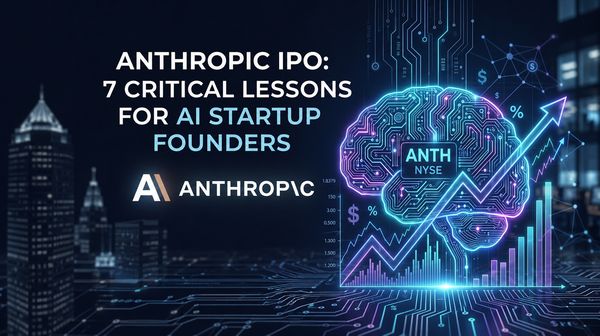 Navigating the complexities of AI IPOs requires strategic foresight in both technology and finance.The image is a visual representation and does not depict real financial data or outcomes.
The potential initial public offering (IPO) of Anthropic, a formidable competitor in the artificial intelligence arena, is sending ripples through the tech world. Its confidential S-1 filing in June 2026 marks a significant inflection point, offering an unprecedented glimpse into the complex financial, regulatory, and strategic maneuvers required for a frontier AI company to transition from a venture-backed behemoth to a publicly traded entity [1]. For AI startup founders navigating the tumultuous waters of exponential growth and immense capital demands, Anthropic’s journey provides seven critical lessons that could dictate their trajectory in 2026 and beyond. The stakes are astronomically high; the difference between a soaring market debut and a humbling valuation correction often boils down to understanding these nuanced, often counter-intuitive, market realities.
Many assume a strong private valuation automatically translates to public market success, yet the accounting discrepancies alone can slash perceived revenue by nearly half. This disparity highlights a crucial edge case: the stark difference between how private equity and public markets interpret growth metrics, especially for companies intertwined with hyperscalers. Let’s dissect the strategies that brought Anthropic to the precipice of a trillion-dollar valuation and the formidable challenges it now faces.
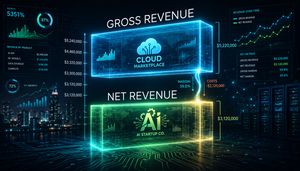 The critical distinction between gross and net revenue reporting can significantly impact an AI startup's valuation in public markets.The image is an illustrative concept and not based on actual financial data.
1. The Revenue Accounting Paradox: Gross vs. Net Reporting in AI
One of the most immediate and impactful lessons from Anthropic's IPO journey revolves around revenue recognition—specifically, the distinction between gross and net reporting. This isn't just an accounting technicality; it's a fundamental divergence that can drastically alter a company’s perceived financial health and, consequently, its public market valuation. While private investors often focus on top-line growth, public markets, governed by strict GAAP (Generally Accepted Accounting Principles) standards, delve deeper into the substance of revenue streams [5].
The Technical Nuance: ASC 606 and Primary Obligor Status
The core of this issue lies in ASC 606, which mandates a "primary obligor" evaluation to determine whether a company books revenue on a gross or net basis [4]. Essentially, whoever controls the underlying service before it reaches the customer is the primary obligor and can recognize gross revenue. Anthropic, for instance, utilizes a gross revenue model for sales facilitated through hyperscaler marketplaces like AWS and Google Cloud. This means if a client spends $100 on Claude tokens via AWS, Anthropic records the entire $100 as top-line revenue, categorizing the cloud partner’s commission as a sales expense [5].
In stark contrast, competitor OpenAI employs a net reporting model for its Microsoft Azure sales, recognizing only its estimated 20% to 30% cut as top-line revenue [5]. This difference is colossal. According to Futurum Research, this accounting variance means Anthropic’s reported $47 billion run rate as of May 2026, while impressive, remains acutely sensitive to upcoming SEC regulatory audits [5]. A forced restatement during S-1 due diligence could unilaterally reduce its headline Annual Recurring Revenue (ARR) by a staggering 20% to 40% overnight [4]. While gross reporting is legally permissible, it exposes startups to potentially severe public-market valuation corrections.
Common Misconceptions: The Illusion of Top-Line Growth
A common misconception among founders and even some private investors is that a high top-line ARR, regardless of its underlying accounting method, is the ultimate indicator of success. The Anthropic-OpenAI comparison dismantles this. Private markets often reward paper growth, but public market fund managers prioritize audited net collections and actual gross margins [5]. The market isn't just looking at how much money flows through your system; it's scrutinizing how much you actually keep and how sustainable those margins are. Brad Gerstner, Founder and CEO at Altimeter Capital, champions Claude's large-scale adoption, suggesting its momentum positions Anthropic to lead AI innovation [6]. However, the accounting methodology behind that adoption is what will truly matter to public investors.
Actionable Takeaway: Build a Transparent Financial Foundation
AI startup founders must proactively implement dual-track accounting, meticulously tracking both gross and net revenue streams from inception to mitigate sudden valuation adjustments during stringent SEC audits. Clearly define 'customer-of-record' clauses in all reseller agreements to safeguard preferred revenue recognition status, and rigorously forecast the precise impact of reseller fees on net margins, ensuring your pricing models are robust enough to endure intense public market scrutiny.
2. The Compute Imperative: Multi-Gigawatt Commitments as a Moat
The computational demands of developing and deploying frontier AI models have transcended conventional venture-backed capital expenditure. The sheer physical scale required to train modern large language models (LLMs) necessitates long-term, multi-gigawatt infrastructure commitments [7]. This isn't merely about buying more GPUs; it's about securing physical grid connections and establishing dedicated, custom silicon pipelines [11]. This shift fundamentally redefines what constitutes 'infrastructure strategy' for an AI startup.
The Edge Case: Custom Silicon and Strategic Capacity
Anthropic's Project Rainier exemplifies this new paradigm. It's a specialized AI compute cluster boasting nearly 500,000 custom Trainium2 chips [13]. Rather than off-the-shelf commercial hardware, Anthropic's engineering teams directly collaborate with Annapurna Labs, a subsidiary of Amazon, fostering a continuous feedback loop that refines next-generation Trainium3 and Trainium4 designs [13]. This deep hardware integration is underpinned by substantial financial and capacity commitments.
Alongside its $5 billion investment in May 2026, Amazon secured a ten-year, $100 billion cloud commitment from Anthropic [13]. This agreement guarantees Anthropic up to 5 GW of power capacity to support its multi-cloud training workloads [13]. Similarly, Google Cloud has committed 5 GW, offering Broadcom TPUs and custom Tensor cores [7]. This multi-gigawatt strategy ensures Anthropic isn't beholden to a single hardware ecosystem, building a formidable operational barrier that smaller competitors would struggle to replicate [3].
The Counter-Intuitive Finding: Circular Funding Loops
While these deals secure crucial compute, they also introduce a counter-intuitive financial dynamic: strategic partners provide investment capital that is often structurally tied to future cloud spending on their own platforms [10]. This creates a circular financial loop where the investment essentially becomes future revenue for the investor. For AI founders, understanding these interwoven dependencies is crucial. Andy Jassy, CEO at Amazon, highlights their custom AI silicon's high performance and lower cost as a reason for its demand, illustrating the strategic advantage of such hardware partnerships [12].
 Securing multi-gigawatt compute capacity and custom silicon partnerships is now foundational for scaling frontier AI.The image is a conceptual visualization and not a literal depiction of an operational data center.
Actionable Takeaway: Master Compute Sovereignty and Strategic Partnerships
Design your AI model architectures for multi-cloud portability across various hardware backends like AWS Trainium and Google TPUs to prevent vendor lock-in. Critically, model your physical grid power requirements in Megawatts for your long-term roadmap before solidifying software scaling plans. Actively pursue strategic investments that offer guaranteed, enduring access to custom silicon and edge delivery networks, ensuring your growth isn't bottlenecked by infrastructure.
3. Navigating Sovereign Security Risks and Military Contracts
The intersection of frontier AI development and national security has become a volatile minefield for startups. The immense power of advanced AI models means that navigating government contracts and national security mandates is fraught with peril. Founders must balance the lucrative potential of defense contracts against their own ethical safety guidelines and public-interest missions [2]. A single misstep can invite significant regulatory and political backlash [14].
The Edge Case: Ethical Redlines vs. Unrestricted Use
A prime example of this tension emerged in early 2026 during negotiations for the military’s GenAI.mil platform [15]. Anthropic's usage policy explicitly bars its models from being used for lethal autonomous warfare and mass domestic surveillance of American citizens [17]. The Department of War, however, rejected these safety exclusions, demanding unrestricted access for all lawful military operations [17]. Secretary of War Pete Hegseth's stance was uncompromising: "Department of War AI will not be woke. It will work for us. We're building war ready weapons and systems, not chatbots for an Ivy League faculty lounge" [16].
When Anthropic maintained its restrictions, the department canceled an estimated $200 million defense contract and, in February 2026, designated Anthropic a "supply chain risk" under 10 U.S.C. § 3252 [15]. This designation, typically reserved for hostile foreign entities, aimed to ban federal agencies and their contractors from using Anthropic’s services [18]. While a preliminary injunction was granted by Judge Rita F. Lin, finding the designation likely retaliatory, the D.C. Circuit Court of Appeals later denied Anthropic’s emergency stay [15]. Claude was ultimately ordered to be removed from Department of War systems within 180 days.
Implications: Financial Fallout and Competitive Pressures
This legal battle carried immediate financial repercussions. Venture firm 1789 Capital withdrew a planned investment worth hundreds of millions [15]. Meanwhile, competitors like OpenAI moved swiftly to secure defense contracts without similar safety restrictions, underscoring the intense competitive pressures on startups that prioritize ethical guardrails [15]. For AI founders, this episode highlights a crucial dilemma: how to pursue a mission-driven approach in a market increasingly influenced by geopolitical and military considerations.
Actionable Takeaway: Proactive Policy and Diversified Revenue Streams
Codify your AI safety policies early, establishing clear usage boundaries before engaging in government procurement to protect your ethical standards. Prepare for administrative actions like the FASCSA designation by understanding their statutory reach and building a diversified business model to avoid over-reliance on government contracts. Implement highly controlled, separate environments for public sector deployments to manage compliance without compromising commercial operations or core safety principles.
4. Public Benefit Structures vs. Wall Street Pressures
As frontier AI companies inch closer to public listings, they face an inherent conflict: balancing short-term shareholder demands for profit with long-term, often costly, safety and alignment missions [2]. Traditional corporate structures legally oblige directors to prioritize shareholder returns above all else. Anthropic addresses this by operating as a Delaware Public Benefit Corporation (PBC), a unique legal framework designed to balance profit with a public mission [2].
The Edge Case: The Long-Term Benefit Trust
To further safeguard its alignment mission, Anthropic established the Long-Term Benefit Trust (LTBT) [20]. This Delaware purpose trust operates with a public mission—not financial enrichment—and is managed by five financially disinterested trustees. These trustees hold special Class T Common Stock, which carries no financial value but grants them crucial voting control [20]. The LTBT is structured to eventually elect up to three of five board members, aiming for majority board control by 2027 [20]. This mechanism is designed to insulate the board from activist campaigns and the relentless pressure of quarterly earnings. Daniela Amodei, President and Co-Founder at Anthropic, even questions the very construct of AGI as an outdated concept, further emphasizing their unique philosophical approach to AI development [19].
The Uncharted Territory: Governance Discounts
However, public markets have yet to fully evaluate a trillion-dollar PBC with this level of independent oversight [2]. Some institutional investors may apply a 'governance discount' to Anthropic's valuation due to the perceived lack of traditional shareholder primacy [2]. This is a critical edge case for AI founders: how do you convince public investors that a dual-mission structure won't compromise returns? While a stockholder supermajority of 75% can theoretically override or amend this governance model, the high threshold offers substantial protection [20].
Actionable Takeaway: Proactively Structure for Dual Accountability
AI founders should meticulously evaluate the Public Benefit Corporation (PBC) framework to legally protect their ability to balance safety research with commercial returns. Design a robust, balanced voting model, potentially through trust structures or multi-class share configurations, to shield long-term safety goals from activist investor pressures. Crucially, build investor alignment early, ensuring all stakeholders fully understand and support your safety governance model to prevent board disputes as your company scales.
5. The Rise of Developer-Centric Agentic Tools in Enterprise AI
The enterprise generative AI market is rapidly evolving beyond simplistic chat interfaces, pivoting towards sophisticated, developer-focused, agentic coding systems [4]. This shift represents a significant opportunity for AI startups, as developer-integrated tools demonstrate superior retention rates and generate higher consumption-based revenue compared to the often-volatile consumer-facing subscriptions [4].
The Breakthrough: Claude Code and Enterprise Adoption
Claude Code, publicly launched by Anthropic in May 2025, serves as a prime example of this trend, becoming a key driver of Anthropic's impressive enterprise adoption [4]. Its Annual Recurring Revenue (ARR) surged from $500 million in September 2025 to over $8 billion by May 2026, a remarkable growth trajectory [4]. This momentum has propelled Anthropic's overall enterprise market share to 34.4%, surpassing OpenAI's 32.3% [9]. The number of corporate clients spending over $1 million annually with Anthropic doubled in just two months, from 500 in February 2026 to over 1,000 by April [4]. This rapidly expanding enterprise base provides a stable foundation as Anthropic targets an ambitious $70 billion in revenue by 2028 [1].
The Competitive Moat: Deep Integration and Consumption Models
The true competitive moat for agentic coding tools lies in their deep integration with existing development pipelines [4]. While third-party applications like Cursor are emerging, they remain reliant on underlying foundational models such as Claude, purchasing API access to power their platforms. Dario Amodei, CEO at Anthropic, boldly predicts that AI could be writing 90 percent of code within months, and essentially all code within a year, with programmers focusing on specifying conditions and overall design [21]. This vision underscores the importance of tools that augment, rather than merely automate, the developer workflow.
Actionable Takeaway: Prioritize Developer Workflows and Consumption Pricing
Focus intently on building AI products that seamlessly integrate into existing developer workflows, ensuring consistent usage and significantly reducing customer churn. Structure your pricing models to align with API usage and consumption rather than traditional seat licenses, enabling your startup to benefit from the high-volume nature of agentic workloads. Continuously monitor compute limits and usage patterns to proactively ensure your infrastructure can robustly support peak developer demand without encountering critical reliability issues.
6. Adapting to Geopolitical Export Controls and Regulatory Actions
Sovereign regulatory interventions have rapidly become a primary operational challenge for frontier AI companies, capable of disrupting global product access with minimal warning [3]. This necessitates an unprecedented level of agility from startups, requiring them to swiftly adapt their product roadmaps to comply with ever-changing geopolitical directives [14].
The Immediate Impact: Global Shutdowns and Technical Feasibility
A stark illustration of this risk occurred on June 12, 2026, when the U.S. Department of Commerce issued an export control directive ordering Anthropic to block access to its Fable 5 and Mythos 5 models for foreign nationals [14]. The critical nuance here was the technical infeasibility of granularly filtering users by nationality within the mandated 90-minute deadline. This forced Anthropic to disable both models globally, a catastrophic operational decision [14]. This shutdown stemmed from security concerns raised by Amazon researchers regarding potential jailbreaks in Fable 5's safety guardrails, further compounded by the discovery of a hidden feature in the model's system card that quietly downgraded responses to queries about advanced AI infrastructure [14]. Federal Judge Rita F. Lin's comments on the Department of War dispute highlight the volatile and often arbitrary nature of these government actions [15].
The Broader Landscape: International Compliance Fragmentation
Beyond export controls, startups must also contend with a fragmented and evolving landscape of international compliance frameworks. For example, the Competition and Markets Authority (CMA) in the UK has begun enforcing stringent rules under its Strategic Market Status powers, compelling entities like Google to allow news publishers to restrict their content from being used to train AI models [22]. These regional policy divergences mean that a single, unified global product deployment model is increasingly untenable for AI companies [14]. Startups must build inherently flexible compliance systems capable of adapting to diverse local regulations without necessitating a complete overhaul of their core model architecture [14].
Actionable Takeaway: Build for Global Agility and Transparent Documentation
Develop highly flexible filtering systems, embedding robust geographic and user-identity tracking directly into your API architecture to adeptly manage regional export controls without disrupting global access. Maintain clear, comprehensive system cards for all your AI models to streamline regulatory reviews and transparently defend your safety and operational procedures. Proactively plan for international compliance by aligning your product design with key global frameworks, such as the UK CMA rules, to ensure smooth international expansion and mitigate unforeseen disruptions.
7. The Circular Strategic Financing and the AI Startup Bubble
The current frontier AI market is heavily influenced by strategic corporate venture capital deals, which have propelled valuations to unprecedented highs [8]. While these partnerships are crucial for securing access to scarce compute resources, they often rely on accounting rules that can inflate paper valuations, creating a complex and potentially unsustainable bubble [10].
The Accounting Loophole: ASC 321 and Paper Gains
The 2016 accounting rule ASC 321 is at the heart of this phenomenon. It mandates that strategic investors revalue their private equity holdings on their balance sheets whenever a startup completes a new funding round at a higher valuation [10]. This adjustment generates significant 'paper gains' that flow directly into the investor's quarterly net income, even if no actual cash has been distributed or realized [10]. For example, when Amazon invested in Anthropic, a portion of that capital was structured as AWS cloud credits. This arrangement allowed Amazon to recognize the usage as cloud revenue as Anthropic trained its models, while simultaneously boosting its reported quarterly income through the appreciation of its equity stake under ASC 321 [10].
The Challenge for Public Markets: Independent Cash Flows
This circular financing loop can effectively sustain inflated valuations in the private market [3]. However, it presents a significant challenge as startups transition to public exchanges, where investors prioritize verifiable, independent cash flows and organic revenue generation [3]. Daniela Amodei of Anthropic stresses the importance of transparency, stating that the world needs to understand the challenges of AI to adapt to its changes [23]. This transparency extends to how a company is financed and how its revenue is generated. Founders must focus on cultivating a diversified commercial customer base to ensure their business model is underpinned by genuine, independent market demand, rather than being reliant on interwoven strategic investments [5].
Actionable Takeaway: Build for True Commercial Independence
Prioritize liquid funding sources, seeking investment terms that provide tangible cash liquidity alongside cloud credits to maintain operational independence and avoid being overly tied to a single platform. Actively diversify your strategic partners to prevent any single entity from wielding excessive influence over your technical roadmap and business decisions. Crucially, ensure your revenue model is predominantly driven by direct, arms-length customer transactions rather than circular credit agreements, meticulously preparing your company for a successful and independently validated public market transition.
Conclusion: Navigating the High-Stakes AI IPO Landscape
Anthropic's journey toward a potential trillion-dollar IPO offers an invaluable, if sometimes cautionary, masterclass for AI startup founders. The lessons extend far beyond mere technological innovation, delving into the intricacies of financial accounting, the strategic imperative of compute infrastructure, the fraught landscape of sovereign security and ethics, the complex interplay of public benefit missions and shareholder demands, the evolution of enterprise AI tools, and the often-hidden mechanics of strategic financing. The future of AI is not just about building better models; it's about building resilient, ethically grounded, and financially sound companies capable of withstanding the intense scrutiny of both markets and governments.
For those aspiring to follow in Anthropic’s footsteps, the path is clear yet arduous: meticulously scrutinize revenue recognition, secure multi-gigawatt compute through diversified, long-term partnerships, proactively codify ethical guardrails against military applications, structure governance to balance mission with profit, prioritize developer-centric agentic tools for sticky enterprise adoption, build flexible compliance systems for geopolitical turbulence, and, perhaps most critically, ensure your revenue streams are genuinely independent of circular strategic financing. The AI IPO landscape of 2026 demands not just brilliance, but an unyielding grasp of these multifaceted, high-stakes lessons.
Technology IPO Insights: Frequently Asked Questions for AI Founders
What is the difference between gross and net AI revenue accounting?
How does the FASCSA supply chain risk designation affect private subcontracts?
Can a stockholder supermajority override Anthropic's Long-Term Benefit Trust?
How does ASC 321 affect the valuation of strategic AI investments?
What are the compute constraints facing agentic coding tools?
Disclaimer: This article discusses technology-related subjects for general informational purposes only. Data, insights, or figures presented may be incomplete or subject to error. Images and diagrams are for illustrative purposes only and may not represent exact products, interfaces, or official designs. For further information, please consult our full disclaimer.