
Heatwave Survival: Calm, Practical Tips to Stay Cool & Clear-Headed in 2026
 Staying calm and cool is paramount during extreme heat events.This image is for illustrative purposes only and does not depict actual individuals or specific products.
Imagine walking into your kitchen at dawn, the concrete floor cool beneath your bare feet, as you pour a glass of crisp, cold water. Outside, the summer morning holds a brief, restorative promise of dew-kissed leaves and steady breezes before the dome of heat settles over the horizon. This quiet moment offers a brief contrast to the prolonged and increasingly intense heatwaves described across India and Europe [2].
My work as a health researcher and investigative journalist is to strip away the overwhelming complexity of climate warnings and deliver sustainable, clear-headed strategies that establish lasting change. We are moving past the quick fixes and media confusion to bring you quiet confidence and actionable, life-saving safety.
To stay cool in 2026, we must look beyond basic advice and build an evidence-informed understanding of our body's physical limits [5].
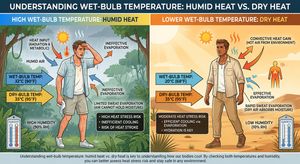 Understanding the difference between humid and dry heat is crucial for effective cooling strategies.This image is for illustrative purposes only and does not depict actual individuals or specific products.
How Does the True Wet-Bulb Limit Rewrite Our Understanding of Human Heat Tolerance?
The Collapse of the Theoretical 35°C Benchmark
For decades, global climate safety models have anchored human survivability to a theoretical wet-bulb temperature (TWb) of 35°C (95°F) [7]. Under this theoretical framework, a wet-bulb temperature of 35°C (95°F) was proposed as a limit for human survival, based on the assumption that fatal heat stroke would become unavoidable under such conditions [7]. However, empirical observations on living human subjects have shattered this assumption [5]. It turns out, our bodies are far more delicate than the models once suggested.
Clinical trials conducted by the Pennsylvania State University HEAT project have demonstrated that the actual compensable limit is significantly lower than previously assumed [5]. In humid environments, the critical threshold where the human body can no longer prevent its core temperature from rising uncontrollably is approximately 31°C wet-bulb (TWb) [5]. This threshold represents a critical physical barrier: when relative humidity reaches extreme levels, sweat simply cannot evaporate from the skin, halting the body's primary cooling mechanism [2]. It's a counter-intuitive finding for many, who might assume higher temperatures are the sole danger, but humidity plays an equally, if not more, insidious role.
“Our results suggest that in humid parts of the world, we should start to get concerned — even about young, healthy people — when it's above 31 degrees wet-bulb temperature. As we continue our research, we’re going to explore what that number is in older adults, as it will probably be even lower than that,” says W. Larry Kenney, Professor of Physiology and Kinesiology and Marie Underhill Noll Chair in Human Performance at Pennsylvania State University [5].
The Metabolic Impact of Physical Work
While a resting individual might survive near the 31°C wet-bulb boundary, basic daily tasks drop this threshold even further [5]. Engaging in light physical activities, such as slow walking, gardening, or washing dishes, lowers the critical wet-bulb survival limit to approximately 28°C (82°F) [9]. This happens because metabolic heat production increases the body's internal heat load faster than the humid air can absorb it [10]. It's not just about the external temperature; it's about the internal furnace we all carry.
When the ambient humidity is high, sweat simply pools and drips off the body without providing any evaporative cooling [8]. Consequently, the heart must work exponentially harder to pump blood to the skin to dissipate heat, creating severe cardiovascular strain [12]. This cardiovascular strain increases as ambient temperatures rise, adding to the multi-system physiological strain experienced during extreme heat [7]. This is a crucial edge case: many heat-related illnesses aren't about direct heatstroke, but the systemic breakdown caused by the body's desperate attempts to cool itself.
Environmental Variations: Humid vs. Dry Heat
The physiological strain of a given wet-bulb temperature is not uniform across different climates [7]. In hot, dry environments, the empirical wet-bulb limit ranges from 25°C to 28°C [5]. This occurs because convective heat gain from extremely hot, dry air outpaces the body's maximum sweating capacity, even when humidity is low [8]. It's a different kind of heat, demanding a different kind of caution.
For instance, during the intense 2026 heatwaves in New Delhi, the heat index peaked at 53.5°C with a wet-bulb temperature of 30.8°C [13]. Such conditions pose extreme risks to outdoor workers who are unacclimatized to these combined factors [13]. Understanding these specific thresholds is key to managing outdoor exposure [5]. To understand the exact safety margins of these environments, meteorologists utilize the Wet-Bulb Globe Temperature (WBGT) index, which is calculated as:
Actionable Takeaway: Monitor Localized Wet-Bulb Temperatures
To maintain clear-headed safety, monitor localized wet-bulb temperatures rather than dry thermometer readings alone. When wet-bulb readings exceed 28°C (82°F) during physical activity, or 31°C (88°F) at rest, active cooling measures—such as seeking air conditioning or applying cold, wet cloths—are required to prevent core temperature escalation [5].
Which Common Prescription Medications Compromise Our Internal Cooling Systems?
Autonomic and Circulatory Impairments
Many individuals are unaware that daily prescriptions can significantly alter how the human body processes environmental heat [17]. Standard clinical compounds often disrupt the neurological pathways controlling sweat production, skin vasodilation, and thirst perception [14]. This disruption can transform a hot afternoon into a life-threatening medical emergency [17]. It's a silent threat, often overlooked in the daily routine of medication management.
Specifically, cardiovascular medications like beta-blockers decrease superficial skin vasodilation, preventing metabolic heat from escaping through the blood [14]. Diuretics prescribed for hypertension or heart failure force the kidneys to excrete sodium and water, reducing the blood volume available for sweat production [17]. This dual impairment rapidly accelerates the transition from mild heat strain to severe hyperthermia [17]. It's a complex interplay, where a medication designed to help one system can inadvertently hinder another vital one.
“Blistering heat can have an entire-body effect on all of us, causing us to perspire, as well as feeling short of breath and exhausted. But, people who take certain medications for chronic conditions may be impacted by the heat even more than usual,” says Andrew Wong, MD, a primary care provider at Hartford HealthCare [20].
Central Nervous System and Sweat Gland Blockades
Antipsychotics and tricyclic antidepressants pose an especially severe threat by blocking acetylcholine receptors [10]. Acetylcholine is the primary neurotransmitter responsible for stimulating eccrine sweat glands to release perspiration [10]. When this signal is blocked, an individual’s ability to sweat is severely restricted, leading to rapid heat accumulation even at rest [14]. Imagine your body's natural cooling system being switched off, without you even knowing it.
Concurrently, medications used to treat attention deficit hyperactivity disorder (ADHD) act as central nervous system stimulants [17]. These stimulants raise metabolic rate, elevate baseline body temperature, and increase the heart rate, compounding environmental heat loads [17]. This metabolic acceleration leaves patients highly vulnerable to exertional heat exhaustion [17]. It's a double-edged sword, where managing one condition can create unforeseen vulnerabilities in another.
The Danger of Dehydration-Induced Toxicity
Dehydration significantly alters how the kidneys filter and excrete standard medications [14]. For narrow-therapeutic-index drugs such as lithium, any decrease in renal clearance can cause blood concentrations to reach toxic levels [14]. This toxicity can manifest as severe neurological impairment, mimicking and worsening the symptoms of heat stroke [10]. It's a critical edge case, where the very act of staying hydrated becomes a life-saving measure for those on specific medications.
Nonsteroidal anti-inflammatory drugs (NSAIDs) like ibuprofen also increase the risk of acute kidney injury when taken in dehydrated states [18]. This clinical hazard is further compounded by the fact that many of these medications suppress the natural sensation of thirst [18]. A comprehensive breakdown of these pharmacological risks is essential for patient safety [17]. It's a vicious cycle: the heat makes you dehydrated, the medication suppresses thirst, and the kidneys struggle, all while you might not even realize the danger.
Actionable Takeaway: Consult Your Physician and Hydrate Rigorously
Anyone taking cardiovascular, psychiatric, or stimulant medications must consult their physician before heat seasons to assess specific risk levels. These individuals must never abruptly stop their medications, but must implement rigid hydration schedules, check their urine color to ensure it remains pale yellow or clear, and remain in air-conditioned environments when temperatures spike [17].
 Certain medications can significantly impair the body's natural cooling mechanisms.This image is for illustrative purposes only and does not depict actual individuals or specific products.
When Do Electric Fans Become a Hazard Rather than a Cooling Tool?
The Physics of Convective Heat Gain
Public health campaigns frequently warn against relying on electric fans during severe heatwaves [3]. This is because fans operate by moving air across the skin to accelerate evaporation, but they do not cool the ambient air [3]. When the room temperature surpasses the skin's surface temperature of roughly 35°C (95°F), fans can paradoxically increase body temperature [11]. It's a common misconception that any moving air is cooling air, but physics has other plans.
In these high-temperature scenarios, the moving air acts as a convection current, transferring heat directly into the body [11]. This convective heating forces the body to sweat more, which can rapidly accelerate dehydration if fluids are not replaced [11]. Therefore, major international health agencies advise against using fans in closed rooms when the temperature reaches the mid-90s or higher [3]. It's a critical distinction: a fan can be your friend or your foe, depending on the ambient conditions.
“Heat is a much more dangerous silent killer than most people acknowledge it to be, and that heat is increasingly putting our health and survival at risk,” says Dr. Marina Romanello, Executive Director of the Lancet Countdown [21].
Humidity and the Limits of Evaporative Cooling
Despite classical warnings, physiological research shows that the safety of fan use is highly dependent on humidity levels [11]. In humid conditions, fans can significantly enhance evaporative cooling at 36°C (97°F) by replacing saturated air above the skin with drier air [4]. Under these conditions, fan use has been shown to reduce heart rate and core temperature elevations [11]. This is an important edge case: the "fan rule" isn't as black and white as often portrayed.
However, this benefit disappears in extremely dry environments where sweat evaporates completely without any air movement [11]. In dry climates, running a fan above 35°C simply accelerates convective heat transfer, raising core temperatures faster [11]. Furthermore, this protective mechanism is severely compromised in elderly individuals who have a reduced capacity to sweat [11]. The nuanced reality of fan efficacy means a one-size-fits-all approach is dangerous.
Hybrid Shading and Ventilation Strategies
To mitigate these physical limits, individuals should combine fans with advanced shading and wetting techniques [3]. The World Health Organization recommends closing windows and using external blinds during peak sunlight hours to block radiant heat [22]. At night, windows should be opened to draw in cooler night air, facilitating natural heat dissipation [16]. It's about working with your environment, not against it.
When using air conditioning, set the thermostat to around 27°C (81°F) to save energy while remaining cool, and use fans to help circulate the air [22]. This approach saves up to 70% on electricity bills and reduces the risk of community-wide power grid failures [31]. If power outages occur, individuals should take steps to stay cool and reduce heat exposure, as extreme heat can pose risks to health and indoor air quality [3]. These hybrid strategies offer both comfort and sustainability, a truly restorative approach to heat management.
Actionable Takeaway: Combine Fans with Wetting or Seek Public Cooling
If indoor temperatures climb above 35°C (95°F) and air conditioning is unavailable, do not rely on dry fans alone to stay cool. To reduce heat exposure, seek refuge in air-conditioned public spaces such as libraries or cooling centers when indoor conditions become dangerously hot [3].
Why Are Heatwave-Related Casualties Systematically Miscalculated by Public Health Agencies?
The Silent Cardiovascular Burden
The official death toll of extreme heatwaves represents only a small fraction of the true mortality burden [23]. Most individuals who die during heatwaves succumb to acute cardiovascular or renal failure, which are rarely coded as environmental heat stroke [12]. The physiological strain of pumping blood to the skin to dissipate heat puts immense stress on compromised hearts [12]. This is a critical edge case: the true impact of heat is often hidden behind other diagnoses.
This diagnostic discrepancy leads to an artificial undercount of heat-related deaths, masking the severity of extreme weather events [23]. For example, a retrospective analysis of the 2026 heatwaves in India showed a massive gap between recorded heatstrokes and officially registered deaths [23]. By failing to record these non-exertional, indoor deaths, public health systems cannot adequately prepare communities for future heat risks [23]. To counter this, researchers utilize “excess all-cause mortality” metrics during heat events to estimate the true toll [23]. It's a quiet crisis, demanding a more honest accounting.
“The heatwave is the final straw for the second category of people. Most people dying during heat waves belong to this category but their deaths are not recorded as connected to the heat,” says Dr. Dileep Mavalankar, former Director of the Indian Institute of Public Health, Gandhinagar [23].
The Fatal Impact of Nighttime Heat
A key factor driving excess mortality is the rising threshold of nighttime temperatures [6]. Normally, cool nights allow the human body and cardiovascular system to recover from daytime heat stress [21]. However, when nighttime temperatures remain above 30°C (86°F), the body is forced to maintain high skin blood flow and elevated heart rates continuously [6]. This continuous thermoregulatory effort accelerates cardiac fatigue, particularly in elderly individuals and those with pre-existing conditions [14]. The night, once a refuge, is becoming another battleground against the heat.
During the heatwave in Ahmedabad and Gandhinagar, minimum temperatures remained around 31°C, with Ahmedabad recording 31.2°C, while heat-related emergencies in Ahmedabad and across Gujarat also saw a recent spike [24]. This highlights why modern heat warning systems must incorporate minimum temperature thresholds rather than maximums alone [6]. It's not just about the peak heat, but the relentless, unyielding warmth that prevents our bodies from ever truly recovering.
The Efficacy of Coordinated Heat Action Plans
When municipal governments implement proactive Heat Action Plans (HAPs), the reduction in mortality is immediate and measurable [25]. Ahmedabad's pioneering 2013 HAP was associated with a 27% reduction in death rates on extremely hot days [25]. This plan successfully avoided over 1,100 deaths annually by implementing simple, cost-effective strategies [25]. These strategies include early warning systems, public education campaigns on heat safety, inter-agency coordination during high-temperature alerts, healthcare professional training, and mapping of high-risk areas [25]. These aren't quick fixes; they're sustainable, community-wide commitments.
However, replicating these municipal successes on a national scale is hindered by the lack of centralized, real-time mortality data [23]. Without precise tracking, policymakers cannot allocate cooling resources to the most vulnerable urban centers [23]. This data gap is a critical barrier to effective public health interventions, an edge case where information, or the lack thereof, directly impacts lives.
Actionable Takeaway: Prioritize Nighttime Cooling and Community Checks
To protect against silent, non-exertional organ strain, prioritize keeping sleeping quarters cool during warm nights. During periods of extreme heat, use air conditioning or other cooling measures to help keep the body from overheating, and check on older adults and other people at higher risk [10].
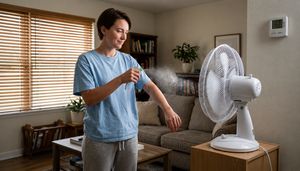 Combining fans with wetting techniques can significantly improve cooling efficacy in high temperatures.This image is for illustrative purposes only and does not depict actual individuals or specific products.
What Physiological Strategies Shield Our Pets from Lethal Heat Stroke?
The Limitations of Non-Human Thermoregulation
Companion animals face a heightened risk of heat stroke because they lack the ability to sweat efficiently [26]. Dogs possess a normal body temperature of 100.5°F to 102.5°F, leaving them only a narrow four-degree margin before reaching lethal heatstroke levels [28]. To cool down, dogs rely almost exclusively on panting, which facilitates the evaporation of moisture from their respiratory tract [27]. It's a delicate balance, easily tipped by rising temperatures.
In environments with high humidity, this evaporative process is severely hindered, causing internal temperatures to rise rapidly [27]. “High humidity amplifies the negative impact of high temperature on your pet—and in combination, these factors magnify the danger zone,” says Dr. Barbara Hodges, DVM, MBA, of the Humane Society Veterinary Medical Association [30]. Cats, while slightly more resilient due to their desert ancestors, cool themselves by spreading saliva on their fur [27]. However, this strategy also fails during extreme heatwaves, making active human intervention vital [27]. Our furry friends need us to be their thermoregulatory allies.
Identifying Vulnerabilities in Brachycephalic and Large Breeds
Not all companion animals share the same baseline susceptibility to heat-related illness [26]. Brachycephalic breeds, such as Pugs, French Bulldogs, and Persian cats, possess shortened upper airways that restrict air flow [27]. This structural limitation makes it incredibly difficult for them to pant effectively, making them highly susceptible to heat stroke at much lower temperatures [28]. This is a crucial edge case: breed-specific vulnerabilities demand tailored care.
Large breed dogs weighing over 15 kilograms also face increased risk due to their lower surface-area-to-volume ratio [26]. Their larger bodies generate more metabolic heat during basic movement while dissipating it less efficiently [26]. Consequently, physical activity must be completely curtailed for these vulnerable groups during hot weather [29]. Understanding these nuances is key to truly protecting our pets.
Rapid Cooling and Environmental Management
When an animal exhibits signs of heat distress, such as heavy panting, bright red gums, or unsteady gait, rapid cooling is required [28]. Working dog research in the United States shows that teaching a dog to voluntarily dunk its head in water is one of the fastest ways to lower its core temperature [27]. Wetting the neck and chest with cool—never ice-cold—water is also highly effective [29]. It's about immediate, gentle intervention.
Ice packs or freezing water should be avoided because they cause the blood vessels in the skin to constrict, trapping heat in the core [29]. Additionally, owners must monitor surface temperatures, as asphalt can reach 140°F in summer, causing severe paw burns [28]. Utilizing shaded, natural grass areas and providing fresh, ice-chilled water are fundamental to maintaining animal safety [30]. These practical steps can make all the difference between a close call and a tragedy.
Actionable Takeaway: Tailor Pet Care to Breed and Conditions
During high-heat seasons, walk dogs only in the early morning or late evening, and suspend physical exercise when temperatures exceed 28°C (82°F) [27]. Avoid leaving dogs in enclosed spaces or poorly ventilated shelters that can trap heat, and instead provide cooling mats, multiple bowls of fresh water with ice cubes, and use the seven-second hand test to determine whether pavement is too hot for their paws [32].
Health FAQ: Navigating Heatwave Survival in 2026
What wet-bulb temperature is considered lethal for humans?
Which medications pose the highest risk of heat stroke?
At what temperature should you stop using a fan?
How quickly can heat exhaustion progress to heat stroke?
What temperature is too hot to walk a dog?
Disclaimer: This article addresses health-related topics for informational purposes only. It does not constitute medical advice and should not replace consultation with a licensed healthcare professional. Images are for illustrative purposes only and should not be interpreted as medical guidance. For complete guidance, please review our full disclaimer.