
Top El Niño Tips 2026: Your Secret Playbook for Extreme Summer Weather
 Gear up, because the 2026 El Niño is bringing the heat. Are you ready?The image depicted is a visual representation for illustrative purposes and does not contain actual meteorological data.
Here’s What’s Blowing Up: Your 2026 El Niño Survival Guide! 🔥
Alright, fam, listen up! I'm dropping some seriously vital intel today because the 2026 El Niño isn't just a weather forecast—it's a vibe shift, a total canon event for our summer plans. We're talking extreme summer weather that's about to redefine 'hot girl summer' into 'how to not spontaneously combust summer.' You know I keep it real, and the scientific data from NOAA and the WMO are screaming that this El Niño cycle is set to hit 'very strong' intensity, unlike anything we've seen in a hot minute [1]. So, are you ready to hack the heat and protect your aura? Because I sure am!
It’s not just about turning up the AC and hoping for the best; this year, we’re looking at a climatic phenomenon so intense, it’s literally reorganizing planetary precipitation patterns and displacing jet streams [2]. Think about that for a second: the very air currents dictating our weather are getting a remix. The traditional Oceanic Niño Index (ONI) doesn't even cut it anymore—climatologists are now using the Relative Oceanic Niño Index (RONI) to dynamically account for overall anthropogenic warming. This means they’re isolating the true ocean-atmosphere interactions from the baseline planetary bake [11]. That’s a deep dive into an edge case most people miss, but it’s crucial for understanding the sheer scale of what’s coming. Your typical weather app isn't giving you this granular intel!
The Pacific’s Big Flex: Warming Up the Globe 💀
So, what's really happening out there in the big blue? The equatorial Pacific is doing a rapid warming cycle, like, seriously rapid [7]. Sea surface temperatures have blown past the +0.5°C threshold [8], and honestly, that’s just the start. Easterly trade winds? Weakened. Cold water upwelling along South America? Slowed down. What does that mean for us? A massive pool of anomalously warm water is straight-up migrating eastward, sending planetary-scale Kelvin waves our way [10]. By mid-Jun 2026, the ocean heat content anomalies between the Date Line and 80°W were twice what they were during the same phase of the 2023 El Niño [8]. Talk about a glow-up no one asked for!
This isn't some niche scientific blip; it's a global red alert. Multi-model ensembles are projecting this event to intensify, with sea surface anomalies potentially exceeding 2.0°C by the end of 2026 [12]. And get this: there’s a 63% probability that this El Niño will hit “very strong” thresholds between November 2026 and January 2027 [1]. If that happens, we're talking about one of the most intense climatological events in recorded history [1]. Ken Graham, Director of NOAA’s National Weather Service, said it best: “Every El Nino is not the same; each one is unique with its own imprint on our weather” [13]. This isn't your grandma's El Niño, trust.
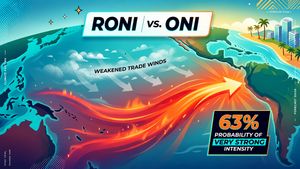 The Pacific is heating up, and traditional metrics just don't cut it anymore.The image depicted is a visual representation for illustrative purposes and does not contain actual scientific data.
Future-Proof Your Vibe: Stay Informed!
Don't just scroll past this—bookmark NOAA's Climate Prediction Center and the WMO's updates. Understanding the RONI framework, rather than outdated ONI baselines, is your secret weapon for anticipating real-time weather shifts and protecting your energy from the unexpected [11].
Coastal Chaos & Marine Meltdowns: The Ocean’s Other Canon Event 🌊
While the Pacific is heating up, our coasts are facing a double whammy—it’s not just El Niño; it’s marine heatwaves (MHWs) too! Global MHW aerial coverage is projected to hit an unprecedented 40% to 45% during Q3 2026 [14]. One monster anomaly, NEP25A, is chilling (or rather, not chilling) across 5,000 miles of the Northeast Pacific, pushing sea surface temps up to 4°F above normal [14]. Unlike historical cycles, this warm-water pool stubbornly held on through La Niña and is now re-intensifying with El Niño’s arrival [15]. The ecological consequences? Major disruptions to marine food webs and fish populations doing a rapid northward exodus [16]. Commercial squid landings in California? Collapsed by more than half, while Oregon and Washington are suddenly squid central [16]. Wild, right?
But wait, there’s more drama for our coastal communities! Eastward-traveling Kelvin waves are raising sea levels along the West Coast, pushing high tides and strong surf much further inland [10]. This is triggering a severe escalation in high tide flooding, made even worse by decades of baseline sea level rise. On the East Coast, the altered jet stream is steering severe storms straight into the Mid-Atlantic, leading to frequent storm surge events [10]. Dr. William Sweet, a NOAA oceanographer, perfectly described this as a “double whammy”: decades of sea level rise making waters “close to the brim,” and now El Niño delivering “more frequent, deeper and widespread high tide flooding” [10]. Your beachfront aesthetic might need a serious rethink, sis.
Secure Your Shoreline: Level Up Your Coastal Prep!
If you're living coastal, it's time to get proactive. Look into automated backflow prevention valves for stormwater and check NOAA's Coastal Inundation Dashboard. Seriously, knowledge is power when the tides are turning against you.
Monsoon Mayhem & Agricultural Anxiety: South Asia’s Struggle 🌾
Okay, let's talk about a real hidden gem of an edge case: South Asia’s agricultural sector. This region is about to get hit hard by the atmospheric coupling of the 2026 El Niño [17]. The India Meteorological Department (IMD) is predicting total southwest monsoon rainfall at only 90% of the Long Period Average (LPA) [18]. This isn't just a number—it’s the lowest projected rainfall volume in 11 years, directly threatening primary kharif crop yields [18]. Seventy percent of the region’s annual precipitation comes from the monsoon, and it’s critical for replenishing reservoirs and groundwater [19]. A weak start to the season already happened in June, with rainfall running 25% below historical averages [20]. Talk about a rough start!
This deficit is no joke. Farmland without formal irrigation is ultra-vulnerable, with advisory boards recommending delayed crop sowing [19]. Dry soil conditions are going to limit planting acreage for pulses, cotton, and oilseeds [19]. Plus, low monsoon rainfall means super low water storage levels in agricultural reservoirs—we're talking just 28.28% of live capacity in early June 2026 [17]. This threatens both current kharif crops and future winter-sown rabi crops due to diminished soil moisture and restricted irrigation [17]. While the Indian Ocean Dipole (IOD) might offer some mitigation by enhancing moisture transport [21], its ability to offset El Niño's drying effect is highly uncertain [20]. As veteran meteorologist M. Rajeevan put it, the atmospheric changes are already happening, and the impact is being felt [9]. This is a common misconception: people often focus only on direct temperature, but rainfall patterns are just as, if not more, critical for global food systems.
Boost Your Resilience: Support Sustainable Farming!
For us, this means thinking about our food sources and supporting sustainable agriculture. Globally, this intel screams for investment in micro-irrigation systems and drought-tolerant seeds, especially in vulnerable regions. It’s all interconnected, bestie.
Gridlock & High Bills: Your Summer Energy Aura is At Risk 💡
Alright, let’s talk about something that hits close to home—your wallet and your comfort. The 2026 El Niño isn't just a weather event; it's an energy crisis in the making [3]. Persistent heating is driving global electricity demand to historically unprecedented levels. In India, power consumption is projected to soar 6-7% year-on-year, hitting 1,810 to 1,830 billion units (BU) in fiscal year 2027 [23]. This is directly linked to prolonged heatwaves pushing peak power demand to a record 271 GW [23]. My mind? Blown.
This massive load spike is absolutely crushing thermal generation assets, which still provide the bulk of grid power [23]. Coal-fired power stations accounted for 68.25% of total generation, leading to a rapid drawdown of fuel stockpiles—national coal inventories dipped to just 16 days' worth of fuel, way below the 21-day safety margin [23]. Simultaneously, hydrological drought is messing with key hydropower reserves; states like Kerala are seeing reservoir capacity at just 21% [22]. This forces regional utilities to buy high-cost energy from the central grid, sending real-time spot market prices up by 21.1% [23]. In the US, average summer cooling costs are projected to jump 10.5% in 2026, hitting $792 per household [5]. We’re talking $25 billion in total residential utility debt, with high-demand regions facing rolling blackout risks [7]. The Crisil Intelligence Report from 2026 literally confirms this El Niño effect on power demand [23]. This is an edge case most people overlook until their AC bill lands or the lights go out: the direct, economic impact of climate on infrastructure.
 Battling high bills and grid strain starts with smart home tech.The image depicted is a visual representation for illustrative purposes and does not contain actual product features or data.
Guard Your Grid: Master Energy Efficiency!
Don’t be a victim of the summer energy crunch. Get smart about your energy use now. Think smart thermostats, optimizing peak hours, and staying updated on local utility programs to save cash and keep your chill when everyone else is sweating.
Cooling Hacks & Chill Zones: Master Your Microclimate 🚀
So, how do we actually survive this extreme summer weather and protect our precious human health? It’s not just about what the thermometer says; it's about the Wet Bulb Globe Temperature (WBGT) [4]. This is a game-changer, integrating temperature, wind speed, solar radiation, and humidity to accurately gauge actual human heat stress [4]. In super humid environments, your sweat literally can't evaporate fast enough to cool you down, leading straight to heat exhaustion [26]. Academic and athletic associations are already mandating WBGT safety standards, restricting outdoor activities when readings spike [4]. This is a crucial, often ignored technical nuance—it’s not just how hot it feels, but how effectively your body can cope.
Beyond staying indoors, we've got some serious hacks for optimizing our personal microclimates. Smart thermostats are your bestie; they can save 8-15% on cooling bills by automating setback temperatures [27]. Plus, many utilities offer incentives for enrolling your devices in peak-demand reduction programs [28]. But for a true glow-up in home efficiency, consider passive design upgrades. Reflective cool roofs? They can bounce back 60-90% of sunlight, keeping your roof up to 50°F cooler than traditional dark surfaces [24]. And yes, there are federal tax credits under the Energy Efficient Home Improvement program to help offset those costs [29]. Dr. Yuri Hosokawa, a sport sciences expert, explains the physiological breakdown under extreme thermal stress: “Your body starts to really fall apart, you lose the ability to cool off fast enough” [25]. We don't want that for our main characters, do we?
Optimize Your Oasis: Smart Cooling for Maximum Chill!
Install an ENERGY STAR certified smart thermostat and consider cool roof coatings. These aren't just eco-friendly moves; they're essential for battling peak heat, saving money, and ensuring your personal space stays a sanctuary, even when the world outside is melting.
The 2026 El Niño Endgame: What Now, Main Character?
So, we’ve unboxed the 2026 El Niño, from its deep Pacific origins to its ripple effects on our electricity bills and even our ability to go outside for a jog. This isn't just about meteorology; it's about being strategically prepared for a summer that’s shaping up to be a true test of resilience. We've talked about the critical shift from ONI to RONI in climate tracking [11], the unexpected impact of marine heatwaves on coastal ecosystems and fishing industries [16], the precarious state of South Asian monsoons and agriculture [17], and the very real threat of surging utility costs and potential blackouts across global grids [5]. These are not just headlines; they are the backdrop to our daily lives this coming season.
The core takeaway? We are living through a significant climatic event, and our old playbooks simply won’t cut it. This isn’t a moment for passive observation; it’s a call to action. From upgrading your home’s energy efficiency with smart tech and cool roofs [24], to understanding your body’s true limits under heat stress using WBGT metrics [4], every step you take makes a difference. This summer, let's embody that 'main character energy' by being informed, proactive, and resilient against the extreme weather El Niño is bringing. Because honestly, who wants their summer vibe ruined by a heat dome? Not me, and not you!
Your Ultimate 2026 El Niño Action Plan: Stay Ahead of the Curve!
Review your personal and home preparedness plans. Invest in smart energy solutions, monitor local weather advisories—especially WBGT—and stay hydrated. This is your moment to adapt and thrive, not just survive, through the intense summer ahead. Your future self will thank you!
Trending Now: Your Hot Takes on 2026 El Niño Extreme Weather
What is the difference between RONI and ONI in 2026 climate tracking?
How do coastal upwelling zones buffer the impacts of marine heatwaves?
Can the Indian Ocean Dipole mitigate the drying effects of El Niño in South Asia?
Why are real-time electricity markets experiencing extreme price volatility in 2026?
What regulatory changes govern outdoor physical activities during the 2026 heatwaves?
Disclaimer: This article addresses trending topics and current events for general informational purposes only. The content may reflect public interest or opinion and has not necessarily been independently verified. Images and visuals are illustrative and may not depict real or official events. For complete details, please review our full disclaimer.