The Ultimate Vibe Check: Unpacking the Best Minecraft & Roblox Crossovers of 2026! 🔥
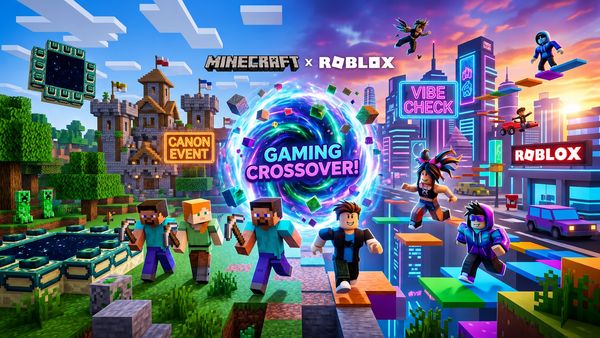 The ultimate vibe check: Minecraft and Roblox are merging in 2026, creating epic new gaming experiences!Image for illustrative purposes only, depicting a conceptual fusion of Minecraft and Roblox aesthetics.
Okay, so listen up, because I’m about to drop some serious knowledge on what’s actually popping off in the gaming world right now. Forget everything you thought you knew about Minecraft and Roblox staying in their own lanes—because in 2026, those lanes? They’ve merged into a superhighway of pure, unadulterated gaming genius. We’re talking about a vibe shift so monumental, it’s a total Canon Event for the entire UGC ecosystem. Are you ready for the rundown?
Here’s what’s blowing up: The structural walls that used to keep Minecraft and Roblox separate are, like, actively disintegrating. It’s not just a trend; it’s an unprecedented ecosystem merger driven by shared developer frameworks, massive cross-platform integrations, and high-profile events like UGCon 2026 [1]. This isn't just about cool new games; it’s about a fundamental redefinition of how we play, create, and even monetize our digital lives. It’s giving main character energy, but for entire gaming platforms.
Voxel Mechanics: When Roblox Started Speaking Minecraft’s Language 💀
Alright, let’s get into the nitty-gritty. The old-school idea that voxel builders and scripting platforms were totally different species? That’s officially canceled in 2026. Developers aren't just copy-pasting aesthetics anymore; they’re doing full-on mechanical ports of iconic Minecraft mods straight into Roblox’s Lua environment [5]. This structural convergence isn't just a flex; it's generated some of the most trafficked multiplayer experiences ever. It’s like, why choose one when you can have the best of both worlds, right?
One of the biggest glow-ups? BedWars by Easy.gg. If you’ve been living under a rock, this is a super competitive combat title that’s basically a direct descendant of Minecraft’s legendary Hypixel Bedwars [6]. By mid-2026, this game had racked up over 11.36 billion lifetime visits on Roblox [6]. Wild, right? But here’s the tea: Easy.gg tried to pull a fast one, launching BedWars 2 on their own indie platform, Airship, in February 2026. Spoiler alert? It flopped harder than a pancake, shutting down by May 4, 2026 [6]. This is a prime example of how crucial a platform's built-in social and matchmaking tools are—you can't just port the game; you need to port the community.
 Roblox games are now integrating complex Minecraft voxel mechanics, blurring the lines between platforms.Image for illustrative purposes only, depicting a conceptual integration of voxel mechanics in Roblox.
Optimize for Community Integration
UGC studio directors should focus on porting high-retention game mechanics rather than simple aesthetic assets, ensuring that core gameplay loops leverage the built-in social and matchmaking tools of the target platform to secure early traction [5].
Collaborative Voxel Sandboxes: Blockate’s Big Brain Move 🧠
While BedWars was doing its thing, Blockate on Roblox was quietly becoming the ultimate collaborative building simulator. It’s literally replicating Minecraft’s classic block-placement and material-editing loops, but with a Roblox twist [8]. And get this: in mid-2026, Blockate dropped a massive physics and shapes update, adding 21 custom shapes and direct image aliases [8]. This isn't just about making pretty pictures; it’s about giving creators unprecedented flexibility, fostering a niche community that hosts epic collaborative build events and even virtual tributes to sandbox legends [9]. It’s a whole new level of creative freedom, and honestly, the aura is immaculate.
The real flex here is how these hybrid studios are scaling, catching the eye of major entertainment and toy conglomerates. They’re all looking to cash in on that high-retention gameplay. Ed Barton, VP of Games and Interactive at Moonbug Entertainment, even said, "The next billion-dollar Roblox company is probably in this room" at UGCon [1]. That’s not just talk; it’s a signal that direct-to-creator licensing is replacing those old, clunky agency models as game studios get seriously professional.
Embrace Creative Flexibility
Developers should leverage advanced building tools and direct image aliases within collaborative platforms to enhance creative flexibility and foster strong community engagement through unique events [8].
Skyblock Showdown: Islands vs. Scarcity ⚔️
Okay, let’s talk about a real Canon Event in the UGC world: the battle of the floating islands. We’re comparing Minecraft Skyblock and Roblox Islands, and trust me, the differences are not subtle. Minecraft Skyblock, the OG created by Noobcrew in 2011, is all about that extreme mechanical scarcity. You’re manually generating cobblestone with lava and water physics [11]. It’s a grind, but it’s the grind.
Roblox Islands by Easy.gg? It’s a whole different vibe. They flipped the script, going all-in on automation with crop totems, industrial conveyor belts, and massive multiplayer trade hubs [6]. It plays more like a factory tycoon than a survival challenge. This mechanical divergence sparked one of the most intense intellectual property battles in UGC history. Noobcrew tried to trademark "Skyblock" in 2019 after unauthorized copies on the Minecraft Marketplace started raking in millions [12]. But Microsoft and its publishers were like, "Nah, that’s generic," and filed an opposition [12]. The financial disparity here is wild: Noobcrew’s free map got 12 million downloads, but rival copies made publishers like Razzleberries an estimated $2.2 to $4.4 million [12]. The USPTO sided with Microsoft on May 11, 2026, declaring "Skyblock" descriptive and stripping Noobcrew of exclusive naming rights [12]. Ouch. This is a major edge case that highlights the precarious position of independent creators.
This landmark ruling sent shockwaves through the entire UGC dev community. It’s a wake-up call: if you’re a creator, you need to establish independent corporate entities to protect your IP. Bruce Blair, Project Director at Ziax, put it perfectly: "We went from small ragtag groups on the fringes of the gaming industry to now running our own conferences, by UGC creators, for UGC creators, all while supporting the careers of tens of thousands of people" [1]. That’s growth, baby!
Protect Your IP Proactively
UGC developers must register explicit trademarks for unique brands before launching experiences, avoiding generic terminology that platform owners can legally claim as descriptive or open-source [12].
Corporate Consolidation: The Money Moves of 2026 💰
The UGC gaming sector? It’s not just a hobbyist playground anymore. It’s a highly structured arena for private equity and corporate consolidation. Big publisher networks are straight-up buying out mature, top-tier game worlds to build diversified multi-game portfolios [13]. This isn't just about getting bigger; it’s about a massive influx of institutional capital that’s totally reshaping how developers monetize and scale their experiences [13]. It’s a whole new game, literally.
The biggest flex of this era? Voldex acquiring Brookhaven RP from Wolfpaq in February 2025. This deal, estimated to be over $100 million and backed by Raine Group and Shamrock Capital, boosted Voldex’s portfolio to more than 145 million monthly active users [13]. And what did Voldex do next? They leveraged their advanced live-ops platforms to drop massive commercial partnerships, including immersive campaigns with NBCUniversal and the LEGO Group [13]. That’s how you turn a viral hit into a global phenomenon.
It’s not just Anglo-Saxon conglomerates, either. European multi-platform developers are getting that venture backing too. French-Vietnamese studio Rivrs, led by Romain Hubert, snagged €4 million from Pléiade Venture to scale their cross-platform pipeline [15]. Rivrs is out here running over 70 games across Roblox and Minecraft, with over 100 million combined visits [15]. This proves that professionalized game development across competing sandboxes isn't just possible; it’s thriving. Venture funds are targeting these pre-existing, high-traffic worlds because building games from scratch on Roblox has become super unpredictable and capital-intensive. Acquiring proven hits means instant data tracking and monetization of a massive player base. Alex Singer, Founder and CEO at Voldex, said it best: "This acquisition is transformational for Voldex" [14].
Strategize for Institutional Appeal
Independent developers should design their games with institutional transferability in mind, establishing clean corporate structures and integrating comprehensive data analytics to attract potential acquisition offers [13].
Minecraft’s Brand Integration Envy: Why Roblox is the Blueprint 🗺️
Okay, let’s talk about a common misconception: that Minecraft is just chilling, doing its own thing. Nope! Minecraft developers are hitting a wall with growth because of the platform’s super restrictive brand integration guidelines. While Roblox and Fortnite creators are out here signing lucrative, independent sponsorships and partnering directly with major corporations, Minecraft builders are stuck with platform-wide licensing deals curated by Microsoft [3]. This policy has a lot of advanced studios feeling left behind, and honestly, it’s motivating them to migrate their resources to other engines [3]. It’s a major edge case that could seriously impact Minecraft's long-term creator retention.
The structural disparity in brand autonomy is glaring. On Roblox, developers are the main characters, negotiating directly with brands. That’s how studios like Voldex land massive integrations with NASCAR and Universal [13]. Minecraft, on the other hand, has always been super conservative, relying on Marketplace purchases and subscriptions [3]. Creators are arguing that this cautious approach is stifling innovation and stopping Minecraft from unlocking its full commercial potential [3]. It’s a vibe killer, for real.
But there’s a glimmer of hope! The global creator community is laser-focused on Matthew Ball’s appointment as Xbox’s Chief Strategy Officer in 2026 [3]. Ball’s extensive writings on the economics of Roblox and Fortnite have given Minecraft creators a major boost of hope that Microsoft will finally reform its rigid brand policies [3]. Builders are saying that cutting out Microsoft as the middleman would let them cultivate direct brand relationships and scale their businesses sustainably [3]. Rafael Fritsche, Co-founder at Spark Universe, said, "having leadership at Microsoft that is excited about UGC could be really good for Minecraft, both within the Xbox ecosystem as a whole, but also within its own organization" [3]. It’s a whole mood.
Advocate for Direct Brand Deals
UGC studio heads should actively lobby platform operators for direct-to-brand licensing rights, using comparative economic data from Roblox to demonstrate how open sponsorships increase long-term platform retention and developer loyalty [3].
UGCon 2026: The Creator’s Canon Event 🚀
The UGC landscape has officially leveled up, and with that comes the rise of independent, platform-agnostic developer conferences. Remember when creators were stuck in platform-specific events like Minecon or RDC [1]? Not anymore! In 2026, developers are building their own professional networks to share insights and navigate the ever-shifting creator economy [1]. It’s a total power move.
This structural shift hit its peak on May 21 and 22, 2026, when 230 top-tier creators from Fortnite, Roblox, and Minecraft descended upon Topgolf Las Vegas for the inaugural UGCon [1]. Organized by Makeshift, led by Trent Hensler and Ben Sarraille, the conference was all about empowering creators over those pesky intermediary agencies [1]. Industry veterans were there, dissecting critical mechanics, like how to align Roblox development with Minecraft’s long-standing multi-year server retention strategies [4]. This cross-pollination of operational intelligence is a game-changer, allowing developers to hedge their platform-specific risks by building diversified, multi-engine game portfolios [4]. It’s strategic, it’s smart, and it’s giving big boss energy.
A major focus? Roblox’s recent algorithm adjustment, which shifted discovery parameters to prioritize 28-day retention over short-term 7-day spikes [4]. Minecraft developers were quick to point out that this mirrored their own server designs for sustaining audiences over years [4]. This kind of shared insight is invaluable. By bypassing traditional middleman agencies, UGC creators are forging direct relationships with major entertainment brands and licensing bodies. This direct-to-creator pipeline is accelerating the transformation of viral digital properties into global entertainment franchises. Andrew Bereza, Director of Business Development at Twin Atlas, said UGCon was "incredibly valuable for us" [1]. It’s a whole new world, and creators are leading the charge.
Network Directly for Growth
UGC studio leads must establish direct connections with intellectual property holders at cross-platform summits, leveraging their high-retention metrics to secure native brand integrations without paying high intermediary fees [4].
Player Demographics & Monetization: The Real Numbers Game 📊
Let’s bust a common misconception right now: the idea that sandbox networks are just for little kids? Totally debunked by 2026 data [16]. While Roblox used to skew younger, a whopping 44% of its active player base is now over 17, showing some serious long-term user retention [16]. And Minecraft? The average player age is around 24, with 15 to 21-year-olds making up the largest segment at 43% [17]. We’re all growing up with these games, and it’s beautiful.
The monetization pathways? They’re totally different, which dictates how dev studios structure their pricing. Minecraft is mostly a buy-to-play model, selling over 350 million units globally, plus those Bedrock Marketplace microtransactions [17]. Roblox, on the other hand, is free-to-play, powered by Robux microtransactions, pulling in an average revenue per daily active user (ARPDAU) of about $0.03 across its 132 million daily players [7]. It’s a fascinating contrast, and understanding these nuances is key to success.
Mobile is the absolute gateway for both platforms, driving global reach like crazy [17]. Mobile gameplay accounts for 46% of Minecraft’s active players, while Roblox’s mobile edition boasts a massive 129.7 million monthly active users [17]. Geographically, Asia-Pacific is Roblox’s biggest audience hub with 43 million daily active users, but the U.S. still holds it down for Minecraft [7]. These digital networks aren't just games; they’re global lifestyle brands, generating massive real-world merchandise revenues through extensive licensing partnerships across fashion, electronics, and home products. Hanna Willis, Head of Consumer Products at Minecraft, said, "'Minecraft's' global licensing program continues to flourish, and we're thrilled to welcome such a diverse array of new partners" [20]. It’s a whole empire, and we’re just living in it.
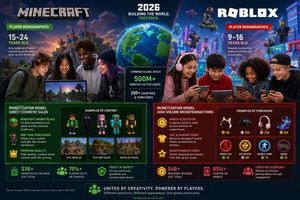 Understanding the evolving player demographics and distinct monetization strategies of Minecraft and Roblox in 2026 is crucial for developers.Image for illustrative purposes only, depicting conceptual player demographics and monetization models.
Tailor Monetization to Demographics
UGC studio analysts must tailor their monetization loops to match platform-specific demographic realities, prioritizing direct cosmetic sales for Minecraft's older user base while utilizing high-volume microtransactions for Roblox's mobile-first audience [17].
Cross-Media Adaptations: Hollywood’s Voxel Obsession 🎬
Okay, so the financial success of sandbox games has officially caught Hollywood’s eye, and they’re coming for that Gen Alpha demographic [21]. The Minecraft Movie, which dropped in April 2025, grossed nearly $1 billion worldwide, becoming the fifth-highest-grossing film of the year [21]. That’s not just a movie; it’s proof that user-generated and block-based IP can pull in serious box office numbers. It’s a total game-changer for how studios view digital content.
And Roblox? Hollywood is already adapting Roblox-native IP for the big screen [21]. Story Kitchen is developing a feature film based on the viral Roblox game Steal A Brainrot, which hit a staggering 25.8 million concurrent players in October 2025 [21]. This isn't just about movies; it’s a major vibe shift where Roblox acts as both a primary marketing vehicle and a source of original cultural IP [21]. It’s a whole new level of synergy.
UGC platform-native studios are even using in-game events to cross-promote cinematic releases, completely bypassing traditional advertising [21]. Rivrs, for example, partnered with PAN Européenne to deploy a persistent RPG on Roblox to support the release of The Legendaries, racking up 1 million visits in its opening week [22]. This seamless integration of gameplay and cinematic marketing is redefining how media companies connect with younger audiences [22]. As these multimedia projects blow up, the creators behind the original digital worlds are gaining serious leverage in negotiations with major studios. Trent Hensler, Co-founder at Makeshift, emphasized, "Everything we do is about platforming creators" [1]. It’s about time creators got their flowers, right?
Build Narrative Depth for Media Potential
UGC studio executives should build narrative depth and recognizable characters into their games early on, positioning their digital intellectual property for future theatrical licensing opportunities [21].
The Grand Synthesis: What’s the Vibe for the Future? 🔮
So, what’s the takeaway from all this? The user-generated content landscape in 2026 has hit a definitive crossroads [2]. The structural merger between Minecraft and Roblox mechanics isn't just a cool phenomenon; it proves that player engagement thrives on platform-agnostic gameplay loops [4]. To truly succeed, studio executives need to evolve from those isolated hobbyist designs to robust, corporate-backed developments that can scale across multiple platforms [13]. It’s not about picking a side anymore; it’s about building bridges.
The future is hybrid, interconnected, and creator-driven. We’re seeing a shift from closed ecosystems to open, collaborative environments where innovation is king and creators are finally getting the recognition—and the monetization—they deserve. This isn't just about games; it’s about the future of digital culture itself. Get ready, because the next few years are going to be absolutely wild.
Diversify Your Development Strategy
Establish a diversified development architecture that leverages the unique structural advantages of both Roblox and Minecraft to maximize long-term audience retention [4].
Games: Your Top Questions on Minecraft & Roblox Crossovers Answered!
What is the monthly player count of Minecraft and Roblox in 2026?
Why did Easy.gg shut down BedWars 2 shortly after its launch?
How do Roblox Islands and Minecraft Skyblock mechanics compare?
What was the final ruling in the Skyblock trademark opposition case?
Why did Voldex acquire the Roblox game Brookhaven RP?
Disclaimer: This article explores gaming topics for informational purposes only. Strategies, opinions, and experiences are subjective and may not apply universally. Images may be illustrative or inspired and do not represent official game assets or copyrighted material. For additional context, please consult our full disclaimer.