
Mobile Esports Reign Supreme: A 2026 Deep-Dive into the Global Arena
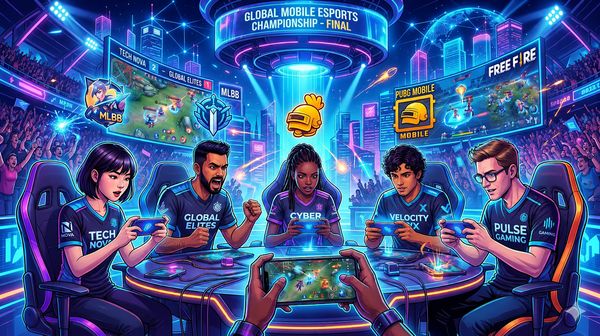 The global stage is set: mobile esports is not just growing, it's defining the future of competitive gaming.This image is an artistic representation of the future of mobile esports and does not depict actual gameplay or specific individuals.
Okay, real talk: if you’re still sleeping on mobile esports, you're missing the biggest Canon Event in competitive gaming history! 🔥 What used to be seen as just a casual swipe-and-play pastime has absolutely blown up into a multi-billion dollar empire, pulling in millions of eyeballs and generating cash flow that would make even a crypto bro blush. And here’s the secret sauce—it’s not just about convenience. The insane glow-up in affordable, high-performance smartphones in emerging markets has completely democratized competitive gaming. We’re talking about a foundational shift in who gets to play and who gets to watch, an absolute vibe shift that nobody saw coming. 🚀
We’re diving deep into a world where Mobile Legends: Bang Bang (MLBB), PUBG Mobile, and Free Fire aren't just holding on; they’re thriving, setting records, and building competitive ecosystems that put some PC and console giants to shame. This isn't just a trend; it's the future. So, buckle up, because we're about to spill the tea on the top titles, the economic forces fueling their fire, the tech innovations making it all possible, and the wild, often overlooked details that define their insane success.
Before we go full send, let’s clear up a common misconception that's been messing with the data: people often conflate MLBB's reported 1.5 billion 'downloads' with simple app-store installs. That’s a major misread of its true reach, fam! 💀 While AppMagic tracks around 601 million app-store downloads, Moonton's 1.5 billion figure actually includes third-party Android stores and regional carrier platforms—channels that are HUGE in Southeast Asia but totally invisible to standard trackers [5]. This is a crucial 'edge case' that shows us just how deep mobile gaming's global footprint really goes, especially in regions with wildly diverse app distribution systems. Mind. Blown. 🤯
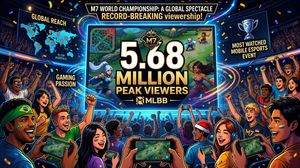 MLBB's M7 World Championship shattered viewership records, proving mobile esports' undeniable global appeal.This image is an artistic representation based on reported viewership figures and not a live broadcast.
MLBB: The Undisputed Viewership King — No Cap!
Let's be real, MLBB has been rocking the crown as the most-watched mobile esports game globally for years, but in early 2026, its lead didn't just grow—it became an absolute chasm. The M7 World Championship Grand Finals, that epic showdown between Alter Ego and Aurora Gaming PH, pulled in a mind-boggling 5.68 million peak concurrent viewers in January 2026 [1]. That’s not just a record for mobile esports; it’s the highest number ever recorded for any mobile esports event, full stop. Esports Charts even confirmed it shattered six separate esports records simultaneously [1]. Talk about a flex!
And here’s the real kicker, the part that gives this achievement serious aura: MLBB snagged third place across all esports titles in 2025—not just mobile—outshining a ton of established PC and console legends, even without its M-Series main event that year [4]. In 2025, MLBB racked up 434 million total Hours Watched across all tournaments, leaving every other mobile title in the dust [4]. Both MPL Indonesia seasons in 2025 each clocked over 100 million hours watched [5]—a milestone only 14 esports events in history, across any game, have ever hit! 🤯
The game has amassed over 1.5 billion lifetime installations in 139 countries as of January 2026, with a massive monthly active user base of 110 million [1]. Its in-app purchase revenue is on the come-up too, hitting $194.99 million in 2024 after a small dip [5]. This consistent growth? It’s proof of serious engagement and monetization power.
"Mobile Legends: Bang Bang ranked as the third most-watched esports title across the entire industry [in 2025], outperforming a wide range of PC and console esports staples."
Now, for a crucial 'edge case' that fuels MLBB's reign: the 'Philippine Dominance Factor.' Filipino teams have snatched up six consecutive M-Series World Championships, a streak that’s been unbroken since 2021 [5]. Aurora Gaming PH’s 4-0 sweep in M7 was the first clean sweep since M3. This regional concentration? It’s both MLBB’s secret weapon, igniting insane national pride and viewership spikes, and a low-key structural risk if that Philippine competitive ecosystem ever loses its juice. It’s a double-edged sword, for sure.
What’s next? The M8 World Championship is already locked for Turkey in January 2027 [5]—marking the very first M-Series event in Europe and signaling a calculated move for global expansion. Plus, a fresh Championship Tour is being piloted across the Americas, East Asia, and Southeast Asia, alongside a franchised MPL Malaysia model with eight locked-in strategic partners [5]. Get ready for MLBB to truly go global. 🌍
Optimize Your Sponsorship Strategy:
For brands and content creators, MLBB’s MPL Indonesia and MPL Philippines are currently the highest-ROI sponsorship properties in mobile esports, measured by hours-watched per dollar. Seize the significant arbitrage opportunity by investing early in the new Americas and East Asia circuits before franchise fees inevitably escalate. This is a prime first-mover advantage, trust.
PUBG Mobile: The Battle Royale Behemoth — Still Hitting Different
Since its drop in March 2018, PUBG Mobile has cemented its legendary status as a battle royale behemoth, racking up an insane 1.75 billion downloads and generating over $15 billion in lifetime revenue [6]. As of June 2025, it still boasts a robust 112.9 million monthly active users, with daily active users chilling around 24.3 million [6]. And when you factor in its regional variants—Game for Peace in China and BGMI in India—the combined daily player count explodes past 90 million [6]. That’s just wild!
In the 2026 prize pool rankings, PUBG Mobile holds the fifth spot across all esports titles globally, flexing an impressive $114.27 million in all-time prize money distributed [7]. The year 2024 alone saw $16.5 million dished out across 283 tournaments [8]. Offline PUBG Mobile tournaments in 2025 also contributed a hefty $14.96 million in prize money, with the PUBG Mobile Super League Americas Spring 2025 in São Paulo offering a cool $200,000 prize pool [6]. We love to see it!
Here's a crucial 'technical nuance' that’s a real head-scratcher: the 'China Revenue Paradox.' PUBG Mobile is officially banned in China, but Tencent operates "Game for Peace" as its replacement. The kicker? Game for Peace actually has more daily players (50 million) than PUBG Mobile (30 million), meaning the "banned" version is bigger in terms of daily engagement [9]. China actually accounts for 69% of global PUBG Mobile player spending, even though the original game isn’t available there [6]. This ban-and-replace strategy is a unique Tencent flex, unmatched by other publishers.
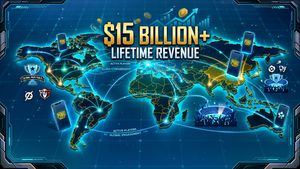 PUBG Mobile continues to be a dominant force, influencing global gaming economies with its massive player base and prize money.This image is an artistic interpretation of PUBG Mobile's global statistics and revenue.
And let’s not forget the 'India Ban Aftermath'—a critical 'edge case.' The 2020 India ban on PUBG Mobile seriously impacted global download numbers. While BGMI (Battlegrounds Mobile India) dropped as a replacement in 2021, it’s been living under a cloud of regulatory uncertainty ever since. This fragmentation means PUBG Mobile's "global" player data consistently undercounts the Indian subcontinent, which has historically been one of its biggest markets [6]. We’re talking about a massive audience that's often invisible to the broader stats.
The PUBG Mobile Global Championship (PMGC) 2025 in Kuala Lumpur hit a peak concurrent viewership of over four million across YouTube and AfreecaTV [9]. The PUBG Mobile esports scene is ready for even more growth in 2027, with a packed schedule and $7 million in prize money already on the table [9]. But hold up, there’s a nuance: PUBG Mobile saw a 65% drop in Twitch viewership between Q1 2022 and Q2 2024 [6]. Meanwhile, competitors like MLBB and Free Fire gained streaming audience share. This strange split between booming live attendance and dipping streaming numbers is wild for esports and suggests PUBG Mobile's fans are more about the live event experience than just watching from home.
Monitor Regulatory Shifts:
Investors and tournament organizers, listen up! Keep a close eye on BGMI’s regulatory developments in India. A stable resolution could trigger a massive viewership and revenue resurgence. The Indian market, with its 1.4 billion people and insane smartphone adoption, is the single largest untapped growth opportunity in global mobile esports, no cap.
Free Fire: The Global South's Competitive Champion — Unmatched Reach!
Garena’s Free Fire? It’s got a flex that few games can claim: it was the most downloaded mobile game in 2019, 2021, 2023, and 2024. Not only that, it’s been the most downloaded mobile battle royale for six consecutive years straight, according to Sensor Tower App Performance Insights [11]. This download dominance is heavily concentrated in the Global South—think Latin America, South and Southeast Asia, the Middle East, and Africa—exactly where mobile infrastructure is blowing up the fastest. Coincidence? I think not!
Free Fire's 2025 competitive season was a testament to its resilience and evolution. The latest Free Fire World Series (FFWS) Global Finals became the most-watched edition in three years, pulling in 775,141 peak concurrent viewers [4]. The introduction of Clash Squad Mode in 2025 spiced up the competitive format, and Bangladesh re-entering the global ecosystem gave a noticeable boost to viewership in South Asian languages like Bengali and Hindi [4]. That’s what we call catering to your audience!
For 2026, Garena just dropped an expanded roadmap: global events are leveling up from 18 to 24 teams, welcoming even more emerging regions. A brand new standalone Clash Squad tournament is set to debut, independent of the FFWS system. Plus, Free Fire is making a grand return to the Esports World Cup 2026 in Riyadh (July 15–18), with the FFWS Grand Finals slated for Bangkok, Thailand, in November [11]. Get ready for an even bigger spectacle!
Here’s the 'edge case' that explains Free Fire’s absolutely massive reach: its 'Low-Spec Advantage.' This game was literally built to run smoothly on devices with as little as 1GB of RAM [11]. This genius technical decision unlocked colossal markets in sub-Saharan Africa, South Asia, and rural Southeast Asia, where those fancy flagship smartphones are just not in everyone’s budget. No other major esports title has systematically optimized for entry-level hardware as a core competitive strategy. This 'low-spec first' philosophy is the secret sauce behind its six years of download dominance in markets where PUBG Mobile and MLBB struggle to even get a foothold.
And let’s squash another common misconception: don't just dismiss Free Fire as some 'lesser' PUBG clone. In reality, its peak concurrent tournament viewership in 2025, heavily fueled by Brazil, Indonesia, and Bangladesh, proves it has a totally distinct global audience that barely overlaps with PUBG Mobile’s predominantly Chinese player base. They're playing on different fields, literally and figuratively.
Target Underserved Audiences:
Media companies and streaming platforms scouting for untapped mobile esports audiences should prioritize Free Fire content in Portuguese (Brazil) and Bengali (Bangladesh). These two high-growth viewer segments are systematically underserved by existing English-language esports media, presenting a ripe opportunity for engagement. It's an open goal, people!
Honor of Kings: The Revenue Giant Chasing Westward — Low-Key Powerhouse
Honor of Kings is giving us major paradox vibes in the global gaming scene: it's one of the highest-grossing games _worldwide_, yet in Western esports media, it often gets crickets. This game dropped prize pools exceeding $20 million in 2024 across 85 tournaments [8]. Its most-viewed event, the 2025 Invitational Season 3, peaked at over 380,000 viewers [8]. Why is no one talking about this?
While its esports scene was a bit quiet between 2017 and 2023, it has since absolutely exploded in global relevance. The fact that major Western organizations, like OG Esports, are now jumping into the Honor of Kings competitive scene? That’s not just a casual move; it signals a fundamental shift in publisher Tencent's international strategy [8]. They're making moves, and the West is finally catching on.
Here’s a significant 'technical nuance' that needs to be shouted from the rooftops: the 'Two Game Problem.' Honor of Kings and Arena of Valor are essentially the _same underlying game_—one for mainland China, one for international markets—but they operate as entirely independent competitive ecosystems. And get this: in 2025, Arena of Valor accumulated more than eight times the total Hours Watched of Honor of Kings [4]. This highlights the sheer scale of its international footprint, even though it's active in fewer markets. This bifurcated structure means that when you look at aggregate global viewership for "Tencent's mobile MOBA," it’s systematically undercounted in industry reports that treat these two as separate, unrelated titles. We’re being slept on!
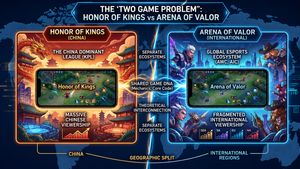 Understanding the 'Two Game Problem' is crucial to grasp Honor of Kings' true global competitive footprint.This image illustrates a technical concept related to Honor of Kings' market strategy and is not a direct representation of gameplay.
The 'Tencent Olympic Partnership' is another powerful 'edge case' that’s about to change the game. Tencent announced a 10-year partnership with the Olympic Council of Asia as the Official Esports Technology Partner [12]. This isn't just a fancy title; this institutional endorsement directly boosts Honor of Kings' legitimacy in crucial markets like South Korea, Japan, and Gulf states, where governmental recognition of esports carries serious commercial weight. It’s a major glow-up for the title.
In terms of global MOBA downloads, Honor of Kings ranked second in June 2025 with 4.8 million installs, which is about 73% less than MLBB’s 8.3 million for the same month [5]. But don’t let that fool you! Its immense strength in China, boasting over 50 million daily users through Game for Peace, means its gross revenue figures absolutely dwarf its Western-visible download data [1]. It’s a quiet giant making major bank.
"Honor of Kings, Genshin Impact, PUBG Mobile, and Clash Royale are no longer oddities at the top of the charts. They are reference products whose update cadences, monetization grammar, and esports ambitions now shape how smaller studios plan a two-year roadmap."
Seize First-Mover Advantage:
Western esports organizations and analysts, you’re underestimating Honor of Kings at your own risk! The Olympic Council of Asia partnership, combined with Tencent’s massive infrastructure, is positioning this title for rapid penetration in the upcoming Asian Games esports segment. Secure partnerships now, before mainstream Western recognition hits, and you’ll gain a disproportionate first-mover advantage. This is your chance to get in early and win big.
Supercell's Two-Title Renaissance: Clash Royale and Brawl Stars — A Comeback Story!
Okay, the journey of Clash Royale in 2025? It’s giving us one of the most compelling, feel-good comeback stories in live-service gaming. After a long period of decline, a strategic rework in October 2024 simplified chest progression and unified evolution currency. This wasn't just a patch; it was a total vibe shift that pulled in an extra 14 million monthly active users by Q3 2025 [13]. Supercell’s CEO even called 2025 a "near-record year" for the company, driven "mostly by an incredible, historic year of Clash Royale" [14]. You love to see it!
Brawl Stars jumped on that same upward trajectory. Its Hypercharge overhaul throughout 2024 allowed it to surpass Clash of Clans in quarterly revenue for the first time in the franchise’s history [13]. And the 2024 Brawl Stars Championship in Helsinki? It absolutely smashed its previous peak viewership record, hitting an incredible 1,103,153 [15]. That’s what we call a glow-up!
Starting in 2026, BLAST, a premier esports tournament operator, has officially taken over the entire Brawl Stars competitive ecosystem through a multi-year partnership with Supercell [16]. This epic collab is launching a global calendar featuring a $2 million total prize pool and 32 broadcast days[16]. It’s a game-changer, for real.
"We need to keep taking big swings. …our shared goal is to make Brawl esports even more accessible for our players while exploring new opportunities for fandom and growth."
The Clash Royale League 2025 World Finals also hit a peak of 698,426 viewers—the highest ever recorded in the game's history [4]. In 2025, three mobile esports titles surpassed one million peak concurrent viewers [4]—a threshold that is still ridiculously hard to hit, even at the highest levels of the industry, according to Esports Charts.
The 'Simplification Principle' is a crucial 'technical nuance' behind both Clash Royale and Brawl Stars' epic recoveries. Their success wasn't about adding more stuff; it was about the _opposite_—"fewer parallel systems, cleaner primary goals on the home screen, and a willingness to remove mechanics that had accumulated during earlier live-service cycles" [13]. This counter-intuitive strategy of feature subtraction, instead of endless additions, totally goes against the old-school mobile game wisdom that screams "more content equals more retention." But the data? It's strongly validating this minimalist, less-is-more approach. Mind. Blown.
Another 'edge case' that's pure gold: the power of 'Word-of-Mouth as a Growth Lever.' Supercell’s CEO explicitly credited organic word-of-mouth as the key ingredient for Clash Royale's insane comeback. "For massive, rapid growth to happen, word-of-mouth discovery has to happen. You and your friends have to talk about the games you're playing," they stated in Supercell's 2026 company blog [14]. Community-driven creator tournaments, where teams just self-organized events, were a measurable driver of 2025 viewership recovery that official broadcast investments alone couldn't have matched [14]. It’s all about the community, baby!
Adopt the Partnership Blueprint:
Publishers lacking robust internal esports infrastructure should see the Brawl Stars + BLAST partnership model—outsourcing competitive operations to specialist tournament operators—as a strategic blueprint, not an exception. This model is likely to become the dominant structure for mid-tier mobile esports titles by 2027. Get on it, don't get left behind.
The Esports World Cup: Riyadh as the New Global Stage — A Game Changer!
The Esports World Cup, hitting Riyadh, Saudi Arabia, every year, has emerged as the single most impactful external catalyst for mobile esports' legit status. The 2026 edition is coming in hot with a mind-blowing $75 million total prize pool, including a $45 million ecosystem commitment [12]—figures that absolutely dwarf any esports spectacle we've seen before. We're talking next-level!
At the 2025 Esports World Cup, MLBB alone generated over 47 million hours watched [5]—that's more than 12% of the total viewership across all 25 participating titles! Free Fire, PUBG Mobile, Honor of Kings, and Brawl Stars all threw down, and the tournament provided a rare, neutral battleground where mobile titles are judged side-by-side with PC and console esports, no prejudice [4]. This is where mobile esports truly proves its mettle.
Now, here’s an important 'edge case' to keep in mind: the 'Viewership Exclusion Problem.' All those viewership figures from Esports Charts and similar services? They systematically exclude Chinese streaming platforms like Douyu, Huya, and Bilibili, because those platforms don't publicly share concurrent viewer data [11]. For titles like Honor of Kings and PUBG Mobile's Game for Peace variant, this exclusion means their actual global concurrent viewers are significantly underreported. The true peak viewership for major Honor of Kings events likely blows past any publicly available figure by a mile. We’re talking a whole other level of hidden engagement.
The Middle East's investment in esports infrastructure isn't just about throwing money at prize pools. Saudi Arabia's Vision 2030 program explicitly makes esports a core part of its economic diversification strategy. We're talking purpose-built arenas, government-backed leagues, and full integration into the national tourism plan. This kind of commitment gives the Esports World Cup a structural stability and long-term vision that no private sponsor, no matter how rich, could ever replicate. It's a Canon Event for the region.
"Esports is no longer just a subculture; it's an industry that influences economies, educates students, reshapes urban spaces, and entertains millions."
Prioritize EWC Engagement:
Teams and publishers not yet plugged into the Esports World Cup ecosystem need to make participation a tier-one strategic priority—not just an optional exhibition. The EWC's broadcast reach, massive prize scale, and government backing make it the de-facto World Cup of esports, and mobile titles are absolutely among its primary beneficiaries. Don't miss this train!
Economic Drivers: The $126 Billion Engine of Mobile Esports — It's Getting Real!
The economic engine powering mobile esports is a force to be reckoned with, truly formidable. Mobile gaming revenue absolutely soared past $126 billion in 2025 and is projected to climb to an eye-watering $140 billion by 2027, according to Statista [3]. While the usual suspects—USA ($25B), China ($40B), and Japan ($18B)—are still top earners, the wildest growth is happening across Asia, Latin America, and the Middle East [3]. This isn’t just pocket change; it’s a global economic earthquake.
Over 3.2 billion people are now vibing with mobile games—that’s more than double the combined player base of PC and console gaming [17]. The average revenue per user (ARPU) hit $95.41 in 2025, a sweet jump from $89.38 in 2021 [3]. Mobile gaming accounted for just over half of global interactive entertainment consumer spending in Q1 2026 [13]. The numbers don’t lie; mobile is where the money is, full send!
Specifically, the mobile esports segment is the fastest-growing platform within the broader esports market, boasting a projected Compound Annual Growth Rate (CAGR) of 27.6% through 2036 [2]. Sponsorships and advertising? They're the fastest-growing esports revenue stream, rocking a remarkable CAGR of 45% [2]. And get this: sponsorships currently inject a significant $1.2 billion into annual esports revenue [12]. The global esports audience is chilling at around 640.8 million viewers, with a whopping 56% of all esports viewing happening on mobile devices [12]. This is massive!
Here’s a key 'edge case' that’s often missed: the 'Freemium Infrastructure Effect.' The collapse of rewarded-video economics and tighter App Store rules in 2022–2023 sent cost-per-install skyrocketing and slashed predictable return-on-ad-spend [13]. The publishers who survived? They adapted, shortening soft launches, shifting to hybrid monetization with modest subscriptions, and building richer retention systems earlier in the player journey. This forced evolution, ironically, strengthened esports titles—which already had deep retention systems—compared to casual game competitors. Talk about a glow-up through adversity!
And let’s clear up a common misconception: people often say mobile gaming, as a whole, is 'flat.' Even Supercell's CEO admitted the market has grown "just 3% per year on average in the last 5 years" at the overall level [14]. But here’s the tea: applying that flat average to esports titles specifically is a huge mistake. MLBB, PUBG Mobile, Free Fire, and Honor of Kings are not flat; they are actively expanding within a mature total market, snatching market share from games that couldn't cultivate sustainable competitive ecosystems. It’s a competitive jungle out there, and these titles are thriving.
"Mobile sits at just over half of the global interactive entertainment consumer spend in Q1 2026, a share that has held broadly stable since 2023 even as console and PC posted recovery quarters through 2025."
Identify Asymmetric Upside:
For my financial analysts and investors out there, the mobile esports segment is one of the few areas within interactive entertainment where the projected CAGR (27.6%) significantly outpaces the parent market’s growth rate (3% aggregate). Portfolio exposure to mobile-first esports publishers and tournament operators offers asymmetric upside compared to PC/console equivalents. This is where the smart money is going!
AI and Emerging Technology: The Invisible Revolution in Competitive Play — The Secret Sauce
The AI takeover in esports? It's not just a sci-fi dream; it’s here, especially "for player training, strategy, and coaching among top teams" [12]. For mobile esports, this is playing out in subtle but profound ways that mainstream coverage often totally misses. It’s the invisible revolution, and it's cooking!
Those slick smartphones we’re all rocking in 2025–2026? They're packing AI-powered processors that can go toe-to-toe with mid-range gaming PCs from just a few years ago [17]. The seamless integration of on-device AI for crucial functions like reducing lag, stabilizing frame rates, and adapting graphics settings means that competitive play on a $300 smartphone is functionally closer to high-end PC esports than ever before. This is a game-changer, leveling the playing field and making top-tier performance accessible to a much wider audience. We love to see that inclusivity!
And cloud gaming is only accelerating this convergence. Services like Xbox Cloud Gaming, NVIDIA GeForce NOW, and PlayStation Remote Play are letting us stream console-quality games directly to our mobile devices [17]. A prime example? Call of Duty Mobile. After its long-anticipated relaunch as Warzone Mobile, it now shares a unified account identity with its console and PC counterparts [13]. This structural shift has huge implications for bringing in new players and ensuring competitive fairness across platforms, paving the way for even more integrated esports ecosystems. It's a true canon event for cross-play.
Here’s a crucial 'technical nuance' that’s seriously boosting mobile esports' legitimacy: 'Controller Adoption.' Call of Duty Mobile, Fortnite, PUBG Mobile, Genshin Impact, and Wuthering Waves? They all support MFi and standard Bluetooth HID controllers with full UI remapping [13]. Plus, the Google Play controller-optimized badge is now popping up on roughly 30% of the premium mobile catalog [13]. This hardware evolution is quietly dismantling that old-school "touchscreen = inferior" argument that’s historically held back mobile esports’ acceptance in Western competitive circles. It's giving us parity!
The 'AI Coaching Asymmetry' is an important 'edge case' to watch. AI-assisted coaching tools are actually more accessible to mobile esports teams than their PC/console equivalents. Why? Because the lower system complexity of mobile games makes replay analysis and build optimization computationally cheaper to automate. This means teams in emerging markets like Indonesia, Brazil, and Pakistan, even with smaller budgets, can leverage cloud-based AI tools to achieve analytical parity with well-funded Western organizations sooner than the industry generally expects. Talk about a power move!
"AI adoption surges in esports for player training, strategy, and coaching among top teams."
Invest in AI Coaching Early:
Mobile esports teams and academies that prioritize investing in AI coaching infrastructure _now_, before these tools become ubiquitous, will establish sustainable competitive advantages over the next two-year cycle. The barrier to entry for such advanced analytical tools is significantly lower for mobile titles than for any other esports format. This is your chance to get ahead of the curve and secure that win-streak aura.
Overlooked Mobile Esports Titles: The Quiet Achievers of 2026 — Hidden Gems!
Beyond the universally recognized giants, there are some mobile games out there diligently building seriously impressive competitive ecosystems, often flying totally under the mainstream radar. These are the hidden gems, the low-key powerhouses of 2026.
Arena of Valor, for instance, in 2025 accumulated over eight times the total Hours Watched of Honor of Kings, despite operating in fewer markets [4]. In fact, AoV finished second overall among all mobile esports titles with 133.6 million total Hours Watched, even surpassing PUBG Mobile [4]! And during the 2025 Southeast Asian Games, Arena of Valor broke the one million concurrent viewer threshold for the first time ever [4]—only the fifth mobile esports title to hit that milestone. This game is quietly crushing it!
Magic Chess: Go Go, an auto-battler set in the MLBB universe, had its inaugural GO1 World Championship pull in more than 290,500 peak viewers [11]. What's even wilder? The championship was won by a Russian player, highlighting the totally unexpected and expansive geographic reach of mobile esports spinoffs. Talk about global domination from unexpected corners!
Clash Royale is still giving us one of mobile gaming’s most successful live-service recoveries, a true masterclass. The October 2024 progression rework, which streamlined chest mechanics, attracted an additional 14 million monthly active users by Q3 2025 [13]. The Clash Royale League 2026 Season 4 is already on the calendar, and the Champions Cup monthly finals are keeping the competitive fire burning through mid-year [7]. The comeback is real!
The 'BGMI Regulatory Wildcard' is a significant 'edge case' for overlooked titles. Battlegrounds Mobile India (BGMI), the India-specific variant of PUBG Mobile, operates under periodic government review. Its temporary ban in 2022 and subsequent reinstatement proved how a single regulatory decision can instantly shake up one of the world's largest gaming markets. As of 2026, BGMI is active and growing, having finished fifth among all mobile esports titles in 2025 with 53.8 million Hours Watched [4]. However, this historical uncertainty suppresses long-term sponsorship and infrastructure investment in the Indian mobile esports scene, creating a structural discount on what should be one of the highest-value global markets. It's a sleeping giant, waiting to wake up.
Explore Untapped Investment:
For tournament organizers, undercovered titles like Arena of Valor, Magic Chess: Go Go, and a stabilized BGMI represent the best risk-adjusted opportunities for first-mover tournament infrastructure investment. This is the opportune moment to enter before their viewership metrics inevitably attract larger-scale competition and drive up costs. Seize the moment!
FAQ: Top Mobile Esports Games & Their Impact in 2026
What is the most-watched mobile esports game globally in 2026?
How substantial are PUBG Mobile's prize pools in its esports tournaments?
Why does Free Fire maintain its popularity despite newer battle royale game releases?
Is the mobile esports market experiencing growth or decline in 2026?
What is the role of the Esports World Cup in promoting mobile esports titles?
Disclaimer: This article explores gaming topics for informational purposes only. Strategies, opinions, and experiences are subjective and may not apply universally. Images may be illustrative or inspired and do not represent official game assets or copyrighted material. For additional context, please consult our full disclaimer.