The AI Talent Brain Drain: Geopolitical Tech Wars – 2026 Outlook
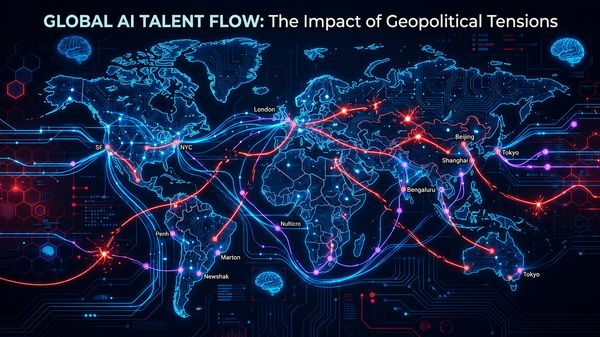 The global AI talent landscape is being reshaped by geopolitical forces, creating new challenges and opportunities for nations and corporations alike.The image above is a visual representation and does not depict actual data or specific geopolitical events.
The Geopolitical Chessboard: AI Talent as the Ultimate Prize
The global race for artificial intelligence supremacy isn't just about computational power or algorithmic breakthroughs; it's fundamentally a contest for human ingenuity. As nations increasingly view AI capabilities through a national security lens, the movement and retention of elite AI talent have become critical battlegrounds in an unfolding geopolitical tech war. This isn't merely a corporate hiring spree; it's a strategic imperative, with profound implications for global innovation, economic power, and military advantage by 2026.
One often overlooked nuance is the intricate dance between national security interests and the inherently collaborative, open-source nature of scientific research. The very restrictions designed to protect national AI advantages can, paradoxically, stifle the cross-pollination of ideas that fuels rapid innovation. This creates a complex dilemma: how do you secure your intellectual property without isolating your brightest minds from the global discourse that makes them brilliant?
The China-to-America Academic Conveyor Belt: A Paradox of Power
The geopolitical architecture of artificial intelligence is built on an ironic foundation: America's leading edge in research relies heavily on importing the brilliant minds of its chief geopolitical rival [4]. Data compiled by the Paulson Institute's MacroPolo archive indicates that 38% of the world's elite AI researchers received their undergraduate education in China, showing a dramatic rise from 29% in 2019 [4]. Yet, the ultimate destination of this talent pipeline is overwhelmingly singular.
Of these Chinese-educated elite scientists, an astounding 72% currently work at academic institutions and corporate laboratories inside the United States [4]. This dynamic exposes a critical asymmetry in the talent strategies of both superpowers. The United States remains deeply dependent on foreign-born talent to sustain its research edge, while China continues to hemorrhage its highly trained academic elite to Western labs [4]. Within American institutions, researchers of Chinese and American origin comprise a staggering 75% of top-tier AI talent, up from 58% in 2019 [1]. This concentrated talent pool underpins America's institutional dominance. The United States remains home to 60% of the world's top AI institutions, cementing its status as the center of gravity for frontier machine learning research [1].
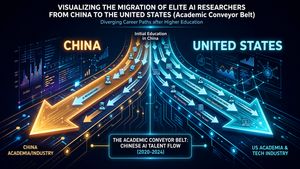 The significant migration of Chinese-educated AI researchers to the United States highlights a critical talent asymmetry.The image above is a visual representation and does not depict actual data or specific geopolitical events.
This reliance on foreign talent, particularly from China, presents a significant edge case: what happens when the source of your competitive advantage becomes a national security concern? The traditional flow of talent, once seen as a pure economic benefit, now carries geopolitical baggage, forcing a re-evaluation of immigration policies and research collaboration frameworks.
The Retention Dilemma of Beijing's AI Ambitions
Despite pouring billions into domestic computing infrastructure, national laboratories, and localized research grants, Beijing has struggled to reverse its domestic brain drain [4]. Only 11% of top Chinese-educated AI researchers remain working in China, a decline from 16% in 2019 [4]. This downward trend demonstrates that capital deployment alone cannot offset the scientific appeal of the Western research ecosystem [4].
While China has successfully increased its overall production of top-tier researchers—its share of global elite talent production rose from 27% in 2017 to 38% in 2024—it remains a net exporter of talent [4]. The highly centralized, state-directed nature of China's AI plan often conflicts with the academic autonomy and open-source collaboration that top-tier scientists demand [4]. Consequently, Chinese researchers migrate to the United States to publish at elite conferences like NeurIPS, ICML, and ICLR [4]. These venues represent the gold standard of scientific achievement in machine learning [4]. For these researchers, access to cutting-edge compute and academic freedom outweighs domestic financial incentives [1]. "America must remain the most competitive and dynamic place to do cutting-edge work—it's the only way to assure that global talent flows our way in the long term," says Henry Paulson, Chairman of the Paulson Institute [1].
Strategic Talent Acquisition:
Venture Capital Firms should prioritize funding for U.S.-based AI startups that demonstrate a clear, legally compliant strategy for recruiting international talent [4]. Ensure these startups actively diversify their hiring pipelines to mitigate geopolitical visa disruptions [4]. Corporate HR Departments should establish dedicated immigration assistance programs to transition elite foreign researchers from temporary student visas to permanent residency options [7]. This proactive support reduces the risk of sudden talent repatriation [4].
Deemed-Exports and the Internal Model Firewall: Navigating Regulatory Minefields
The regulatory boundaries of the geopolitical tech wars are no longer confined to physical shipping docks [2]. Under the Export Administration Regulations, releasing controlled technology or source code to a foreign national inside the United States is legally treated as an export to that individual's home country [2]. This "deemed-export" rule has created unprecedented operational friction for frontier AI laboratories [2].
On June 12, 2026, the Commerce Department's Bureau of Industry and Security notified Anthropic that an export license was required to transfer its unreleased Claude Mythos 5 and Fable 5 models to all global destinations and foreign persons—including releases to foreign nationals working inside the United States [2]. Because Anthropic could not instantly screen its vast user base by nationality, the lab suspended global access to both models and blocked its own foreign-person employees from using them [2]. Although the Commerce Department lifted these specific controls on June 30, 2026, after intense negotiations, the incident sent shockwaves through the tech sector [2]. It demonstrated that any foreign researcher interacting with an unreleased frontier model could trigger a deemed-export violation if the model's capabilities exceed specific performance thresholds [2].
Splitting the Neural Architecture: The Internal Model Firewall
To comply with strict deemed-export rules, frontier AI labs must build internal firewalls to restrict foreign-person access to unreleased model weights [2]. This creates a bizarre working environment where elite scientists are legally barred from inspecting the very models they are tasked with aligning [2]. For example, running pre-deployment evaluations for chemical, biological, radiological, or nuclear risks could inadvertently expose a foreign researcher to controlled technical data [2].
Furthermore, under the International Traffic in Arms Regulations, there is a strict licensing policy of denial for Chinese nationals [2]. This policy creates a massive operational challenge for American labs, given that Chinese nationals make up a critical segment of their elite research talent [1]. If U.S. labs are forced to segregate their research teams based on citizenship, they risk alienating top-tier talent [2]. This internal fragmentation directly slows down the development cycle of frontier models, threatening the very technological lead that the regulations are designed to protect [2]. "Personnel vetting is a key element of a TCP [Technology Control Plan] for ensuring that foreign-person employees can continue to do their jobs," writes Joe Khawam, Managing Director, Legal and AI Policy at the Law Reform Institute, in Just Security[2].
Compliance and Research Strategy:
AI Lab Compliance Officers should implement granular Technology Control Plans that log all model inputs and outputs generated by foreign national employees [2]. This logging system provides a clear compliance record and deters potential technology diversion without requiring blanket employment bans [2]. Research Directors should structure development pipelines so that foreign national researchers work primarily on open-source, non-controlled foundational architectures [2]. Keep evaluations of sensitive dual-use capabilities restricted to pre-vetted, licensed personnel [2].
Vetting Foreign AI Talent: The Clash of Privacy and Security
Securing America's AI ecosystem requires rigorous personnel vetting, yet this national security mandate directly clashes with state-level employment and privacy protections [2]. In California, where the vast majority of frontier AI startups are headquartered, the Investigative Consumer Reporting Agencies Act (ICRAA) presents a formidable barrier to counterintelligence screenings [2].
Under ICRAA, any employer utilizing a third-party investigative consumer report to screen a candidate must provide written disclosure to that individual [2]. Crucially, the employer must also share a copy of the final report with the candidate within three business days [2]. This procedural requirement makes it legally impossible for private AI labs to conduct confidential counterintelligence or foreign-influence checks on prospective hires [2]. If an investigation uncovers a candidate's active ties to foreign military research bodies, the employer must legally hand over the investigative files to the candidate [2]. This loop risks exposing active federal intelligence-gathering methods to potential adversaries, leaving labs in a regulatory bind [2].
NSPM-11 and the Future of Federal-Industry Vetting Partnerships
To resolve this legal disconnect, the federal government issued National Security Presidential Memorandum 11 (NSPM-11) [2]. NSPM-11 directs the Pentagon, the Department of Energy, and the intelligence community to partner with willing private AI companies to assist with personnel vetting [2]. Under this framework, sensitive intelligence remains with the government, while the labs receive actionable, preemption-protected access recommendations [2].
This federal-industry bridge is vital because immigrants are the lifeblood of American tech entrepreneurship [6]. A study by the Center for Security and Emerging Technology reveals that 66% of the top-ranked U.S. AI startups have at least one immigrant founder [6]. Furthermore, 72% of these immigrant founders first arrived in the United States on student visas [6]. This reliance is equally stark in the academic pipeline [3]. Over 50% of computer scientists with graduate degrees employed in the U.S. were born abroad, as were nearly 70% of enrolled computer science graduate students [3]. Vetting mechanisms must therefore be highly calibrated, as blanket exclusions of foreign nationals would dismantle America's entrepreneurial lead [2]. "Robust implementation of the administration's pledge to provide the private sector with assistance in vetting employees would help ease the challenges of conducting it confidentially," writes Tim Schnabel, President of the Law Reform Institute, in Just Security[2].
Navigating Legal and Academic Pathways:
Startup Founders should utilize the federal support systems outlined under NSPM-11 to run secure, government-assisted background checks [2]. This minimizes the risk of hiring individuals with undisclosed foreign military ties while shielding your firm from California ICRAA liability [2]. University Administrators should maintain open, transparent pathways for international F-1 STEM students, but ensure researchers are trained on data export compliance early in their graduate programs [7]. This structural training protects academic research labs from inadvertent technology transfer violations [9].
India's Reverse Brain Drain: Shifting the Geopolitical AI Balance by 2026
India has historically operated as the premier exporter of elite engineering talent [4]. The Global AI Talent Tracker reveals that 10% of the world's elite AI researchers received their undergraduate education in India [4]. However, historically, almost all of these researchers pursued opportunities abroad, leaving India with a meager 2% working share of the global elite pool [4].
This pattern is beginning to shift as India experiences a strong wave of reverse brain drain [1]. By 2026, the Indian technology sector is projected to reach $350 billion in revenues with a workforce exceeding 6 million professionals [10]. To accelerate this, the Indian government allocated ₹1,000 crore to the national IndiaAI Mission in its 2026-27 Union Budget, focused on building public-private GPU compute infrastructure and funding deep-tech startups [11]. This domestic push is creating highly attractive opportunities for returning diaspora professionals [12]. The rise of sophisticated Global Capability Centers (GCCs) has transformed major Indian metros into advanced R&D hubs, offering competitive compensation packages and state-of-the-art infrastructure [14]. In 2019, nearly all Indian AI researchers migrated overseas; by 2026, one-fifth of Indian-educated AI researchers are opting to remain home [1].
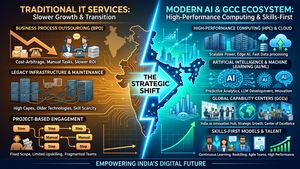 India's tech landscape is undergoing a significant transformation, with a shift from traditional IT services to advanced AI and Global Capability Centers.The image above is a visual representation and does not depict actual data or specific geopolitical events.
Traditional IT Service Churn and the Senior Engineering Shift
This domestic talent retention is further accelerated by a major shift within India's traditional IT services sector [14]. Mid- and senior-level employees at firms like TCS, Infosys, and Wipro are facing unprecedented structural pressure as slowing growth and agentic AI automate legacy workflows [14]. According to data from specialist staffing firm Xpheno, more than 7,700 senior tech professionals with over 15 years of experience exited India's top seven IT services firms within a 12-month period—representing roughly 4% of the total senior talent pool [14]. Crucially, 43% of these experienced exits were absorbed by GCCs [14].
This migration of veteran talent from legacy services to high-end AI and digital engineering units is transforming hubs like New Town, Kolkata's Bengal Silicon Valley Tech Hub [14]. Spanning 250 acres, this hub has attracted over 42 major companies—including LTIMindtree, Tata Consultancy Services, and major data center providers [14]. "AI is not a cyclical disruption. It is a structural rewrite.... requiring business model shifts from effort-based billing to outcome-based value, from bespoke coding to productized platforms...and from back office to AI-native architect," said Debjani Ghosh, Distinguished Fellow at NITI Aayog and Former President of NASSCOM [15]. This highlights a counter-intuitive finding: the growth of the gaming industry can indirectly contribute to a nation's AI talent pool by fostering digital engineering skills.
Capitalizing on India's AI Surge:
Multinational Tech Executives should rapidly expand their Global Capability Centers in India, focusing on high-end AI research rather than basic software maintenance [14]. Tap into the massive pool of exiting senior IT professionals to build local R&D leadership [14]. Government Policymakers should expand tax benefits, research grants, and housing support specifically tailored to attract returning NRI (Non-Resident Indian) founders and researchers [13]. This structural support will solidify the reverse brain drain and build sovereign IP [11].
DePIN: Circumventing Hardware Sanctions with Decentralized Compute
As the United States tightens hardware export controls, target nations are turning to decentralized networks to secure computational power [16]. Decentralized Physical Infrastructure Networks, or DePINs, coordinate underutilized, globally distributed GPUs to execute intensive machine learning workloads [16]. These networks allow anyone to supply GPU capacity and anyone to purchase it, matched automatically by smart contracts rather than traditional legal agreements [18].
Protocols like Akash Network, io.net, and Bittensor operate global marketplaces for computing power [16]. Akash Network has integrated NVIDIA Blackwell B200 and B300 GPUs into its marketplace, achieving over 428% year-over-year growth in usage and maintaining an 80%+ utilization rate heading into 2026 [17]. Furthermore, Akash's consumer GPU validation allows clusters of RTX 4090s to perform batch inference jobs at a 75% cost reduction compared to dedicated NVIDIA H100s [17]. This capability bypasses traditional geographical restrictions, allowing developers in sanctioned regions to access cutting-edge hardware anonymously [16]. To prevent data leakage and ensure total confidentiality, some advanced configurations combine DePIN with Trusted Execution Environments (TEEs) [19]. Phala Network utilizes TEEs to process workloads securely at the edge, ensuring that anonymous node operators cannot inspect or modify the underlying models or data [19]. To guarantee that AI training actually occurred correctly, Gensyn leverages "Proof-of-Compute" cryptographic verification [17]. Gensyn offers A100-equivalent verified compute at just $0.10 per hour, providing a highly attractive, sanction-resistant alternative to centralized clouds [17].
Enterprise SLA Realities vs. Token-Subsidized Workloads
Despite the cost benefits, DePIN platforms present significant drawbacks for enterprise workloads [17]. The cost savings of decentralized networks are heavily subsidized by native token issuance (such as AKT, RENDER, or IO) [17]. When speculative interest in these tokens is high, node operators are well compensated; but when token values plummet, the economic model strains, and operators pull their hardware offline [17]. This volatility is a critical edge case for enterprise adoption.
Additionally, DePIN networks do not offer the strict Service Level Agreements (SLAs) or uptime guarantees provided by centralized hyperscalers [17]. For large-scale frontier training runs, which require weeks of uninterrupted compute, any hardware failure can corrupt progress and cost thousands of dollars [17]. Furthermore, enterprise compliance frameworks require audited, physical datacenters with documented security controls [17]. An anonymous node operator on a decentralized network cannot satisfy SOC 2, HIPAA, or GDPR audit requirements [17]. "By leveraging on-chain candle auctions for price discovery and reliability incentives, Periphery unlocks significant efficiencies in the rapidly growing AI and DePIN sectors, collectively valued at over [100 billion dollars]," according to the Periphery 2025 technical thesis [18].
Optimizing Decentralized Compute:
ML Infrastructure Engineers should deploy non-critical, interruptible workloads—such as batch inference processing and hyperparameter tuning—on DePIN networks to reduce infrastructure costs by up to 75% [17]. Keep core, non-checkpointed training runs on compliant centralized clouds [17]. DePIN Protocol Founders should prioritize the integration of Trusted Execution Environments and build verified compliance layers that meet SOC 2 and GDPR standards [17]. Transition your economic models away from volatile token subsidies toward stablecoin settlement to attract enterprise users [17].
The Multipolar AI World Order: Bifurcation of Global Talent Pools
The escalating geopolitical tech wars are systematically ending the era of open, global scientific collaboration [1]. As the United States and China restrict access to their respective AI technologies, the global talent pool is separating into distinct, non-overlapping technological ecosystems [2]. This bifurcation forces researchers to align permanently with one geopolitical block, ending the fluid cross-border careers that defined the early deep-learning boom [1].
In response to Western restrictions, China is building a parallel, self-reliant AI ecosystem [5]. This includes developing proprietary deep-learning frameworks, specialized model architectures optimized for domestic hardware, and distinct safety alignment criteria aligned with state guidelines [2]. This ecosystem relies on highly specialized domestic training pipelines [4]. While this isolation allows China to secure its technology, it limits its researchers' ability to collaborate with the broader global scientific community, potentially slowing long-term innovation [4]. This is a common misconception: that isolation automatically leads to greater security without considering the cost to innovation.
The Cost of Isolationism
This geopolitical divide carries a high cost for the United States [8]. Because America's AI advantage is fundamentally built on importing talent, any domestic policy that restricts immigration or targets foreign-born researchers threatens its technological lead [2]. If strict vetting regimes make U.S. laboratories hesitant to hire foreign nationals, or signal that their work will be restricted, elite talent will migrate elsewhere [2]. This dynamic is already benefiting alternative destinations like the United Kingdom, South Korea, and continental Europe [1].
These regions are actively reforming their immigration policies to capture the talent displaced by the U.S.-China tech wars, positioning themselves as highly attractive, neutral tech hubs [1]. "The most powerful—and perhaps only—lasting and asymmetric American advantage is its ability to attract and retain international talent, a feat China has not been able to replicate despite extensive efforts," writes Dr. Remco Zwetsloot, technology competition and migration researcher [8]. The counter-intuitive finding here is that openness, not restriction, may be the ultimate national security asset in the long run for talent-dependent sectors.
Strategic Global Positioning:
Multinational Tech Enterprises should establish secondary research headquarters in neutral, highly talent-friendly jurisdictions like London, Singapore, or Toronto [1]. This distributed footprint allows you to employ elite global talent who cannot clear strict U.S. security screenings [2]. National Security Policymakers should avoid implementing broad, nationality-based employment bans on STEM talent [2]. Instead, implement graduated, risk-based vetting frameworks that secure sensitive model weights while keeping the door open for global scientists [2].
Technology Insights: Addressing Key Queries on AI Talent and Geopolitics
How will the 2026 deemed-export regulations affect foreign AI researchers in the U.S.?
How does California's ICRAA complicate national security background checks for AI startups?
Can DePIN compute networks like Akash be used to train frontier AI models anonymously?
Why does the United States rely so heavily on imported talent for its AI dominance?
What is the impact of India's IndiaAI Mission on global talent repatriation in 2026?
Disclaimer: This article discusses technology-related subjects for general informational purposes only. Data, insights, or figures presented may be incomplete or subject to error. Images and diagrams are for illustrative purposes only and may not represent exact products, interfaces, or official designs. For further information, please consult our full disclaimer.