What is Quantum AI Convergence? 2026 Predictions Explained: The Next Wave of Tech Evolution
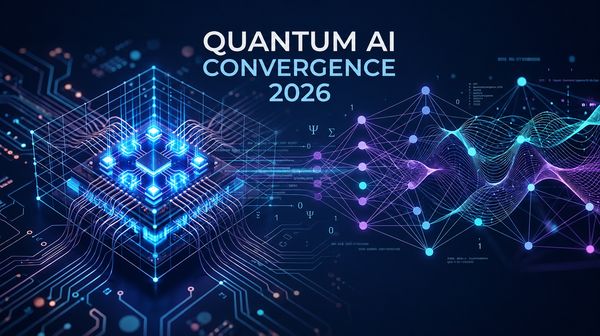 The symbiotic future: Quantum AI convergence reshaping computational landscapes and setting new benchmarks for technological advancement by 2026.The image above is a conceptual representation of quantum AI convergence and does not depict any specific real-world technology or product.
The convergence of quantum computing and artificial intelligence (AI) is no longer a distant futuristic concept. It's an emergent reality, fundamentally reshaping computational paradigms and redefining what's possible in data processing. At its core, quantum AI convergence addresses the intractable problems that even the most powerful classical supercomputers cannot solve due to inherent physical limitations.
Consider the delicate balance of quantum states: qubits, the fundamental building blocks of quantum computers, are incredibly fragile, susceptible to environmental noise that can cause them to 'decohere' and lose their quantum properties. This susceptibility introduces computational errors, making the task of building reliable, scalable quantum systems immensely challenging.
Yet, amidst these technical hurdles, 2026 stands as a pivotal year. We're witnessing a structural transition in quantum hardware, specifically moving from noisy intermediate-scale quantum (NISQ) platforms—characterized by their limited error correction—to more robust, 'Resilient' systems. These advanced systems are now capable of executing active, real-time error correction on logical qubits, paving the way for practical, fault-tolerant quantum computation [1]. This isn't merely an incremental upgrade; it represents a foundational shift, altering how we measure progress and, more critically, how we harness this revolutionary technology.
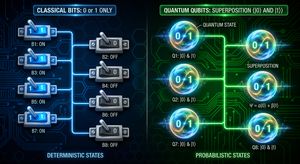 Understanding the foundational difference: Classical bits operate in binary states, while quantum qubits leverage superposition for exponential computational power.The image above is a conceptual illustration for educational purposes and does not depict any specific real-world technology or product.
How the Raw Physics of Quantum AI Convergence Breaks the Classical Processing Wall
The inherent constraint of classical artificial intelligence lies not in its algorithms, but in the very physical geometry of modern silicon. While today's GPU clusters have scaled to handle billions of parameters, their operations are ultimately governed by the linear limitations of classical bits [16]. Each bit can represent only a singular state—either a 0 or a 1—at any given moment, a binary constraint that, for all its utility, severely limits the scope of simultaneous computations [16].
Quantum AI convergence, by stark contrast, maps classical information onto quantum variables, or qubits [16]. Through the profound principle of physical superposition, a quantum system can simultaneously embody a mathematical blend of both 0 and 1. This allows a relatively small number of highly coherent qubits to represent an exponential number of possible calculation outcomes concurrently, shattering the linear barriers that shackle classical machines [16].
Adding another layer of complexity and power, the physical mechanism of quantum entanglement intricately links the states of separate qubits across a processor [16]. When qubits become entangled, their joint wave function holds correlations so profound and interwoven that a classical supercomputer would require impossibly large probability tables just to track them [16]. This isn't just a computational speed-up; it's a paradigm shift in how information is processed and related.
This exponential scaling explains why classical systems simulating a quantum register quickly run out of physical memory [17]. For example, simulating a basic 50-qubit register requires approximately 10 petabytes of classical random-access memory (RAM) [17]. This staggering requirement overwhelms all but the world's most advanced high-performance computing (HPC) installations [17]. This fundamental difference underscores the power of quantum mechanics in handling complex data spaces.
This physical scaling elucidates the massive performance leap demonstrated by Google's 105-qubit superconducting processor, Willow [8]. In standard benchmarking tests, Willow completed a targeted computational task in under five minutes [8]. According to data published by Google, executing that identical algorithm on a state-of-the-art classical supercomputer would require approximately 10 septillion years [8]. This is a temporal horizon that vastly exceeds the known age of our universe [19], offering a stark illustration of quantum supremacy in certain problem sets.
An intriguing aspect of this computation lies in its physical mechanism. The remarkable speed is achieved through constructive and destructive wave-function interference across parallel computational pathways [19]. This allows correct answers to be amplified, while incorrect states effectively cancel each other out [19]. This physical behavior lends mathematical weight to David Deutsch's multiverse hypothesis, which posits that quantum algorithms execute computations by distributing information across a vast spectrum of parallel physical states [19].
Hartmut Neven, Founder and Lead of Google's Quantum AI lab, stated, "The Willow chip is a major step on a journey that began over 10 years ago. When I founded Google Quantum AI in 2012, the vision was to build a useful, large-scale quantum computer that could harness quantum mechanics — the 'operating system' of nature to the extent we know it today — to benefit society by advancing scientific discovery, developing helpful applications, and [tackling some of our biggest challenges]," [18].
Despite these milestones, a common misconception in the broader technology market is that these systems can immediately replace classical neural network pipelines. This is incorrect. The benchmarks showing extreme speed advantages often rely on non-practical mathematical tasks with no direct commercial utility [20]. True, useful quantum AI is not a standalone system [4]. Rather, it functions as an integrated, hybrid classical-quantum machine where classical GPUs handle data preprocessing and control flows, while the quantum processor acts as a specialized linear algebra accelerator [4][21]. This nuanced understanding is crucial for practical applications.
Optimize Hybrid Architectures:
Enterprise technology officers must avoid vendor roadmaps promising immediate, standalone quantum-native replacements for existing AI workflows. Instead, software development teams should immediately begin building hybrid interfaces using open-source libraries like Google's Cirq or IBM's Qiskit [8]. This strategy ensures that high-value optimization or pattern-recognition workloads are partitioned, allowing classical data ingestion to GPUs while establishing APIs to offload complex mathematical kernels to quantum processing units (QPUs) [4].
Why Error Correction and Logical Qubit Stabilization are the Real Benchmarks of 2026
A persistent and formidable challenge of quantum hardware is its acute susceptibility to decoherence, where environmental heat, electromagnetic fields, and even subtle mechanical vibrations disrupt fragile qubit states and introduce computational errors [10]. In near-term NISQ hardware, these errors accumulate rapidly, severely limiting the depth of executable circuits to merely a few hundred logic gates before the precious quantum data degrades irreversibly into classical noise [1]. This instability is a fundamental barrier to complex quantum computations.
To overcome this critical bottleneck, the industry has aggressively prioritized Quantum Error Correction (QEC) [1]. This sophisticated technique integrates multiple physical qubits into a single, highly stable "logical qubit" through the power of quantum entanglement [23]. Under this paradigm, the physical-to-logical qubit ratio becomes the defining metric of hardware efficiency [9]. It's a measure of how effectively the raw, noisy physical systems can be tamed into reliable computational units.
Traditional surface codes, while compatible with planar, solid-state chips, are mathematically constrained [9]. Because superconducting qubits are fixed in place on a chip, they can only interact with their immediate physical neighbors [9]. This nearest-neighbor constraint requires a massive physical overhead, often needing up to 1,000 noisy physical qubits to encode a single, reliable logical qubit [9]. This high overhead highlights a critical design limitation in certain quantum architectures.
To resolve this limitation, developers have deployed quantum Low-Density Parity-Check (qLDPC) codes [9]. These codes require long-range, non-local connectivity between physical qubits [9]. This capability is natively supported by neutral-atom architectures, which utilize laser traps to physically move and shuttle atoms during a computation [9]. This dynamic reconfigurability offers a significant advantage in error correction efficiency.
Using the 2026 Kasai code construction, QuEra and its academic partners have demonstrated a highly efficient qLDPC architecture [9]. This framework operates at an exceptionally high encoding rate: this configuration encodes 1,156 stable logical qubits into just 2,304 physical qubits, achieving an encoding rate of 0.502 [9]. This innovation dramatically reduces the physical-to-logical qubit ratio to nearly 2:1, effectively bypassing the prohibitive overhead of standard surface codes [9].
Concurrently, Microsoft and Quantinuum have achieved Level 2 "Resilient" quantum computation, a significant milestone [2]. By applying an advanced, custom qubit-virtualization system to Quantinuum's H2 trapped-ion processor, the joint team successfully created 4 highly reliable logical qubits from a register of only 30 physical qubits [3]. The resulting logical circuits demonstrated a logical error rate, representing an 800-fold improvement over the corresponding physical qubit error rate [13]. Crucially, this system successfully executed active syndrome extraction, a process of diagnosing and correcting physical gate faults in real time without collapsing the active logical qubit states [13].
Krysta Svore, VP of Advanced Quantum Development at Microsoft, affirmed, "As leaders, we will continue to innovate more rapidly than the competition, with hardware innovations and developing applications to take advantage of the new era of truly logical qubits" [3]. This structural progress has fundamentally changed how hardware performance is measured [1]. Leading organizations have shifted their focus from raw physical qubit counts to "QuOps" (error-free Quantum Operations) [1]. QuOps provides a standardized metric that quantifies the total number of logical operations a machine can execute before experiencing an error [1]. This metric cuts through the noise of marketing claims, establishing a reliable roadmap for true quantum scale [1].
 The backbone of reliable quantum computing: Multiple noisy physical qubits coalesce to form a stable, error-corrected logical qubit.The image above is a conceptual illustration for educational purposes and does not depict any specific real-world technology or product.
Target Logical Qubit Architectures:
When designing algorithms, enterprise developers must target virtual logical qubit architectures rather than raw, uncorrected physical hardware. Organizations should design applications to be compatible with logical-qubit-aware software tools, such as Riverlane’s Deltakit or Microsoft’s Azure Quantum virtualization layer [13]. This strategic approach ensures that as hardware providers transition to larger-scale fault-tolerant systems, existing enterprise software can scale without requiring a complete rewrite [13].
How the Quantum Data Loading Bottleneck Impacts Machine Learning Models
While the theoretical processing potential of quantum AI is undeniably clear, a significant practical challenge persists: efficiently transferring classical data into a quantum processor [22]. Classical computers store data as bits in physical silicon, which, by their very nature, cannot be directly read or interpreted by a quantum processor [22]. Therefore, before any quantum machine learning algorithm can execute its powerful computations, classical data streams must undergo a crucial transformation, being encoded into quantum states [22]. This process, known as quantum data loading or state preparation, is far from trivial and represents a significant hurdle.
Historically, machine learning researchers often overlooked this critical state preparation step, implicitly assuming that classical datasets could be converted into quantum states without significant overhead [22]. In practice, however, this data translation can be extremely slow, negating many of the theoretical advantages of quantum computation [22].
The two primary data encoding strategies—rotation-based (angle) encoding and amplitude encoding—each present distinct physical limitations. Rotation-based encoding maps classical data points to the physical rotation angles of individual qubits using parameterized gates [26]. While relatively straightforward to implement, this technique scales poorly with qubit count, requiring one physical qubit per classical feature [26]. This high physical qubit requirement severely limits the model's ability to process large, high-dimensional datasets on current hardware [26].
Amplitude encoding, on the other hand, represents an N-dimensional classical vector by mapping data points directly onto the complex amplitudes of an n-qubit quantum state [17]. Because an n-qubit system naturally contains 2n computational states, amplitude encoding is highly space-efficient, requiring only log2N qubits to represent N features [26]. However, generating this quantum state generally requires an exponentially large number of operations [26]. For example, under standard image encoding schemes like the Flexible Representation of Quantum Images (FRQI), the ideal circuit depth scales as O(N), where N is the total pixel count [17]. Because these operations cannot be executed in parallel, loading a high-resolution image demands a deep, complex sequence of multi-controlled rotation gates [17]. This deep circuit often exceeds the coherence times of current quantum hardware, causing qubits to decay into classical noise before the data is even fully loaded [17].
This structural gap has been starkly demonstrated in physical evaluations [17]. While simulations optimistically suggested that amplitude encoding could theoretically manage up to 1024x1024 pixels, real superconducting quantum hardware has struggled immensely [17]. In empirical studies, researchers attempting to reconstruct images found that while simulations could theoretically manage up to 216 pixels, real hardware limits restricted reliable data loading to simple 2x2 pixel images [17]. This is primarily because the physical routing of qubits via SWAP operations adds significant gate overhead, causing the total circuit depth to exceed the machine's noise threshold [17].
To resolve this critical limitation, researchers are actively exploring two primary architectural approaches: Quantum Random Access Memory (QRAM) and algorithmic bypasses. QRAM, based on the fanout or bucket-brigade designs proposed by Giovannetti, Lloyd, and Maccone, utilizes a tree-like switching architecture to retrieve classical data in superposition [22]. When address qubits are sent down the tree, they route through active switches to retrieve the corresponding data as a quantum-encoded amplitude [22]. While QRAM offers efficient retrieval times that scale slowly with memory size, building physical QRAM requires specialized, noise-resistant hardware that can survive decoherence [22].
To avoid the data loading bottleneck on near-term hardware, researchers have also developed Shot-Based Quantum Encoding (SBQE) [27]. This protocol ingeniously shifts the encoding workload from complex coherent gates to the classical control layers that manage repeated circuit executions ("shots"), thereby significantly reducing the physical circuit depth [27]. Similarly, Quantum Oracle Sketching allows streaming classical data to be processed on-the-fly [14]. By loading data dynamically, approximately 60 logical qubits can represent feature spaces that would otherwise require exponential classical memory [14].
Ben Bloom, Founder and CEO of Atom Computing, noted, "Quantum will be a big compute resource like classical computers are a big data resource. We need to figure out how to use that" [15]. Ultimately, the competitive advantage of quantum machine learning depends heavily on resolving this data loading hurdle [22]. If the time and energy spent preparing quantum states exceed the speed advantage of the quantum algorithm, the system provides no overall benefit [22]. This space-time asymmetry is a critical consideration; classical supercomputers can perform 1018 operations per second, but managing exabyte-scale datasets is constrained by memory bandwidth and speed-of-light latencies [14]. Quantum systems can compress these massive feature spaces, but the overall runtime remains bottlenecked by physical gate speeds and state preparation times [14].
Prioritize Data Pre-processing:
When designing early quantum machine learning pipelines, enterprise data scientists must avoid high-dimensional classical datasets like raw high-resolution images or large-scale document databases [17]. Instead, teams should focus QML initiatives on small, information-rich, or pre-compressed datasets, such as PCA-reduced financial indicators or low-dimensional molecular graphs [17]. This approach allows developers to explore quantum advantage in optimization and pattern recognition without exceeding the coherence budgets of current hardware [17].
How Financial Algorithms and Drug Discoveries Utilize Hybrid Quantum Pipelines Today
The convergence of quantum computing and artificial intelligence has transitioned from a theoretical concept to a source of tangible business value in specific industries [4]. This pivotal shift is particularly visible in the Finance and Pharmaceutical sectors, where enterprises grapple with highly complex optimization problems and molecular simulations that remain insolvably large for even the most advanced classical hardware [4]. Rather than attempting to run complete applications entirely on quantum hardware, these industries are smartly utilizing hybrid workflows that strategically deploy quantum co-processors to accelerate the most computationally demanding subroutines [4]. This collaborative approach leverages the strengths of both paradigms.
In the financial services sector, algorithmic credit trading and risk modeling represent exceptionally high-value opportunities [4]. Corporate bond markets are notoriously complex and predominantly over-the-counter (OTC), meaning assets are traded directly between parties without the intermediation of a centralized exchange [5]. Traders must rapidly analyze real-time market conditions, liquidity, and intricate risk variables to accurately estimate the probability of a trade being filled at a quoted price [5]. Classical machine learning models frequently struggle to resolve these complex patterns embedded within noisy, unstructured market data, leading to suboptimal decisions [6].
To address this, HSBC collaborated with IBM to demonstrate quantum-enabled algorithmic trading [4]. Utilizing IBM's Heron superconducting quantum processor alongside classical machine learning pipelines, the team meticulously analyzed production-scale bond trading data in the European corporate bond market [5]. By mapping noisy market data onto quantum feature maps—mathematical structures capable of revealing correlations that classical models simply cannot detect—the hybrid system delivered a remarkable 34% improvement in predicting trade fill probabilities compared to classical-only methods [4]. These results represent some of the first empirical evidence of current quantum systems providing a genuine performance advantage for algorithmic bond trading [5].
Concurrently, the pharmaceutical sector is strategically deploying quantum AI to accelerate drug discovery, with a particular focus on molecular docking and intricate chemical interactions [4]. Classical computational chemistry faces fundamental limitations; simulating even a small, 50-atom molecule requires tracking an exponential number of electron configurations, a task that quickly overwhelms the memory limits of even the largest classical supercomputers [17]. To bypass this insurmountable limit, pharmaceutical companies are increasingly deploying Quantum Neural Networks (QNNs) to natively model complex quantum chemical behaviors [4].
For example, Roche partnered with Quantinuum to run QNNs to predict protein-ligand binding energies, a critical step in determining precisely how a drug candidate will interact with target disease proteins [28]. In empirical evaluations across a dataset of 1,200 compounds, the hybrid quantum-classical model demonstrated a 15% improvement in binding energy prediction accuracy compared to traditional classical machine learning models [28]. Similarly, St. Jude Children's Research Hospital deployed quantum-enhanced machine learning to target previously "undruggable" proteins like KRAS, which plays a critical role in cancer development [4]. Additionally, Pasqal and Qubit Pharmaceuticals utilized quantum algorithms for protein hydration analysis, providing a quantum solution to a pharmaceutically significant molecular biology task [4].
Jay Gambetta, Vice President at IBM Quantum, commented, "This exciting exploration shows what becomes possible when deep domain expertise is integrated with cutting-edge algorithm research, and the strengths of classical approaches are combined with the rich computational space offered by quantum computers" [5]. To put these advancements into a broader context, major pharmaceutical companies are not abandoning their classical high-performance computing (HPC) assets. Instead, they are integrating quantum pipelines into their existing classical AI computing infrastructure [21]. For example, Roche expanded its global AI computing footprint by deploying 2,176 NVIDIA Blackwell GPUs in early 2026, establishing a private supercomputing cluster of over 3,500 GPUs [29]. This massive classical footprint acts as the core orchestration and data-processing layer, while quantum co-processors are reserved to accelerate the most complex molecular simulations, illustrating the truly hybrid architecture of modern industrial computing [4].
Invest in Hybrid Proof-of-Concepts:
Enterprise decision-makers in finance and life sciences must establish small-scale, dedicated quantum-classical research units to identify mathematical bottlenecks within their current machine learning workflows [7]. These groups should prioritize proof-of-concept projects in portfolio optimization, fraud detection, and ligand-binding simulations using cloud access to processors like IBM's Heron or Quantinuum's H-series [4]. Building this in-house capability prepares organizations to seamlessly integrate full logical quantum accelerators as they become commercially available [1].
How National Security Missions and Sovereign Procurement Fragment the 2026 Global Market
As the commercial value of quantum computing rapidly solidifies, the technology has fundamentally transitioned from an academic research focus to a core component of national security and technological sovereignty [25]. Governments worldwide are acutely recognizing that the convergence of quantum and AI creates both unprecedented opportunities and profound risks [24]. Consequently, sovereign nations are now implementing structured policies, substantial funding initiatives, and stringent regulatory frameworks to secure their local supply chains and protect their critical digital infrastructure [24]. This geopolitical dynamic is creating distinct shifts in global technological development.
A major factor in these geopolitical shifts is the rise of sovereign quantum procurement [7]. The 2026 Quantum Readiness Report reveals a compelling trend: 62% of organizations actively factor national sovereignty into their procurement and sourcing decisions, while a mere 5% state it is not a factor [7]. Sourcing models are increasingly fragmenting as regional priorities diverge significantly [7].
- The United States: Organizations in the US prioritize performance-driven, globally open sourcing strategies to secure near-term computational advantages [7]. To support this, the US Department of Commerce has backed the launch of Anderon, America's first pure-play quantum wafer foundry [12]. Backed by a $1 billion cash investment from IBM alongside physical assets and intellectual property, Anderon focuses on scaling the domestic manufacturing of superconducting quantum processors [12].
- The European Union: EU organizations place a much heavier emphasis on domestic supply chain resilience, regional capability building, and robust data sovereignty [7]. This strategic approach has driven significant funding to European hardware providers like Quandela and Pasqal, with the explicit goal of building local, secure quantum data centers [16].
Concurrently, India has significantly accelerated its quantum infrastructure development through the ambitious National Quantum Mission (NQM) [25]. Approved with a substantial budget of ₹6,003.65 crore (approximately $700 million USD) spanning from 2023 to 2031, the NQM aims to firmly establish India as a global leader in quantum Research & Development [25]. The mission is meticulously organized around four thematic hubs (T-Hubs) strategically established at leading academic and research institutions across the nation [33]:
- Quantum Computing: Located at the Indian Institute of Science (IISc), Bengaluru, this hub focuses on developing intermediate-scale computers with 50 to 1,000 physical qubits [33].
- Quantum Communication: Anchored at IIT Madras and the Centre for Development of Telematics (C-DOT), New Delhi, this initiative is developing satellite-based and fiber-based quantum key distribution (QKD) across an impressive 2,000-kilometer range [32].
- Quantum Sensing & Metrology: Based at IIT Bombay, this hub is dedicated to designing high-precision magnetometers and atomic clocks [33].
- Quantum Materials & Devices: Located at IIT Delhi, this focuses on researching novel quantum states and advanced fabrication techniques [33].
The implementation timelines for India's NQM are precisely structured to deliver progressive, indigenous physical benchmarks across key operational horizons [34], showcasing a clear strategic roadmap.
While quantum computing offers significant performance opportunities, it also presents a major, looming threat to global cybersecurity [25]. Shor's 1994 algorithm chillingly demonstrated that a sufficiently large, fault-tolerant quantum computer could efficiently factor large integers and solve discrete logarithms. This capability would utterly undermine widely used public-key cryptographic systems like RSA and elliptic curve cryptography [25]. This profound threat has driven the "Harvest Now, Decrypt Later" (HNDL) strategy, where adversaries collect and store encrypted data today, patiently waiting for scalable quantum systems to emerge and decrypt it in the future [25].
To counter this existential risk, India's Department of Science and Technology (DST) published the 'Implementation of Quantum Safe Ecosystem in India' report [31]. This pivotal policy document establishes a phased transition to post-quantum cryptography (PQC) and quantum-resistant security [31]. The DST task force divides national transition targets into two primary tracks [31]:
Track 1: Critical Information Infrastructure (CII)
This track covers high-priority strategic sectors, including Defense, Power, Telecom, ISRO, DRDO, and ONGC [31].
- 2027 Milestone (Build Foundations): Establish quantum risk governance, conduct complete inventories of cryptographic assets, launch PQC/hybrid pilots, and require Cryptographic Bills of Materials (CBOMs) from vendors [31].
- 2028 Milestone (Migrate High-Priority Systems): Enforce a "no new classical-only" security procurement policy, upgrade Public Key Infrastructure (PKI) and Hardware Security Modules (HSMs), and implement PQC digital signatures [31].
- 2029 Milestone (Full PQC Adoption): Achieve enterprise-wide PQC or hybrid deployment, enforce PQC-only trust chains, and move legacy systems to managed enclaves [31].
Track 2: Other Government & Private Enterprises
This track covers standard-priority sectors, including Banking, Healthcare, Education, and General IT [31].
- 2028 Milestone (Build Foundations): Establish quantum risk governance, inventory cryptographic assets, launch PQC pilots, and begin implementing CBOM requirements [31].
- 2030 Milestone (Migrate High-Priority Systems): Transition pilots to full implementation, enforce "no new classical-only" policies, and upgrade core security systems [31].
- 2033 Milestone (Full PQC Adoption): Complete organization-wide PQC migration, implement PQC-only trust chains, and establish continuous algorithm lifecycle governance [31].
Laszlo Pokorny, Researcher at the Department of National Cybersecurity Research, ICL Institute of Applied Sciences, observed, "The concurrent maturation of quantum computing and artificial intelligence (AI) presents a compound threat to national cybersecurity that transcends the risks posed by either technology in isolation" [30]. This geopolitical dynamic has created a critical policy challenge: the "Convergence Blind Spot" [30]. Standard governance frameworks historically managed quantum hardware development and AI software capabilities through separate institutional channels [30]. However, their convergence creates synergistic threat vectors—such as AI-driven automated vulnerability discovery accelerated by quantum co-processors—that siloed defense frameworks are structurally unprepared to address [30]. Addressing these compound threats requires an integrated defense model that combines cybersecurity, AI safety, and post-quantum cryptography under a single, unified national framework [30].
Implement Quantum-Safe Security Protocols:
Sectors handling highly sensitive or long-horizon data must act immediately to establish quantum risk governance and mandate Cryptographic Bills of Materials (CBOMs) from all software vendors [31]. Organizations should prioritize the transition of high-value, long-lived data assets to hybrid cryptographic architectures, combining classical algorithms with NIST-approved post-quantum algorithms like ML-KEM or ML-DSA [31]. This dual-track approach maintains compliance with existing standards while proactively securing systems against future quantum decryption capabilities [31].
Strategic Synthesis and Next Steps: Navigating the Quantum AI Future
The convergence of quantum computing and artificial intelligence represents not just an evolution, but a profound redefinition of high-performance computing itself [4]. As physical hardware continues to scale and error correction methods relentlessly improve, the industry is unequivocally moving beyond the experimental, noisy NISQ era toward the promise of truly fault-tolerant computing [1]. This monumental shift carries far-reaching, practical implications for enterprise strategy, geopolitical competitiveness, and the very foundations of global cybersecurity [24]. It’s a transition that demands attention, foresight, and decisive action from every organization.
To successfully navigate this unprecedented technological transition, organizations must move beyond merely observing the technology to actively preparing their systems and strategies for its integration [7]. The path forward is complex but clear, requiring a disciplined, phased implementation strategy that accounts for both the opportunities and the risks inherent in this transformative convergence.
By taking a disciplined, hybrid approach—combining the proven strengths of classical computing with the burgeoning power of quantum co-processors—enterprises and public sector institutions can not only secure their digital assets against future threats but also strategically position themselves to leverage the next wave of technological evolution [4]. This isn't just about adopting new tools; it's about fundamentally rethinking computational strategy for an increasingly quantum-influenced world.
Blueprint for Enterprise Quantum Adoption:
- Phase 1: Readiness: Conduct comprehensive cryptographic inventories and mandate Cryptographic Bills of Materials (CBOMs) from all software vendors [4].
- Phase 2: Hybrid Integration: Identify and map existing software bottlenecks amenable to quantum acceleration, then pilot hybrid classical-quantum solutions using frameworks like NVIDIA's CUDA-Q [4][17].
- Phase 3: Deployment: Transition successful pilots to logical-qubit workflows as fault-tolerant systems become more accessible, ensuring scalability and reliability [1][13].
Quantum AI Convergence: Technology Adoption FAQ
What is the difference between a physical qubit and a logical qubit in quantum machine learning?
What is the "Convergence Blind Spot" in national cybersecurity policies?
How does the Kasai qLDPC code reduce physical qubit overhead in neutral-atom arrays?
How did HSBC demonstrate quantum advantage in algorithmic bond trading?
What are India's 2027 mandates for Critical Information Infrastructure regarding quantum security?
Disclaimer: This article discusses technology-related subjects for general informational purposes only. Data, insights, or figures presented may be incomplete or subject to error. Images and diagrams are for illustrative purposes only and may not represent exact products, interfaces, or official designs. For further information, please consult our full disclaimer.