Best Global Universities 2026: Unpacking What Rankings Truly Mean for Your Future
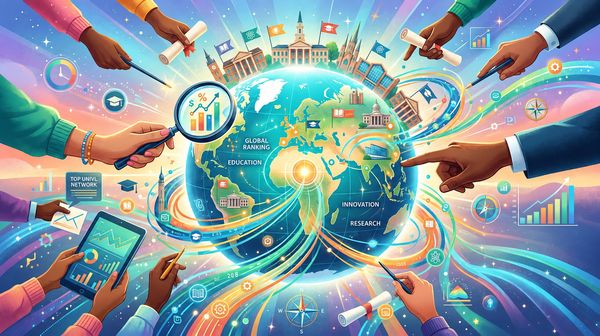 Navigating the dynamic landscape of global university rankings and what they mean for your future in 2026.The image illustrates the dynamic landscape of global university rankings and what they mean for your future in 2026. This is a conceptual image and does not represent specific universities or ranking methodologies.
Best Global Universities 2026: Unpacking What Rankings Truly Mean for Your Future
The world of higher education is constantly evolving, but 2026 marks a particularly dramatic turning point. Gone are the days when a university's global ranking was a simple, universally understood measure of excellence. Today, these prestigious lists—from QS to Times Higher Education—are reflecting complex geopolitical shifts, fierce competition, and a high-stakes game of academic strategy. Understanding what these rankings truly represent, and perhaps more importantly, what they don't, is crucial for anyone planning their future in this new educational landscape.
It's not just about impressive numbers; it's about discerning the underlying methodology, recognizing the subtle biases, and interpreting how these shifts intersect with real-world factors like student visa policies and the rapid integration of artificial intelligence. Failing to grasp these nuances can lead to costly missteps, while a clear-eyed perspective can unlock unprecedented opportunities. Let's dive deep into the 2026 global university rankings and explore what they truly mean for your academic journey and beyond.
How Do the 2026 Global University Rankings Reflect a Geopolitical Shift in Higher Education?
The long-standing dominance of Western universities is indeed cracking. For decades, institutions in the United States and the United Kingdom held an almost unshakeable grip on the top echelons of global higher education. Yet, the 2026 rankings reveal a structural rebalancing of academic power, with their collective influence beginning to plateau.[2] This isn't just a minor blip; it's a fundamental shift in how global academic prestige is distributed.
A common misconception is that a university's global rank directly reflects the quality of its undergraduate teaching or the happiness of its students. This simply isn't the case. These rankings are actually heavily weighted toward massive research outputs, the number of doctoral degrees awarded, and historical reputation surveys.[6] Consequently, smaller liberal arts colleges, despite offering exceptional undergraduate experiences, often get overlooked, while large, research-intensive institutions dominate the upper tiers. It’s a bit like judging a restaurant solely on the volume of ingredients it buys, rather than the taste of its dishes.
This technical skew has birthed a highly commercialized landscape where global rankings operate more like corporate stock tables than academic quality guides.[9] When a university suddenly leaps ten spots, it's rarely due to profound classroom improvements.[6] Instead, it often signals that their public relations team has expertly optimized their global reputation survey responses or strategically consolidated their publishing networks.[11] It's a calculated game of perception as much as it is academic prowess.
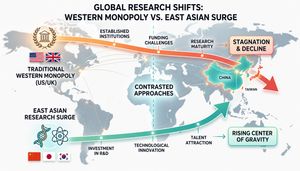 The shifting tides of academic influence: East Asia's ascent challenges traditional Western dominance in the 2026 global university rankings.This diagram conceptually illustrates the shifting tides of academic influence in 2026. It is a visual representation and not based on specific geographical data points or exact institutional movements.
The most striking illustration of this structural shift is visible in East Asia. Asia now proudly leads the world with an astounding 565 ranked universities in the 2026 QS cycle, significantly surpassing Europe's 487 and the Americas' 358.[3] This rapid ascent is akin to a high-speed train leaving older, legacy systems in its wake. India, for example, has shown spectacular momentum, with 41% of its ranked institutions rising in the QS standings. It now holds the distinction of being the second-most represented country in the THE rankings, boasting 128 universities.[1][15]
A prime technical nuance influencing this year's rankings is the impact of institutional mergers. These strategic consolidations allow universities to instantly scale their rankings, as seen with the newly formed Adelaide University in Australia. This institution impressively debuted at 82nd globally, a direct result of merging two distinct campuses.[15] By instantly combining faculty counts, enrollments, and publications, they secured a top-100 position on day one. It's an administrative shortcut to prestige that traditional growth models can't match.
Meanwhile, mainland China continues its relentless climb, placing five universities into the top 40 in the Times Higher Education (THE) rankings.[2] However, an interesting subtle ceiling has emerged. Elite schools like Tsinghua University have stalled at 12th place, seemingly restricted by rigid national policies and limits on academic freedom.[2] This suggests that while state-backed investment can drive rapid growth, systemic constraints can ultimately cap ultimate global standing.
The various ranking platforms also reveal a deep methodological divide. While US News and ARWU (Academic Ranking of World Universities) rely almost entirely on hard bibliometrics (the statistical analysis of scholarly publications), QS allocates a massive 40% of its score to subjective academic reputation surveys.[6][12] This inherent bias inevitably rewards historical prestige over current reality, much like a classic film winning an award despite newer, perhaps more innovative, releases.[14]
“We are witnessing a rebalancing of global academic influence. The Ranking highlights a shifting center of gravity in higher education—towards Asia, which now claims the highest number of ranked universities worldwide,”
This geopolitical pivot means that students are no longer automatically choosing expensive Western schools. Why pay premium tuition in a country with increasingly hostile visa laws when high-ranking, heavily subsidized options are thriving closer to home?[4] The classic monopoly once held by the Ivy League and Oxbridge is, for all intents and purposes, officially over.[2] This is a critical edge case; students are now weighing economic and migratory realities over pure brand power.
Optimize Your University Search:
Look past a university's overall global rank. Instead, compare how the institution performs in subject-specific rankings, and critically match that data directly against the regional job market where you intend to build your career. This ensures your investment aligns with tangible future prospects.[6]
How Do Academic Metrics Fail Under the Weight of Goodhart's Law and Gaming Tactics?
The academic world, like any system with measurable targets, is susceptible to Goodhart's Law: when a measure becomes a target, it ceases to be a good measure.[14] Nowhere is this more apparent than in higher education, where global rankings have incentivized systemic metric gaming.[8] This over-optimization has inadvertently triggered a massive academic integrity crisis, as institutions prioritize appearance over genuine scholarship.
A widespread misconception is that massive research growth is always a sign of intellectual brilliance or groundbreaking discovery. In reality, many hyper-growth institutions have simply learned to run their research departments like automated factories.[11] They pour state money into easy-to-publish disciplines, pressure scholars to write in English for broader citation reach, and artificially inflate citation counts through various networks. It's a calculated, almost industrial approach to academic output.
This industrial-scale publishing has given birth to a dark market of "predatory rankings" and falsified platforms.[9] In 2025, when Webometrics smartly transitioned to OpenAlex to bypass Google Scholar manipulation, clone sites instantly cropped up. These nefarious platforms sought to sell fake, inflated ranks to schools struggling with real academic standards.[9] This is a stark edge case that highlights how institutional vanity can be exploited, misleading both prospective students and well-meaning donors.
The tactics employed to game the system are disturbingly organized and widespread. A landmark bioRxiv study meticulously scrutinized 98 of the world's fastest-growing universities. The findings were revealing: 18 schools, spanning India, Lebanon, Saudi Arabia, and the United Arab Emirates, exhibited publication surges of up to 965% in a mere five years.[10] Shockingly, these same institutions showed sharp drops of over 35% in first authorship and 15% in corresponding authorship.[18] These numbers act as a smoking gun, clearly indicating unethical co-authorship networks. Researchers' names were added to external papers without real contribution, or authorship slots were simply bought from "paper mills"—shady commercial entities that manufacture fake scientific papers for a fee.[8] It's a hollow form of academic progress, creating an illusion of research excellence.[11]
Other common manipulation tactics are outlined below:
- Citation Cartels: Groups of researchers systematically cite each other's papers to inflate their citation scores, artificially boosting apparent impact.[8]
- Salami-Slicing: Splitting a single, comprehensive study into multiple smaller, fragmented papers to maximize publication counts, flooding academic databases with low-value, repetitive findings.[8]
- Authorship Buying: Adding non-contributing institutional faculty to high-impact international papers, thereby eroding scientific accountability and research integrity.[10][14]
- Administrative Class Capping: Capping college enrollments at exactly 19 students to exploit ranking formulas that reward smaller class sizes.[14] This diverts resources into scheduling tricks rather than actual teaching improvements.
The consequences of this metric-chasing are severe and far-reaching. When a university reorients its budget toward paying for honorary co-authorships or optimizing its research output for ranking algorithms, it inevitably starves vital undergraduate programs.[14] Teaching quality drops, class sizes grow unwieldy, and crucial student support services are slashed.[13] It’s a classic case of the tail wagging the dog, where the pursuit of a number overshadows the core mission of education.
“The alteration concerns how rankings define excellence and how efficiently certain systems learned to exploit that definition,”
Even elite Western universities are not immune to administrative tricks. For years, American universities notoriously capped class sizes at exactly 19 students because US News heavily rewarded classes under 20.[14] This is not educational leadership; it is pure formula optimization. When institutions prioritize metrics as their primary target, the true, invaluable mission of higher education—to foster critical thinking and genuine inquiry—is tragically lost.[10] The classroom transforms from a vibrant space of intellectual debate into a sterile printing press for low-quality papers.[8] For students, this means their expensive degrees may be backed by little more than a carefully constructed, yet ultimately hollow, illusion.[9]
Verify Academic Integrity:
Before committing to a university, make it a point to check its retraction record on databases like Retraction Watch. A high number of retracted papers, or a sudden, unexplained spike in publication volume, are major red flags indicating a school might be prioritizing rankings over genuine, rigorous scholarship.[8][14]
What Are Ranking Bodies Doing to Protect Bibliometric and Institutional Data Integrity?
To combat the rampant gaming and save their lists from becoming utterly meaningless, ranking bodies are now building robust defense systems. The Times Higher Education (THE) World University Rankings 2026, for example, has significantly overhauled its framework. It now includes 18 distinct performance indicators, strategically spread across five massive pillars.[8] This comprehensive approach makes targeted manipulation incredibly difficult, raising the bar for institutions attempting to game the system.
A common misconception is that ranking agencies simply accept any data a university submits. This couldn't be further from the truth. In reality, institutions are required to legally sign off on their core data under strict audits. Any missing metrics are not simply ignored; they are replaced with highly conservative estimates, specifically designed to penalize non-disclosure. This rigorously audited data is then cross-referenced with independent, third-party databases, acting as a crucial check and balance.[8]
The front line of this defense is a highly sophisticated, multi-stage bibliometric cleansing pipeline. In a crucial partnership with Elsevier and Scopus, THE actively scans publishing patterns for "red flags" and statistical outliers. If a university exhibits sudden, suspicious citation spikes—a tell-tale sign of potential manipulation—the institution is immediately flagged for a manual, in-depth audit. This proactive monitoring catches anomalies that might otherwise slip through the cracks.[8]
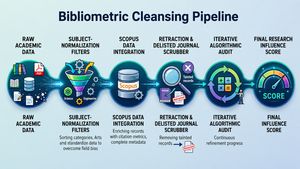 Behind the numbers: Times Higher Education's rigorous multi-stage pipeline ensures the integrity of bibliometric data in university rankings.This image depicts Times Higher Education's bibliometric cleansing pipeline to ensure data integrity in university rankings. It is a conceptual illustration of the process and not a direct screenshot of their internal systems.
Perhaps the most powerful technical weapon in this pipeline is the "research influence" metric. This iterative algorithm completely bypasses simple citation counts, which are easily manipulated. Instead, it measures the academic authority of the citing papers themselves. This ensures that a citation from an established, highly peer-reviewed journal is worth significantly more than a suspicious citation originating from a suspected citation cartel.[8] It's a quality-over-quantity approach that truly reflects impact.
Furthermore, the database rigorously scrubs retracted papers and articles published in recently delisted journals. When a journal is suspended from Scopus or Web of Science due to poor quality or unethical practices, all its papers are retroactively removed from the ranking calculations. This directly and harshly penalizes universities that rely on predatory publishers to artificially boost their numbers, effectively closing a major loophole for academic charlatans.[8]
To understand how THE meticulously balances these anti-gaming metrics, examine the 2026 methodology breakdown:
- Research Quality (30%): Utilizes "research influence" algorithms to actively discount self-citations and identified citation cartels, ensuring genuine impact.[8]
- Teaching (29.5%): Normalizes staff ratios and doctoral degrees awarded against the specific subject mix of the university, accounting for disciplinary differences.[8]
- Research Environment (29%): Crucially, "research productivity" is weighted at only 5.5% to intentionally disincentivize raw publishing volume, forcing a focus on quality.[8]
- International Outlook (7.5%): Normalizes international metrics against national populations, ensuring large countries aren't unfairly penalized for their sheer size.[8]
- Industry (4%): Tracks patents that cite the university's research, providing a tangible verification of practical, economic impact beyond pure academic papers.[8]
These sophisticated defenses represent a massive and welcome shift toward data-driven quality control. By keeping the "research productivity" metric at a remarkably low 5.5%, THE has effectively removed the primary incentive for universities to churn out high volumes of low-quality papers.[8] This change forces schools to concentrate on the long-term, high-impact research that genuinely advances human knowledge. It's an important pivot for the integrity of academia.
“Our balanced approach with a range of data sources and a comprehensive basket of 17 separate performance indicators, ranged across the teaching environment, research quality, international outlook and industry relations, makes manipulation particularly tricky and highly unlikely,”
This defensive push isn't isolated; it's spreading across the industry. Large language models (LLMs) and predictive AI are now being deployed to identify hidden publishing anomalies that even seasoned human auditors might miss. This ongoing technological upgrade is transforming the rankings game into a high-tech arms race, where integrity is constantly being safeguarded by cutting-edge tools.[8] For students, this cleanup is excellent news. It means that future rankings will gradually become more reliable, reflecting real academic strength rather than mere public relations tricks. However, until these advanced systems are fully deployed across all platforms, users must remain highly skeptical of sudden, unexplained ranking spikes. Trust, but verify.
Evaluate Ranking Methodologies:
When reviewing university rankings, look for platforms that utilize multi-indicator, subject-normalized methodologies (like the latest THE framework) and actively penalize self-citations. Avoid simpler lists that rely heavily on raw publication volume, as these are often more susceptible to manipulation and offer a less accurate picture of true academic quality.[8]
How Do Global Visa Restrictions Undergo a Cost-to-Value Shift for International Students?
In 2026, the primary factor determining where international students enroll is no longer solely university prestige. A wave of strict immigration curbs in traditional destination countries like Canada, Australia, and the UK has profoundly altered the landscape. Student visas have become a massive logistical hurdle, turning university selection into a high-stakes geopolitical puzzle where visa policy often outweighs school rank.[4] This "cost-to-value" shift is forcing students to completely rethink traditional study-abroad pathways.
A major misconception is that simply gaining acceptance into a top-ranked Western university guarantees a student visa. In 2026, visa approval rates are plummeting, driven by new national caps and stringent financial audits. Immigration officers are now looking beyond acceptance letters to closely scrutinize funding consistency, future career plans, and genuine academic intent.[7][17] It's a significantly tougher gateway to cross.
This regulatory shift has effectively broken the old "study now, pay later" model, which many international students relied upon, covering high tuition with part-time work. With living costs rising exponentially and part-time work hours capped at just 24 hours per week in Canada and 48 hours per fortnight in Australia, students must demonstrate massive upfront funds just to cross the border.[4] This creates a high-cost environment where even minor planning errors can lead to immediate financial ruin, transforming an academic dream into a precarious gamble.
Canada's recent structural reforms serve as a stark warning of this new reality. Immigration, Refugees and Citizenship Canada (IRCC) has capped new study permits at 155,000 for 2026 and completely abolished the once-popular fast-track Student Direct Stream (SDS).[4][7] Furthermore, college diploma students are now entirely barred from receiving a Post-Graduation Work Permit (PGWP) unless their program directly aligns with one of 119 designated labor shortage fields.[7] This means vocational training no longer guarantees a post-study work route.
However, Canada has introduced one major administrative improvement. As of April 1, 2026, international students no longer need to apply for a separate co-op work permit to participate in mandatory internships, drastically cutting down on bureaucratic red tape.[20] Moreover, Master's and PhD students remain entirely exempt from the provincial caps and field-of-study restrictions, receiving a guaranteed three-year work permit regardless of their major.[4] This crucial edge case highlights that higher-level academic pursuits still offer a more secure path.
To navigate these complex changes, review this comprehensive regulatory comparison:
- Canada: 155,000 new permits (408,000 overall target)[4][7]. Requires ~CAD 22,895 + 1st-year tuition & travel in proof of funds[7]. Post-Study Work (PSW): Master's/PhD get 3 years, Diplomas 0–3 years (restricted to labor shortage fields)[4][7]. Family/Dependent Visas: Banned for college/undergrad; spouses of Master's/PhD students remain eligible[7].
- Australia: 295,000 international places[7]. Requires ~AUD 29,710 (total AUD 60k–65k) in proof of funds[4][7]. PSW: Bachelor/Coursework get 2 years, Master's Research/PhD get 3 years, with an age limit under 35[4]. Family/Dependent Visas: Permitted but subject to strict, upfront financial vetting[4].
- United Kingdom: No official cap, but strictly enforced via high refusal rates[7]. Requires £1,529/mo (London) or £1,171/mo (outside) in proof of funds[17]. PSW: Undergrad/Master's get 2 years (reduces to 18 months from Jan 2027), PhD gets 3 years[4][7]. Family/Dependent Visas: Banned for taught postgraduate courses since 2024 (exceptions for research/PhD)[17].
This regulatory squeeze is already having a massive impact on campus demographics. In summer 2025, the US issued 97,000 fewer F-1 student visas compared to the previous year, including a significant 22,000 drop from India alone.[19] This decline is driven by a growing, sober realization among students that high-priced Western degrees are no longer a guaranteed ticket to permanent residency or employment.[7]
“The rankings – one of many tools that U.S. News offers to assist with college decision-making – help students identify universities with worldwide recognition and cross-border academic excellence that can serve as a launching pad for their careers,”
Meanwhile, Australia's age cap reduction on the subclass 485 visa has heavily penalized mature students and mid-career professionals. Anyone over 35 is now completely blocked from post-study work rights, severely disrupting plans for thousands of MBA and research candidates.[4] Additionally, the UK's pending reduction of the Graduate Route visa to just 18 months, starting in January 2027, means students enrolling in late 2026 will face a highly compressed timeline to find sponsored employment.[4] These are critical edge cases that can make or break a student's long-term plan.
As these traditional destination countries build higher walls, other nations are smartly capitalizing on the opportunity. Germany, New Zealand, and advanced Asian hubs are keeping their post-study pathways open and welcoming, attracting top-tier talent that is being shut out of the UK, Canada, and Australia.[1][3][4] For international students, the map of global opportunity has never been more dynamic, demanding careful research and strategic thinking.
Strategize Your Visa Path:
If your long-term goal is global employment, calculate your return-on-investment (ROI) based fundamentally on visa policies rather than solely on rankings. Prioritize master's programs in high-demand STEM (science, technology, engineering, math) fields, as these remain heavily protected and frequently exempt from caps in countries like Canada and the UK.[4]
How Is Generative AI Reshaping Classroom Learning and Academic Credibility?
The classroom is experiencing nothing short of an unprecedented technological revolution. Generative AI usage among college students has skyrocketed, with a massive 88% of scholars admitting to using tools like ChatGPT for coursework, a dramatic increase from just 53% last year.[21] This rapid adoption has far outpaced institutional policies, leaving higher education in a state of regulatory chaos and creating an urgent need for new frameworks.[23]
A major misconception is that universities are successfully using AI detection software to police academic integrity. In reality, authorship verification tools are notoriously unreliable, frequently generating false accusations and violating student privacy.[24] Consequently, many forward-thinking universities are wisely abandoning punitive bans entirely, shifting their focus instead to the ethical, responsible integration of AI as a learning partner, rather than an adversary.[5]
This technological shift is forcing a deep, essential re-evaluation of what academic value actually means. If an AI tool can write a flawless essay or pass a standard coding exam in mere seconds, then testing students on raw memorization is no longer useful or relevant.[11] Instead, the modern classroom must pivot to focusing on critical thinking, nuanced qualitative analysis, and complex real-world problem-solving, skills that AI can augment but not replace.[11][24]
Despite the initial anxiety surrounding cheating, the data on AI-enhanced learning is highly encouraging. Students immersed in active, AI-personalized environments achieve test scores an impressive 54% higher than their peers in traditional settings.[21] Adaptive software allows students to learn at their own pace, providing on-demand tutoring and immediate, tailored feedback that human instructors simply cannot scale across large classes.[22] This is a significant edge case demonstrating AI's potential to personalize education at scale.
Furthermore, AI-powered early warning systems are proving invaluable in helping universities prevent dropouts. By analyzing subtle patterns in student engagement, attendance, and grades, these platforms can flag struggling students long before they reach a crisis point, driving a commendable 15% reduction in overall dropout rates.[22] This technology effectively helps bridge the gap for diverse student populations, offering support where it's most needed.
To understand how AI is profoundly reshaping both the student and faculty experience, compare these compelling metrics:
- Student Engagement: Up to 60% higher engagement in AI-enhanced settings, driven by personalized content that keeps students highly motivated.[22]
- Course Completion: 70% better completion rates in AI-enhanced environments, as AI effectively bridges cultural and academic gaps through adaptive support.[22]
- Learner Talk-Time: Students exhibit 13x more active participation in interactive AI platforms, encouraging peer collaboration and deeper engagement.[22]
- Dropout Rates: A 15% reduction in dropouts due to predictive analytics, which allows for early intervention and targeted student support.[22]
However, institutional policy is conspicuously struggling to keep pace with this rapid technological evolution. While a vast 94% of administrators use AI in their daily work, a concerning reality is that only 54% are aware of actual guidelines governing its use.[23] This policy gap exposes institutions to major data privacy and security risks, and it creates massive inconsistencies across different academic departments, leading to confusion and uneven implementation.[24][25]
“We're rebranding learning as exciting and developing a learning algorithm to simultaneously deliver results,”
As AI becomes deeply embedded in the modern workforce, universities are under immense pressure to build essential digital skills into their curricula. Institutions that stubbornly refuse to adapt risk producing graduates who are woefully unprepared for the demands of the modern economy.[24] The elite universities of 2026 will be those that actively train students to use AI responsibly, critically, and creatively, transforming it from a tool for cheating into a catalyst for profound learning.[5]
For students, this means that the value of a degree is dramatically shifting from what you simply know to how you think and how adeptly you can leverage advanced tools. Chasing high-ranking schools that still rely on outdated, lecture-and-exam models is increasingly a losing strategy. Instead, look for universities that are boldly redesigning their curriculums to treat AI as a powerful partner in human curiosity and intellectual exploration.[5][11] Embrace the future, or be left behind.
Inquire About AI Integration:
When choosing a university, directly ask admissions counselors how their curriculum incorporates generative AI literacy. Prioritize institutions that offer 'sandbox' environments for ethical AI experimentation, fostering innovation, rather than those that cling to punitive bans and rely on notoriously unreliable AI-detection policies.[5]
Education Navigator: FAQs on Global University Rankings and Your Future
How does the Adelaide University merger affect global rankings?
What are the 2026 PGWP field-of-study restrictions in Canada?
How does the Research Integrity Risk Index (RI²) flag academic gaming?
How do Australia's subclass 500 visa changes in 2026 affect older students?
What is the impact of generative AI on classroom student test scores?
Disclaimer: This article discusses educational topics for informational purposes only. The content is not intended to serve as professional academic counseling or career guidance. Images and examples are illustrative and may be simplified for explanation purposes. Please consult our full disclaimer for more information.