
Closing the Fiber Gap: Simple Strategies to Revolutionize Student Wellness and Academic Performance
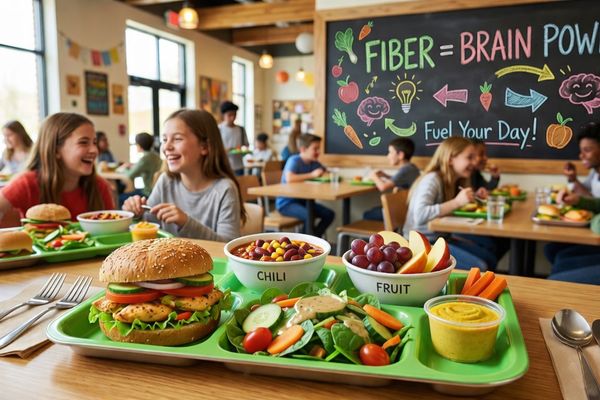 A well-balanced school lunch, rich in fiber, designed to fuel both body and mind.Image for illustrative purposes only. Actual meal contents and presentation may vary by school district.
The contemporary landscape of school nutrition presents a striking paradox: while school meals are often considered the healthiest food sources for children and adolescents, a pervasive "fiber gap" silently undermines the foundational wellness of our student population. This isn't just about digestive regularity; it's a critical oversight in the biological optimization of the student body, impacting cognitive architecture, metabolic regulation, and long-term academic attainment.
Currently, an alarming 97% of children in the United States fail to meet the minimum recommended daily intake for dietary fiber, a deficiency so significant that federal health authorities classify fiber as a "nutrient of public health concern" for all Americans, including the school-aged demographic [1]. The Institute of Medicine (IOM) sets a minimum adequate intake (AI) of approximately 14 grams of fiber per 1000 calories. However, empirical menu analyses consistently reveal that school breakfasts and lunches fall short of this target by a magnitude of 3 to 5 grams per 1000 calories [1]. Despite the significant reforms initiated by the Healthy, Hunger-Free Kids Act (HHFKA) of 2010, which mandated increased portions of fruits, vegetables, and whole grains, this fiber deficiency remains nearly universal among public school students, which is particularly concerning given that children may receive up to half of their daily caloric intake within the school environment [2].
The Pervasive Fiber Gap: A Silent Crisis in Student Wellness
The "fiber gap" isn't merely a dietary statistic; it's a foundational issue impacting student vitality at every level. This systemic deficit represents a critical failure in optimizing the student body's biological functions, which in turn affects cognitive processes, metabolic health, and even academic achievement over time. The implications of this widespread nutritional shortfall are far-reaching, extending well beyond immediate health concerns to influence long-term developmental trajectories.
The IOM's recommendation of 14 grams of fiber per 1000 calories serves as a critical benchmark, yet school meal programs routinely miss this target. This consistent shortfall, often by several grams per 1000 calories, underscores a systemic challenge that legislative efforts like the HHFKA, while well-intentioned, have not fully resolved. The reforms did push for more fruits, vegetables, and whole grains, but the deep-seated issue of universal fiber deficiency persists, especially when considering the substantial portion of daily calories children consume within school walls [2].
"These new standards allow us to take the next step in putting kids’ health at the forefront… to give kids the right balance of nutrients for healthy, tasty meals."
As the United States Department of Agriculture (USDA) prepares to implement the first-ever quantitative limits on added sugars in school meals beginning in the 2025–2026 school year, a critical window of opportunity emerges. This regulatory shift provides a unique chance for school nutrition professionals to strategically pivot towards high-fiber, nutrient-dense alternatives. Such a pivot can address both metabolic and cognitive wellness simultaneously, moving beyond a singular focus on calorie counting and sugar reduction to embrace the holistic benefits of intact fiber [4].
Optimize Your School's Nutritional Foundation
School district leaders should initiate a comprehensive audit of current dietary offerings against the IOM's minimum adequate intake of 14 grams of fiber per 1000 calories, rather than merely adhering to the regulatory 80% whole-grain-rich minimum. Establish a localized "Fiber-First" procurement policy as a primary preventative health measure, potentially reducing absenteeism and improving behavioral outcomes across the student body.
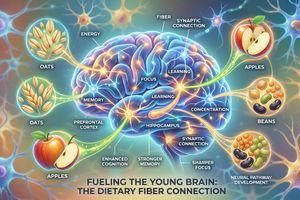 Fiber fuels the gut-brain axis, supporting critical cognitive functions essential for learning.Image for illustrative purposes only. Actual biological processes are complex and nuanced.
Beyond Digestion: Fiber's Profound Impact on Cognitive Architecture
The relationship between what we eat and how our brains function is a rapidly expanding area of research, with immense implications for how students perform in the classroom. It's not just about physical health; accumulating evidence suggests that while aerobic fitness and body fat are linked to childhood cognitive function, dietary fiber stands out as a unique and independent predictor of "cognitive control" and attentional inhibition [3]. This means that fiber isn't just helping digestion; it's actively shaping a child's ability to focus and manage complex tasks.
Studies involving children aged 7 to 9 have shown a clear positive association between total dietary fiber and insoluble fiber intake and higher accuracy on tasks demanding variable amounts of cognitive control. This correlation holds true even after accounting for factors like age, IQ, and pubertal staging [3]. The underlying mechanism for this neuro-nutritional link is fascinating: it's rooted in the fermentation of non-digestible polysaccharides. Soluble fibers—such as pectins, gums, and mucilages—act as primary substrates for bacterial fermentation in the large intestine. This process yields short-chain fatty acids (SCFAs), with butyrate being particularly notable. Preclinical and clinical data suggest that butyrate increases the transcription of brain-derived neurotrophic factor (BDNF), a crucial molecule for neuronal integrity and plasticity in the frontal cortex [3]. High levels of BDNF are essential for learning, as they facilitate the survival and growth of neurons and synapses.
"There are multiple ways people can eat to optimize brain health… this work provides some evidence behind one option."
Conversely, a diet low in fiber and high in saturated fats is linked to neuroinflammation and a decline in hippocampus-dependent memory tasks [3]. Naiman Khan, a professor of Kinesiology and Community Health, underscores that even small dietary changes can have measurable impacts on cognitive performance [5]. Khan highlights that fiber-rich foods, such as avocados, offer "neuroprotective" options that optimize brain health regardless of other health behaviors [5]. The cognitive stakes of fiber consumption are clearly high, influencing everything from focus to memory. Furthermore, the CDC emphasizes that a healthy breakfast, which is a prime opportunity for fiber intake through whole grains and fruit, is associated with improved memory, reduced absenteeism, and improved mood among students [6]. When children are fiber-deficient, they are more prone to blood sugar surges and subsequent crashes, which can lead to irritability, fatigue, and difficulty maintaining focus during instructional periods.
Empower Students with Brain-Boosting Nutrition
Educators should utilize the "gut-brain axis" as a central theme in secondary biology and health curricula. By explaining the role of SCFAs and BDNF, teachers can move nutrition education beyond simple caloric math into the realm of "brain hacking," empowering students to make dietary choices that directly enhance their academic abilities and mental clarity.
Navigating the Regulatory Tides: USDA Mandates and the Fiber Imperative (2025-2027)
The United States Department of Agriculture (USDA) is currently in the midst of a multi-phase update to its National School Lunch Program (NSLP) and School Breakfast Program (SBP). These changes are designed to align school meals with the 2020–2025 Dietary Guidelines for Americans [4] and represent the most significant shift in school nutrition policy since the 2010 Healthy, Hunger-Free Kids Act (HHFKA). While fiber isn't explicitly mandated with its own numeric requirement, these new standards for sugar and whole grains effectively create a regulatory "forcing function" that necessitates greater fiber integration into school meals.
Starting in July 2025, schools will need to comply with product-based limits for added sugars in specific items like breakfast cereals, yogurt, and flavored milk [4]. This phased approach provides crucial time for the food industry to develop lower-sugar products and allows school nutrition directors to gradually transition their menus. The whole grain requirement is another cornerstone of this regulatory framework, with the USDA finalizing the rule that 80% of weekly grains offered must be "whole grain-rich" – meaning the product contains at least 50% whole grains [4]. While this maintains existing whole grain standards, the concurrent reduction in sugar means these whole-grain-rich products will need to be the primary source of satiety for students, naturally encouraging higher fiber content.
A technical nuance to this discussion is the inclusion of the "Whole Milk for Healthy Kids Act," effective January 2026 [8]. This law permits the reintroduction of whole and reduced-fat milk into the NSLP. While it allows for higher fat content in milk, the underlying DGA 2025-2030 recommendations continue to prioritize "high-quality protein, healthy fats, fruits, vegetables, and whole grains" while advocating for the avoidance of "highly processed foods" [8]. This juxtaposition suggests that as schools potentially reintroduce whole milk, the need for fiber-rich plant foods to balance and offset saturated fat intake becomes even more pronounced. This legislative landscape, therefore, creates an indirect but powerful imperative for schools to prioritize fiber in their menu planning.
Proactive Compliance for School Meal Success
Food Service Directors should immediately begin "pre-compliance" testing of low-sugar, high-fiber cereals and yogurts. By sourcing products that already meet the SY 2025–2026 sugar limits, districts can mitigate potential supply chain disruptions and utilize the 2024–2025 school year as a crucial taste-testing period to ensure student acceptance of higher-fiber formulations.
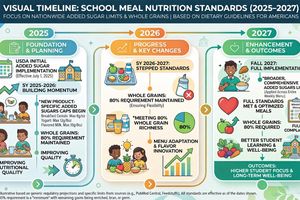 Upcoming USDA mandates will reshape school menus, implicitly driving higher fiber content by targeting sugar and whole grains.Image for illustrative purposes only. Specific dates and details are subject to official USDA announcements.
Equity in Nutrition: The Fiber Gap in Title I Schools
Nutritional equity remains one of the most pressing challenges within the American education system. Title I schools, serving high concentrations of students from low-income families, are the primary beneficiaries of federal nutrition programs. Yet, paradoxically, these institutions often face the steepest barriers when it comes to providing high-fiber, "scratch-cooked" meals [2]. With approximately 63% of traditional public schools being Title I eligible in the 2021–2022 school year, the sheer scale of students who rely on school meals for their primary nutrition is immense [9].
Investigative findings consistently show that school meals frequently fail to meet the IOM's adequate intake of dietary fiber, often falling short by 3 to 5 grams per 1000 calories [1]. This disparity is further exacerbated by critical funding cuts, such as the termination of the "Local Food for Schools" (LFS) Cooperative Agreement Program in March 2025 [2]. This program, which had committed to helping schools purchase local, unprocessed foods, was instrumental for Title I schools. Local food initiatives are vital in building regional food systems that can provide fresh, intact fiber (fruits and vegetables) that would otherwise be too expensive for districts operating on tight "per-meal" budgets [10].
Another significant technical hurdle is the "Missing Middle" of school food infrastructure. Many high-poverty districts report severe staffing shortages (94%) and a lack of adequate equipment (94%) to process bulk, high-fiber legumes and whole grains from scratch [7]. This forces them to rely on "nutrient-dense, pre-prepared" items. While healthier than many commercial alternatives, these often incorporate "functional" (processed) fibers rather than the "intact" fibers found in scratch-cooked beans or freshly milled grains [1]. The distinction here is crucial: intact fibers offer a complete package of nutrients and phytochemicals, which may not be fully replicated by isolated or synthetic alternatives.
Bridge the Nutritional Equity Gap
District Procurement Officers should actively explore "Group Purchasing Organizations" (GPOs) to leverage collective bargaining power for whole-grain-rich and legume-based products. Additionally, Title I schools should investigate "Community Eligibility Provision" (CEP) benefits, which can significantly reduce administrative costs and free up funds for higher-quality, fiber-rich ingredients, thereby enhancing nutritional equity.
Empowering Learning: Integrating Fiber Education into STEM and Health Curricula
Truly elevating student wellness through fiber demands a paradigm shift from passive consumption to active, engaged education. Integrated STEM (Science, Technology, Engineering, and Math) curricula provide a powerful framework for students to tackle real-world nutritional challenges head-on. By applying the essential "4C" skills—Collaboration, Critical Thinking, Communication, and Creativity—students can delve into the science of fiber within authentic, meaningful contexts [11].
A highly effective model for this integration is the "Socio-Scientific Issue" (SSI) approach. SSIs present controversial, real-world problems that necessitate both scientific reasoning and social consideration [12]. Fiber deficiency in schools fits this mold perfectly, allowing students to engage with the topic through various lenses:
- Engineering/Design: Students could be tasked with designing a "Fiber-Dense School Tray" that costs less than $1.50 in raw ingredients but provides a target amount of fiber, pushing them to innovate within real-world constraints.
- Technology: Utilizing 3D printing or advanced food science kits, students can explore and understand the intricate structure of plant cell walls, differentiating between cellulose and hemicellulose [13].
- Math/Data Analysis: An engaging activity could involve students tracking their own heart rate and energy levels after consuming refined grains versus whole grains, providing a tangible visualization of the glycemic index and its impact [14].
The "Fit to Learn" program emphasizes that healthy habits must become a "routine part of how kids learn," irrespective of the subject matter [15]. For instance, a social studies unit exploring the history of agriculture could seamlessly incorporate statistics from the Whole Grains Council. This could illustrate how human calorie consumption has dramatically shifted over recent decades, moving from a slight increase in whole grain calories to a significant decrease, accompanied by a rise in sugar and refined grains [16]. Such interdisciplinary approaches not only enhance understanding but also foster a deeper appreciation for the role of nutrition in personal and societal well-being.
Innovate Nutrition Education in the Classroom
Teachers should implement "Flavor Stations" in the cafeteria, allowing students to personalize meals with high-fiber toppings like sunflower seeds, dried berries, or chickpeas. These stations can serve as a "living lab" where students collect data on topping popularity, seamlessly integrating math and nutrition education into the lunch experience, making healthy choices both engaging and routine.
Addressing Unique Needs: Fiber for Neurodivergent Students
While the fiber gap impacts nearly all students, a critical edge case arises with neurodivergent students—those with Autism Spectrum Disorder (ASD), ADHD, and other neurodevelopmental disorders (NDDs). For this population, fiber consumption is frequently hampered by distinct sensory processing differences. Research indicates that children with autism and oral sensory oversensitivity often refuse whole grains and vegetables due to their unpredictable textures—be it crunchy, gritty, or the presence of "skins" [17]. This can lead to chronic deficiencies in fiber and other vital nutrients, which in turn may exacerbate existing gastrointestinal issues and behavioral challenges [17].
However, for students with ADHD, a carefully curated "sensory diet" that includes high-fiber foods can be a powerful tool for self-regulation [19]. Fiber helps to prevent the rapid blood sugar spikes and subsequent crashes that often contribute to hyperactivity and a pervasive "brain fog." The core challenge, then, lies in making high-fiber foods "safe" and appealing for these sensitive palates. Generic approaches simply won't suffice; targeted, empathetic strategies are essential.
Effective strategies for sensory-friendly fiber integration include:
- Adjusting Textures: For children who strongly dislike "mushy" or soft textures, roasting chickpeas to achieve a high crunch factor or serving raw, crisp vegetables (like snap peas) is often more effective and palatable than offering steamed or boiled versions [18].
- Gradual Exposure: Employing the "Look, Touch, Smell, Taste" hierarchy can be profoundly helpful. A student might first engage with a bean or a piece of kale in a low-pressure science lesson, exploring its properties without the immediate expectation of consumption. Only after repeated, positive exposure would they be gently encouraged to taste it [18].
- The "Bridge" Approach: This involves combining a preferred food with a new, high-fiber food. Examples include mixing a small amount of brown rice into white rice, or blending white beans seamlessly into a smooth, familiar pizza sauce, subtly introducing new flavors and textures [18]. Similarly, using divided bento boxes can prevent foods from touching, alleviating anxiety for routine-driven students [20].
Support Neurodivergent Students' Nutritional Success
Special Education Staff should coordinate directly with the school’s Occupational Therapist (OT) to integrate high-fiber foods into "sensory play" sessions. By normalizing the smell and feel of these foods outside the high-pressure cafeteria environment, staff can significantly reduce "mealtime anxiety" and substantially improve the long-term nutritional status of neurodivergent students.
The Science of Fiber: Intact vs. Isolated and Synthetic Fibers
As food manufacturers scramble to meet the new "low sugar" and "high fiber" standards driven by evolving regulations, it’s imperative for school nutrition professionals to grasp the fundamental distinction between "intrinsic and intact" fiber and "isolated or synthetic" (often termed functional) fiber. The National Academy of Medicine precisely defines intact fiber as that which naturally occurs within plants, complete with its accompanying vitamins, minerals, and phytochemicals. Functional fiber, conversely, is extracted from plants or synthetically produced and must demonstrably prove a physiological benefit to be officially labeled as such [14].
In the school environment, many "high fiber" snack bars and fortified cereals frequently incorporate functional fibers. Common examples include:
- Inulin/Chicory Root: A soluble fermentable fiber often added to yogurts and cereals to boost fiber content and act as a prebiotic [21].
- Polydextrose: A synthetic fiber derived from glucose, primarily used to add bulk to foods without contributing significant calories [14].
- Isolated Pectin/Gums: These are often utilized to enhance the mouthfeel and texture of low-fat or low-sugar foods, giving them a more appealing consistency [21].
While these functional fibers can undeniably help a school meet its numerical fiber targets, they often lack the complete "synergistic package" of vitamins, minerals, and phytonutrients inherently found in whole plants [21]. Furthermore, an important consideration for school-aged children is that some synthetic fibers, if introduced too rapidly or in excessively high doses, can lead to gastrointestinal distress such as gas and bloating [22]. The FDA mandates that isolated or synthetic fibers must demonstrate at least one physiological benefit (e.g., lowering blood glucose, cholesterol, or blood pressure) to be classified as "dietary fiber" on food labels [21]. However, human intervention trials using these isolated fibers have shown inconsistent results when compared to the robust, consistent health benefits observed in studies focusing on whole-food fiber intake [23].
Prioritize Whole-Food Fiber in Procurement
Procurement Managers should prioritize "intact fiber" sources whenever feasible. If products containing functional fibers are necessary, ensure they do not serve as the primary source of fiber. A practical rule of thumb is: "If the fiber is 'added,' it's a supplement; if the fiber is 'part of' the ingredient, it's a nutrient." This distinction guides purchasing towards more wholesome, beneficial options.
The Economic Lens: Procurement, Market Trends, and Long-Term Outlook (2026–2033)
The economic landscape governing school nutrition is becoming increasingly complex, heavily influenced by the global whole-grain food market. This market is projected to reach an astounding $60.81 billion by 2033 [24], a clear indicator of growing consumer health consciousness. Indeed, surveys show that 1 in 3 diners expresses a willingness to pay a premium for whole-grain menu items [16]. Despite this consumer trend, school districts operate within notoriously stringent budgetary constraints, often on extremely narrow margins, making price a paramount factor in procurement decisions.
The cost of whole grains typically remains higher than that of their refined counterparts. Furthermore, limited consumer awareness in emerging markets can hinder manufacturers from achieving the economies of scale necessary to lower prices for institutional buyers like schools [24]. These financial pressures are not diminishing; the School Nutrition Association (SNA) identifies "serious concern" regarding the financial sustainability of school meal programs over the next three years, with a staggering 51% of directors worried about their ability to meet evolving standards without a significant increase in funding [7]. The persistent "reimbursement gap"—the difference between the cost of providing meals and the federal reimbursement rates—continues to widen due to inflation, placing an unsustainable burden on districts [7].
Adding another layer of complexity is the growing trend toward "Clean Label" foods—products free from artificial dyes and additives. Several states, including Arizona, Arkansas, Utah, Louisiana, and West Virginia, have already passed bans on certain dyes in school meals, with these regulations taking effect as early as the 2026–2027 school year [25]. This shift, while beneficial for student health, implicitly pushes manufacturers towards using whole, minimally processed ingredients, which are, by their very nature, naturally higher in fiber. Thus, while the direct cost of fiber might seem high, broader market and regulatory trends are inadvertently nudging the entire supply chain towards more fiber-rich options, albeit with significant financial implications for schools.
Secure Long-Term Nutritional Value with Financial Foresight
District Financial Officers should strategically consider multi-year "Futures Contracts" for whole-grain staples. By locking in prices for bulk items such as brown rice, oats, and whole-wheat pasta, districts can effectively hedge against market volatility and the anticipated rising costs associated with the "whole grain boom," ensuring stable access to fiber-rich ingredients.
Closing the Gap: A Comprehensive Strategic Conclusion
The persistent "fiber gap" in American schools is a solvable crisis, but it demands a coordinated, multi-disciplinary approach that extends far beyond the confines of the cafeteria. Elevating student wellness through increased fiber intake is not merely about adjusting recipes; it’s about recognizing the profound biological necessity of non-digestible carbohydrates for the optimal development of both the growing brain and body.
From the proven cognitive benefits derived from butyrate and brain-derived neurotrophic factor (BDNF) [3] to the strategic regulatory evolution prompted by USDA sugar limits [4], the evidence is unequivocally clear: fiber is a foundational nutrient for academic success and overall well-being. To truly achieve the ambitious goals outlined in the 2025–2030 Dietary Guidelines—which prioritize "high-quality protein, healthy fats, fruits, vegetables, and whole grains"—schools must proactively overcome the entrenched socioeconomic barriers prevalent in Title I districts [8] and thoughtfully address the unique sensory challenges faced by neurodivergent students [17].
By treating fiber as a strategic asset rather than merely a regulatory burden or an added expense, the American education system can take a definitive and transformative step toward a future where every student is not only nourished but truly optimized for both physical health and unparalleled cognitive excellence.
Education and Student Wellness: Fiber FAQs
Why is fiber considered a "nutrient of public health concern" for children?
How does fiber specifically impact a child's cognitive abilities?
What are the new USDA mandates for school meals regarding sugar and whole grains?
How can schools integrate fiber education into STEM curricula?
What are effective strategies for increasing fiber intake among neurodivergent students with sensory sensitivities?
Disclaimer: This article discusses educational topics for informational purposes only. The content is not intended to serve as professional academic counseling or career guidance. Images and examples are illustrative and may be simplified for explanation purposes. Please consult our full disclaimer for more information.