
Hormuz Under Siege: Deconstructing Oil's Role as a Crypto Hedge for Investors in 2026
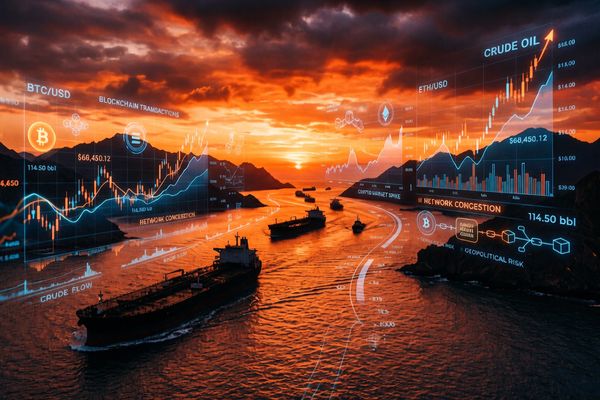 The Strait of Hormuz: A critical chokepoint influencing global oil markets and challenging assumptions about crypto hedges.Image is for illustrative purposes only and does not depict actual events or endorse specific investment outcomes.
The year 2026 has brought to a head a fascinating, almost paradoxical, convergence: the age-old, high-stakes world of Persian Gulf maritime logistics and the hyper-liquid, algorithm-driven universe of digital assets. This unexpected intersection was violently catalyzed on February 28, 2026, when military conflict flared in the Middle East, effectively halting normal shipping through the Strait of Hormuz—the undisputed jugular vein of global energy.[4] As Brent crude prices rocketed from a January baseline of $73 to staggering intraday peaks of $120, investors worldwide found themselves grappling with a pressing question: Does this 'Hormuz Crisis' genuinely offer a data-backed hedge for crypto market volatility, or are both asset classes merely pawns to a larger, shared set of macro-liquidity drivers, rendering such hedging strategies nothing more than a mirage?
This isn't just another hiccup in energy supply; it's a monumental disruption. Fatih Birol, Executive Director of the International Energy Agency (IEA), has starkly described the current energy crisis as the 'greatest threat to global energy security in history,' equating its force to the combined might of the 1973 and 1979 oil shocks and the 2022 invasion of Ukraine.[5] With roughly 20% of global oil and liquefied natural gas (LNG) supply passing through this impossibly narrow waterway, the repercussions on global inflation, central bank policy, and risk-asset valuation have been nothing short of profound.[6]
This deep-dive will meticulously analyze the statistical independence of Bitcoin and oil, dissect the mechanics of tokenized energy as a synthetic hedge, and explore the subtle yet significant geopolitical shift towards alternative settlement infrastructures that are increasingly decoupling digital assets from traditional energy-driven macro cycles. Let's peel back the layers and see what the data truly tells us.
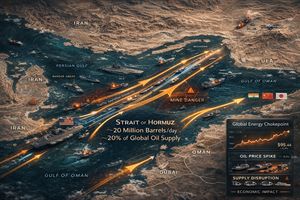 Mapping the perilous Strait of Hormuz, a critical bottleneck for global energy.Image is for illustrative purposes only and does not depict actual events or endorse specific investment outcomes.
The Anatomy of a Chokepoint: Physical and Strategic Realities of Hormuz
The Strait of Hormuz is more than just a waterway; it's a geographic and operational anomaly, a 'single point of failure' for the entire modern global economy.[7] Situated between Iran to the north and Oman and the United Arab Emirates to the south, this vital passage connects the Persian Gulf directly to the Gulf of Oman and, ultimately, the Arabian Sea. The raw numbers speak volumes about its importance.
Physical Constraints and Volume Dynamics
In 2025, just before hostilities commenced, the Strait of Hormuz was handling an estimated 21.8 million barrels per day (mb/d) of crude oil and petroleum liquids, alongside over 110 billion cubic meters (bcm) of LNG.[7] To truly grasp the scale, consider this: nearly 25% of the world’s seaborne oil trade and one-fifth of global LNG trade squeezed through this single, constricted channel.[7]
The navigational channels themselves are exceptionally narrow, barely two miles wide at their tightest points.[8] This physical reality enables 'asymmetric attrition,' a chilling tactic where regional actors can inflict massive economic pressure through relatively low-cost military interventions.[8] Since February 2026, Iranian forces have leveraged an arsenal of 5,000 to 6,000 naval mines, deployed specialized boarding teams comprising 20,000 Revolutionary Guards personnel, and utilized sophisticated rocket-propelled systems like the Chinese-made EM-52 to target commercial vessels.[8]
The Operational Collapse and the Insurance Tax
While the Strait hasn't always been physically blocked in a complete, impassable sense, it has effectively become a 'no-go zone' for international shipping, largely due to the catastrophic collapse of the maritime insurance market.[9] Standard maritime insurance rates, typically a negligible 0.01% of a vessel’s value, skyrocketed to an astonishing 1.0% during the peak of tensions in March 2026.[8] For a state-of-the-art supertanker valued at $100 million, this translates to a $500,000 surcharge for a single passage—a cost that renders commercial viability untenable for many operators.[8]
By the third week of the conflict, AIS-visible crossings had plummeted to near zero, with a mere 16 vessels recorded transiting the Strait in a single week.[10] Those brave enough to attempt passage often engaged in 'dark activity,' turning off transponders and altering routing behavior to evade detection or retaliatory strikes.[10] This dangerous operational environment has compelled Gulf producers—including Saudi Arabia, Iraq, Kuwait, the UAE, Qatar, and Bahrain—to shut in an estimated 11 million to 17 million barrels per day of crude production as their storage facilities rapidly filled to capacity.[11]
"A sustained shutdown of the strategic waterway could lead to catastrophic consequences for global oil markets."
Common Misconception: Many investors incorrectly assume that a blockade must imply a total physical barrier. The reality is that the 'insurance tax' effectively halts trade and creates economic paralysis long before any physical obstruction is ever established.[12]
Monitor Shipping Surcharges
Instead of fixating solely on military headlines, astute investors should monitor 'War Risk Surcharges' issued by major carriers like Maersk and MSC. These surcharges frequently precede official supply chain data by as much as 72 hours, offering an early warning signal of escalating risk and economic impact.[13]
Energy Market Shockwaves: Inventories and Refined Products
The International Energy Agency has unequivocally assessed the current crisis as the most significant supply disruption in the history of global oil markets.[7] The staggering loss of nearly 20 mb/d of crude and refined product exports has created acute tightness, particularly devastating for Asian markets, which typically receive approximately 80% of the oil transiting the Strait.[7]
The "Invisible Floor" of Global Inventories
A primary driver behind the current volatile price action is the precarious state of global stockpiles. For years leading up to the conflict, chronic underinvestment in upstream capacity and a robust post-pandemic demand surge had left inventories critically thin.[9] Amin Nasser, the CEO of Saudi Aramco, highlighted that global oil inventories were already at five-year lows even before the February 28 strikes.[14]
The IEA's emergency release of 400 million barrels—the largest in its history—was intended to 'comfort the markets.' Yet, expert consensus, including Birol’s, suggests this is merely a 'band-aid' solution.[5] At current disruption levels, these reserves represent less than 40 days of the total lost Gulf output, underscoring the severity of the long-term structural deficit.
Disruption of the Refined Product "Vitals" and the Food Security Timebomb
The Hormuz crisis has also effectively paralyzed the export of refined oil products, a sector in which the Gulf region serves as a crucial global hub. In 2025, the region exported 3.3 mb/d of refined products and 1.5 mb/d of liquefied petroleum gas (LPG).[7] The cessation of these vital flows has hit the aviation, agriculture, and automotive sectors with particular ferocity.[14] More than 4 mb/d of refining capacity in the region has been shut down or severely damaged due to military strikes and a critical lack of export outlets.[15]
Furthermore, the disruption of fertilizer materials—specifically sulphur and urea—poses a dire 'food security timebomb'.[12] Roughly 50% of the world's seaborne sulphur trade and 32% of global urea trade pass directly through the Strait.[8] Major agricultural powerhouses like India and Brazil are heavily reliant on these Middle Eastern supplies to sustain their essential crop outputs, inevitably leading to 'agflation'—the escalating cost of food driven by agricultural production expenses.[8]
"This crisis, as things stand now, is two oil crises and one gas crisis put all together."
Technical Nuance: A critical 'edge case' illustrating the cascading impact is Lebanon’s electricity grid, which faces total systemic collapse. This dire situation stems from its 100% reliance on fuel oil imports, which must transit these increasingly perilous regional routes.[12]
Rethink Emerging Market Equity Allocations
Equity investors should consider rotating out of consumer discretionary sectors in emerging markets, particularly those heavily exposed to Gulf supply chains (like India's Sensex). Instead, direct capital towards domestic fertilizer producers or agricultural technology companies insulated from these specific geopolitical risks.[13]
Bitcoin and Oil: Debunking the Correlation Myth
The popular narrative among some investors often posits Bitcoin as a reliable hedge against energy-driven inflation. However, the 2026 Hormuz crisis has provided definitive, undeniable data that strongly suggests Bitcoin and crude oil returns are, in fact, 'statistically independent processes'.[4] This finding directly challenges the long-held assumption of a direct, inverse relationship.
Statistical Analysis of the Decoupling
Binance Research, after a meticulous analysis of ten years of weekly data (2016–2026), found no stable return-level relationship between Bitcoin and oil.[4] The correlation coefficient consistently proved indistinguishable from zero across the vast majority of macroeconomic regimes.[4]
The only period exhibiting a somewhat significant positive correlation (+0.34) was between 2020–2022. This timeframe was, notably, characterized by unprecedented global monetary easing and fiscal stimulus, a period where virtually all risk assets moved in tandem due to a shared, overarching liquidity factor.[4] Even then, an R-squared value of just 6.9% meant that a staggering 93.1% of Bitcoin's return variation was explained by factors entirely unrelated to oil.[4]
The Hormuz Stress Test: February–March 2026
The crisis following the February 28 strikes delivered a crucial out-of-sample confirmation of this independence. Between February 23 and March 18, 2026, Brent crude dramatically surged by 46% as supply fears reached a fever pitch.[4] Over that exact same window, Bitcoin robustly gained 15%, significantly outperforming both the Nasdaq (+1%) and gold (-3%).[4]
Bitcoin’s response to the crisis followed a distinct three-phase pattern:
- Expectation Shock (Days 1–3): An initial, albeit brief, weakness where Bitcoin dipped 3% to a crisis low of $63,047 on February 28, reflecting a generalized, knee-jerk risk-off transmission across markets.[4]
- Range-Bound Absorption (Days 4–14): As oil prices began to stabilize near the $100 mark, Bitcoin remarkably remained range-bound, trading consistently between $66,000 and $73,000, demonstrating a surprising resilience.[4]
- Independent Rally (Days 15–24): A decisive decoupling occurred as Bitcoin launched from $66,000 to $75,000, driven predominantly by fresh institutional demand rather than any direct energy market signals.[4]
"Oil and Bitcoin move ‘essentially independently’, with no meaningful and stable correlation."
Edge Case: While the data overwhelmingly shows oil doesn't directly drive Bitcoin, a phenomenon known as 'forced deleveraging' can create brief, artificial correlations. Funds facing margin calls on underwater energy positions may be compelled to sell highly liquid assets, including gold or Bitcoin, to raise immediate cash.[16]
Avoid Direct Short Signals on Oil Spikes
Do not interpret oil price spikes as a direct short signal for Bitcoin. Instead, look for Bitcoin to demonstrate its decoupling resilience and emerge as a 'liquidity source of last resort' approximately 14 days after the initial shock, once forced deleveraging pressures have subsided.[4]
Institutional Capital: The "Decisive Factor" in Crypto Stability
The primary reason for Bitcoin’s surprising resilience during the 2026 energy shock points to a fundamental and enduring shift in market structure. The introduction of U.S. spot ETFs in early 2024 anchored the market with what can only be described as 'sticky' institutional capital, providing a robust buffer that effectively absorbed macro shocks.[4] This was not merely a retail-driven speculative surge, but a calculated influx of long-term capital.
The ETF Inflow Buffer
During the very peak of the Hormuz crisis (March 2–17, 2026), spot Bitcoin ETFs collectively recorded impressive total net inflows of +$1.7 billion.[4] This sustained institutional appetite was most visibly demonstrated between March 9 and March 17, a period that saw seven consecutive trading days of positive inflows, averaging a healthy +$166 million per day.[4]
This consistent institutional presence has effectively created a 'floor' for Bitcoin, a critical development that prevents the dramatic 70-80% drawdowns observed in previous, pre-ETF cycles.[17] Consequently, the 2026 crisis suggests that geopolitical oil events are now more likely to create strategic 'allocation entry points' for institutions rather than pose existential, terminal risk events for the asset class.[18]
"Nvidia's P/E, or price-to-earnings ratio, was 40 times. Since then, it's been cut in half... But keep in mind, Nvidia keeps raising its revenue estimates."
Technical Nuance: The 'Coinbase Premium'—the price difference between Bitcoin on Coinbase (favored by institutional investors) and other exchanges—actually flipped positive in early March 2026. This subtle but significant indicator signaled that U.S.-based institutional buying was, in fact, the primary underlying driver of Bitcoin's recovery, rather than broader retail sentiment.[4]
Track Net ETF Inflows for Institutional Sentiment
During market crises, closely monitor Net ETF Inflow data daily. If these inflows remain consistently positive despite a 10% or greater price dip, it's a strong indicator of robust institutional 'buy-the-dip' behavior, rather than a generalized retail panic.[4]
Tokenized Energy: The True Data-Backed Hedge?
While Bitcoin has clearly demonstrated its independence from oil, it doesn't provide a direct, symmetrical hedge for those explicitly seeking to capitalize on or mitigate energy scarcity. For these investors, however, the 2026 crisis has significantly accelerated the adoption of tokenized Real-World Assets (RWAs). Energy tokenization—the digitalization of physical oil or infrastructure on a blockchain—offers a novel and direct mechanism for neutralizing energy price shocks.[19]
Technical Nuances of Tokenized Oil
Tokenized oil assets, such as those issued on robust platforms like ChainUp or leveraging Chainlink’s Proof of Reserve infrastructure, represent a direct, verifiable claim on a physical barrel of crude.[19] Unlike traditional 'paper oil' or futures contracts that often settle in cash with significant delays, tokenized oil exists on a shared, immutable ledger and can frequently be redeemed for physical delivery or instantly cash-settled.[19]
- Atomic Settlement (T+0): Traditional energy trades can take 2-3 days to settle, forcing banks to incorporate an 'uncertainty premium' in volatile times. Tokenized oil settles at the speed of the internet, virtually eliminating counterparty risk during supply panics.[19]
- Fractional Liquidity: Traditional hedging mechanisms demand high capital and complex futures accounts. Tokenization democratizes access by allowing fractional ownership, down to 1/1,000th of a barrel. This makes hedging against fuel costs accessible even for small businesses and individual households.[19]
- On-chain Provenance: Tokenized barrels come with embedded metadata, a 'digital passport,' allowing buyers to instantly identify and pivot to supply from stable, non-conflict regions in real-time, greatly enhancing supply chain transparency and resilience.[19]
The "Neutralization" Mechanism
During the 2026 crisis, tokenized oil assets proved to be a remarkably robust solution for protecting operating budgets. As geopolitical tensions drove petrol prices up by as much as 40 cents per litre at the pump, the value of an investor's corresponding digital oil holdings increased proportionally.[19] This direct 'neutralization' mechanism allowed users to effectively offset the immediate hit to their wallets through corresponding gains in their on-chain portfolios.
"Tokenization bridges the gap between the physical barrel and the digital trade."
Common Misconception: Many mistakenly believe tokenized oil is simply another 'stablecoin.' In reality, it is a programmable claim on physical inventory, often rigorously verified and secured by decentralized infrastructure like Chainlink’s Proof of Reserve, providing far more tangible utility than a mere peg.[20]
Leverage Tokenized Oil for Operational Hedging
Small and medium-sized businesses can strategically utilize tokenized oil to 'neutralize' the impact of rising petrol costs. By holding a digital position equivalent to their monthly fuel consumption, the gains in their tokenized portfolio can directly offset increases at the pump, providing a dynamic and efficient hedge.[19]
The Geopolitical Pivot: De-dollarization and the RMB Infrastructure
The Hormuz blockade has done more than just disrupt physical trade; it has inadvertently accelerated a fundamental paradigm shift in the monetary framework governing energy trading. Sanctioned nations, alongside major importers like China, have shrewdly leveraged the crisis to hasten the transition away from the 'Petrodollar' towards a more multi-polar 'Petroyuan' and an entirely new digital settlement system.[21] This is a long-game strategy now playing out in real-time.
The Rise of the Petroyuan and Project mBridge
Beijing has been diligently constructing the necessary financial infrastructure for years, specifically designed to route around the U.S. dollar's dominance. In 2026, credible reports emerged that Iran was permitting tankers to transit its waters exclusively if the trade was settled in Chinese yuan.[22] This pivotal shift is strongly supported by Project mBridge, an ambitious cross-border CBDC (Central Bank Digital Currency) platform that includes the central banks of China, Thailand, the UAE, and Saudi Arabia.[23]
Project mBridge has witnessed activity scale sharply since late 2024, with transaction volumes exploding by 2,500-fold from its early pilots to surpass $55 billion by November 2025.[24] In late 2025, the UAE executed its first government payment using the wholesale digital dirham on mBridge, a critical test of the system’s readiness to settle substantial energy trade outside traditional dollar rails.[23]
ElectroYuan 1.0: "Rails Before Reserves"
A crucial APRI report on 'ElectroYuan 1.0' identifies a brilliant, subtle strategy: China isn't necessarily aiming to replace the dollar as the world's primary reserve currency. Instead, it's meticulously creating 'corridors' where the renminbi simply becomes the path of least resistance.[25] By strategically bundling its dominance in green manufacturing—think EV fleets, expansive solar grids, and charging infrastructure—with long-dated RMB finance and warranties, currency adoption subtly becomes a 'procurement default.'[25]
The 'existence proof' of this strategy was vividly demonstrated in Uzbekistan, where a Chinese firm successfully settled a 500-MW wind power project’s contracts entirely in renminbi.[25] This signifies a monumental shift from 'Petrodollar' logistics (where prices are set and defended by the U.S.) to an 'ElectroYuan' stack (where prices and services are increasingly dictated by China).[25]
"The high efficiency of the digital yuan will not only enhance the swiftness and convenience for global traders and investors, but also streamline the entire business chain."
Technical Nuance: The e-CNY framework underwent a significant update on January 1, 2026, to allow for interest-bearing features. This crucial enhancement makes the digital yuan a far more viable savings-adjacent instrument for international trade partners, further incentivizing its adoption over traditional currencies.[26]
Monitor Cross-Border Payment System Evolution
Investors should diligently monitor the growth of CIPS (Cross-Border Interbank Payment System) transaction volumes. A noticeable spike in non-dollar denominated volumes, especially during energy crises, serves as a strong signal of a permanent and accelerating erosion of 'Petrodollar' dominance.[21]
Stagflation and the Federal Reserve’s Impossible Choice
The sudden and sharp oil spike at Hormuz has, unfortunately, revived the dreaded 'unholy trinity' of stagflation: persistently rising prices, agonizingly slowing economic growth, and the insidious threat of negative job creation.[27] This toxic environment has placed the Federal Reserve squarely in a 'difficult holding pattern,' as explicitly noted in the March 18, 2026, FOMC minutes.[28]
The Inflationary Impulse
Core PCE inflation—the Federal Reserve’s preferred gauge for underlying price pressures—stubbornly remained at 3.0% for the fifth consecutive year, even before the full impact of the oil shock registered in the official data.[27] Federal Reserve Chair Jerome Powell, in his March 2026 press conference, emphasized the critical need for the Fed to 'carefully monitor inflation expectations.' This vigilance is paramount because a succession of significant supply shocks can lead the public to internalize and begin expecting higher inflation over the long term, a truly dangerous scenario.[29]
The dilemma facing the Fed is stark and unenviable:
- Cutting Rates: To support an already cooling labor market (with unemployment at 4.4% in February) would risk unleashing a 1970s-style wage-price spiral, especially given current elevated oil prices.[27]
- Raising Rates: To aggressively combat the $113+ oil-driven inflation would risk tipping an economy already teetering (Q4 GDP was revised down to a meager 0.7%) into a deep and potentially protracted recession.[28]
The "Look Through" Policy
Initially, Powell hinted that the Fed might 'look through' the energy shock if it proved to be merely temporary. However, with at least 40 energy assets in the Gulf now 'severely damaged,' even a complete cessation of military conflict will not instantly restore supply capacity.[5] This profound structural disruption has compelled Goldman Sachs to push back its forecast for the first rate cut from June to September 2026. Simultaneously, the Fed’s own projections now show only a single rate cut for the entirety of the year, signaling a prolonged period of tighter monetary conditions.[30]
"We have very powerful tools. They're supposed to be for maximum employment and price stability."
Edge Case: Beyond acting as a direct 'tax' on every American consumer, high oil prices also critically disrupt the global supply of helium. This often-overlooked commodity is absolutely essential for the cooling systems in advanced MRI scanners and, crucially, for semiconductor fabrication—a bottleneck for numerous industries.[3]
Prepare for "Higher for Longer" Rates
Anticipate 'higher for longer' interest rates, even in the face of slowing economic growth. In a stagflationary environment, Treasury Inflation-Protected Securities (TIPS) and physical gold typically outperform broad equity indices, offering valuable portfolio protection and inflation-hedging capabilities.[27]
Comparative Asset Performance: Gold vs. Crypto
A final, critical pillar of our data-backed hedge analysis involves examining the comparative performance of traditional safe havens versus digital assets during the tumultuous March 2026 volatility. The results offer some compelling insights that challenge conventional wisdom.
Gold: The Liquidity Source of Last Resort?
Contrary to its entrenched 'safe haven' reputation, gold demonstrably struggled during the initial Hormuz shock. While it initially spiked towards $5,500, it quickly reversed course, falling over 6% from its intraday high.[31] This counter-intuitive behavior was primarily driven by 'forced deleveraging.' As oil prices soared, they created immense margin stress across commodity trading desks. Funds finding themselves underwater on energy positions were compelled to sell their most liquid asset—which often was gold—to raise immediate cash and meet margin calls.[31]
Bitcoin: The Decoupling Signal
In stark contrast, Bitcoin’s intraday volatility was efficiently absorbed by its new, robust institutional demand channels.[18] While Bitcoin saw a year-to-date fall of 24.7% through March 27, it demonstrated a specific and remarkable resilience during the three crucial weeks of the Hormuz shock, significantly outperforming gold.[18]
"The largest oil supply shock ever will likely lead policymakers and markets to recognise the structural risks from the high concentration of production."
Technical Nuance: Bitcoin mining profitability, often measured by 'hashprice' (revenue per unit of compute), fell to a record low of $27.89 per PH/s/day in February 2026. However, this decline was predominantly due to Bitcoin's own price corrections rather than a direct impact from rising energy costs, as approximately 90% of global miners utilize non-oil reliant energy grids.[32]
Differentiate Portfolio Roles for Bitcoin and Gold
For genuine portfolio diversification, it's crucial to treat Bitcoin as a high-beta technology asset with unique decoupling properties during specific geopolitical shocks, and Gold as a long-term hedge against currency debasement. Avoid viewing them as interchangeable assets with similar risk profiles or hedging functions.[33]
Conclusion: Synthesising the Hormuz Hedge
The question of whether the Strait of Hormuz truly represents a 'data-backed hedge' for crypto investors demands a nuanced, multi-faceted answer. Our in-depth analysis of the 2026 crisis unequivocally confirms three fundamental and transformative shifts occurring within the global financial architecture.
First, and perhaps most decisively, Bitcoin has formally and decisively decoupled from traditional energy markets. Its price action is now primarily driven by its own intrinsic institutional liquidity and burgeoning digital-native demand channels, rather than being beholden to the volatile fluctuations in the price of crude oil.[4] Statistical correlation remains stubbornly near zero, meaning oil forecasts are no longer reliable signals for making informed crypto trades.[4]
Second, the concept of a direct 'Hormuz Hedge' for actual energy price exposure is no longer confined to traditional markets; it is rapidly migrating onto the blockchain through the innovative power of tokenized Real-World Assets (RWAs).[19] The inherent technical advantages offered by atomic settlement and fractional ownership have propelled on-chain oil into a far more efficient and tactical instrument for managing inflation than cumbersome, traditional paper futures contracts.[19]
Third, the geopolitical response to the blockade—specifically the accelerated development and adoption of the Petroyuan, Project mBridge, and ElectroYuan systems—is actively constructing a permanent 'shadow' financial infrastructure. This burgeoning system is designed to intelligently route around the entrenched dollar-based system, potentially rendering the burgeoning crypto-economy significantly more resilient to future U.S.-centric macro shocks over the long term.[21]
For professional investors navigating these complex waters, the data strongly suggests that adjusting Bitcoin positions based solely on Hormuz headlines is, in fact, a category error.[18] Instead, the crisis profoundly underscores the critical importance of monitoring oil for its broader impact on the macro environment—specifically, its influence on inflation expectations, Federal Reserve policy, and overall global liquidity—rather than seeking a direct, one-to-one correlation with digital assets.[18] As the Strait of Hormuz remains 'effectively closed' and regional energy assets suffer irreversible damage, the 'Hormuz Crisis' will undoubtedly be remembered as the pivotal event that matured the crypto-market from a largely retail-driven speculative vehicle into a permanent, institutionally-buffered, and increasingly independent component of the global financial infrastructure.[5]
Finance FAQs: Navigating Crypto & Oil Volatility for Investors
Does Bitcoin correlate with oil prices in 2026?
What is the "War Risk Premium" impact on global shipping?
How does the Hormuz crisis affect global food security?
Can tokenized oil be used as collateral in digital finance?
How does "Project mBridge" bypass the US dollar in energy trade?
Disclaimer: This article covers financial topics for informational purposes only. It does not constitute investment advice and should not replace consultation with a licensed financial advisor. Images, charts, and visuals are for illustrative purposes only. Please refer to our full disclaimer for more information.