
Hormuz Impact: 5 Resilience Lessons for Oil Prices 2026 – Navigating a Canon Event
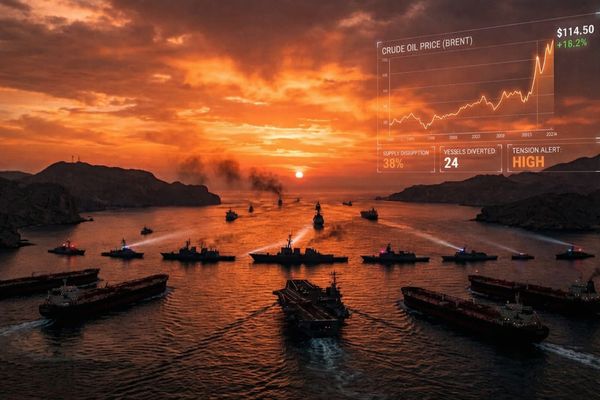 The Strait of Hormuz blockade in 2026: A pivotal moment for global oil prices.The image above is an artistic representation and does not depict actual events or individuals.
The 2026 Hormuz Crisis isn't just another blip on the geopolitical radar; it's a 'canon event' that has fundamentally reshaped the global energy landscape. For weeks, the world watched as escalating warfare in the Persian Gulf culminated in the United States' announcement of a full naval blockade of Iranian ports on April 13, 2026. This decisive move sent Brent crude prices rocketing past $103 per barrel, a stark reminder of our enduring reliance on a volatile region [1]. But beyond the immediate price surge, this crisis has unveiled profound lessons in resilience for anyone navigating the complex world of oil prices in 2026 and beyond.
General news outlets often miss the subtle yet critical 'Iraqi exception' that initially offered a glimmer of hope. In the conflict's early stages, a select few vessels, primarily those from non-hostile nations, were granted passage through a tightly controlled northern corridor. However, this fragile arrangement crumbled by April 12, 2026, when US-Iran negotiations failed, forcing even these privileged tankers to execute abrupt 180-degree turns at the Strait's entrance [9]. This signaled the total closure, plunging markets into an unprecedented liquidity shock. We're not just talking about gas prices; this is about understanding the systemic vulnerabilities of a globalized economy. Let's dive into the five crucial lessons this crisis has taught us.
 The intricate web of global energy logistics faces unprecedented challenges during the Hormuz Crisis.The image above is an artistic representation and does not depict actual events or individuals.
Lesson 1: Strategic Reserves are a Bridge, Not a Destination
The 2026 Hormuz Crisis has unequivocally redefined the operational utility of Strategic Petroleum Reserves (SPRs). While the International Energy Agency’s (IEA) unprecedented release of 400 million barrels served as a vital, albeit temporary, 'liquidity shock,' it ultimately proved incapable of counteracting the structural loss of 9.1 million barrels per day (bpd) in global oil production [6]. The critical lesson for 2026 is that strategic reserves function as a bridge to manage the velocity of price increases, not as a permanent solution to halt them entirely.
A common misconception prevalent in early 2026 was that this massive release would 'fix' the market. However, as Fatih Birol, Executive Director of the IEA, incisively observed, "The only sustainable solution is the safe resumption of transit through the Strait" [7]. This profound statement underscores that for nations heavily reliant on SPRs, the 'bridge' afforded by these reserves is only as robust as the diplomatic or military strategies concurrently deployed to resolve the underlying conflict. The IEA's response in 2026, while successful in preventing refinery shutdowns through liquidity injection, ultimately failed in its price suppression objective, with Brent surging to $103 per barrel despite the intervention [7].
"The oil market challenges we are facing are unprecedented in scale, therefore I am very glad that IEA member countries have responded with an emergency collective action of unprecedented size,"
The technical nuance here lies in the sheer scale of global inventory draws. In Q2 2026, global inventory draws reached an alarming 5.1 million bpd [5], rapidly depleting the buffer provided by the IEA release. True resilience in 2026 demands a dual-track approach: maintaining substantial strategic reserves while simultaneously investing in and building redundant physical infrastructure. It’s about more than just having oil; it’s about the ability to move it efficiently and safely.
Future-Proofing Reserves
Policymakers should view the SPR as an "Emergency Room" intervention—essential for immediate stabilization, but never a substitute for the "surgery" required to restore physical supply lines or pivot towards more decentralized, secure energy sources.
Lesson 2: Redundancy is the Only True Security
The 2026 crisis dramatically elevated the status of Saudi Arabia's East-West pipeline (Petroline) and the UAE’s Habshan-Fujairah pipeline from mere 'insurance policies' to indispensable lifelines for global energy security [10]. These overland arteries, despite their finite capacities, became the sole viable routes for Gulf crude to reach international markets in Asia and Europe, effectively bypassing the perilous Strait of Hormuz [10]. The monumental achievement of the Petroline reaching its designed maximum throughput of 7 million bpd on March 28, 2026, underscores a crucial point: long-term, strategic investment in redundant pathways is the only truly effective mitigation against chokepoint risks [10].
However, the concept of redundancy extends beyond simply laying more pipe; it crucially involves ensuring that loading and export capacities match pipeline throughput. The 'Yanbu Bottleneck' of 2026—where the East-West pipeline delivered 5 million bpd of export-grade crude, yet the Yanbu export terminal could only effectively load 4 million bpd—highlighted a critical flaw in resilience planning [10]. This discrepancy created an immediate challenge, leading to operational inefficiencies and missed opportunities. True redundancy, therefore, necessitates end-to-end capacity matching, from the initial wellhead to the final tanker berth, ensuring seamless flow.
"The current crisis at Hormuz has forced the world to rely on two specific pipelines, Saudi Arabia's East-West artery to Yanbu on the Red Sea, and the UAE's Habshan-Fujairah pipeline to the Gulf of Oman,"
Adding to this, the UAE’s Habshan-Fujairah pipeline also demonstrated remarkable resilience, surging from its normal 1.1 million bpd capacity to 1.8 million bpd in late March [12]. Fujairah’s extensive storage capacity, over 70 million barrels, coupled with the ongoing construction of the world’s largest underground crude storage cavern, provides an invaluable strategic advantage [13]. Despite these vital bypasses, their combined capacity of approximately 9–10 million bpd still fell significantly short of the 20 million bpd that typically transits the Strait [10]. This 10 million bpd deficit was the primary driver for the unprecedented 9.1 million bpd production shut-in across Iraq, Kuwait, and the UAE [6]. The lesson is undeniable: for a 2026 energy leader, redundancy must be rigorously tested and flawlessly integrated across the entire logistics chain. Any solitary point of failure, whether a pumping station or a loading berth, can effectively nullify a multi-billion-dollar investment in bypass infrastructure.
Optimizing Export Throughput
Global logistics providers must shift their focus from mere 'pipeline capacity' to 'demonstrated export throughput.' This entails substantial investment in floating storage solutions and pre-negotiated emergency berthing contracts at critical hubs like Yanbu and Fujairah, activatable within 72 hours of any chokepoint closure.
Lesson 3: The "Dark Fleet" is a Double-Edged Sword
In the tumultuous landscape of 2026, Iran’s 'dark fleet' of approximately 200 vessels emerged as an unexpected, yet significant, factor in global supply stability [14]. By continuing to move 60-70% of its normal oil volumes through opaque shadow networks, Iran inadvertently prevented the total supply vacuum that would have otherwise propelled crude prices towards an astronomical $200 per barrel [15]. For the global market, this shadow supply acts as an unofficial safety valve, mitigating catastrophic price spikes, even as it operates outside and often in defiance of international sanctions and maritime regulations.
The technical nuance defining these 2026 dark fleet operations is their sophisticated utilization of the Jask terminal on the Gulf of Oman [14]. By loading oil outside the traditional Persian Gulf chokepoint, Iranian tankers effectively bypass the Strait of Hormuz entirely, enabling millions of barrels to flow undetected by conventional tracking systems. This network has evolved into a "sophisticated system capable of transporting substantial petroleum volumes despite comprehensive international sanctions" [14].
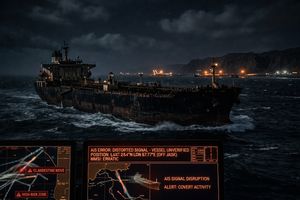 Iran's 'dark fleet' operates in shadows, navigating geopolitical tensions to sustain oil flows.The image above is an artistic representation and does not depict actual events or individuals.
However, this reliance on the dark fleet is fraught with "deeper risks" that remain critically underestimated by many market analysts [15]. These vessels are predominantly aging, poorly maintained, and operate with minimal or entirely absent conventional insurance coverage [8]. Any significant accident involving a dark fleet tanker could trigger an environmental catastrophe of immense proportions, which would further restrict the already narrow and precarious corridors currently monitored by the Islamic Revolutionary Guard Corps (IRGC) [8].
"This network, built over years of sanctions pressure, now plays a central role in stabilizing supply during geopolitical stress,"
The existence of the dark fleet creates a bifurcated global energy market where traditional price discovery mechanisms are increasingly decoupled from physical reality. While official figures might suggest a near-total collapse in exports, the presence of this 'shadow supply' is precisely what prevented prices from reaching the $200 per barrel threshold that Tehran threatened [11]. The resilience lesson here is one of 'strategic ambiguity.' Global policymakers often find themselves balancing the imperative for oil supply with the necessity of security, frequently tolerating dark fleet flows to avert a catastrophic supply shock. For the astute business leader, the key takeaway is that 'visible' tanker data alone no longer provides a complete or accurate picture of global oil supply.
Detecting Shadow Changes
Maritime insurance providers and regulatory bodies must urgently develop more robust 'shadow-change' detection methods. As the dark fleet enhances its AIS manipulation capabilities, identifying vessels involved in illicit transshipment operations becomes paramount for preserving the integrity of international sanctions and ensuring maritime safety.
Lesson 4: The 2026 Crisis is an Industrial, Not Just a Consumer, Shock
Perhaps the most profound resilience lesson gleaned from the 2026 Hormuz Crisis is that modern energy crises are inherently multi-commodity events, extending far beyond the immediate impact on gasoline prices. The Strait's closure didn't just push gasoline prices in places like Carson, California, above $6.00 a gallon; it concurrently triggered a severe global food security threat through an acute urea shortage and crippled the aviation industry with a staggering 95% jump in jet fuel costs [3]. This intricate interconnectedness means that a shock originating in one primary sector, such as oil, rapidly cascades into a 'canon event' for seemingly unrelated industries, including farming, global travel, and logistics.
Technical nuances in refining and chemical processes are the primary drivers of these ripple effects. Because urea, a critical nitrogen-based fertilizer, is derived from natural gas, and the Hormuz crisis severely restricted Qatari LNG and broader Gulf gas flows, the cost of fertilizer skyrocketed by an astonishing 140% [3]. This dramatic increase makes basic food production, especially for staple crops like corn and wheat, prohibitively expensive, leading to widespread fears of food insecurity not only in developing nations but also within the food-import-dependent Gulf states themselves [3].
"The Strait of Hormuz is central to the global fertiliser trade... Much of the cost of producing some foods, including corn and wheat, is in the cost of fertiliser, and this cost, along with rising energy costs, makes basic food production very expensive,"
An edge case highlighting the localized severity of this industrial shock is the situation in Italy, where refueling services at major airports, including Bologna and Milan, were restricted for operators linked to Air BP Italia [4]. Similarly, in the United Kingdom, airline Aurigny canceled all flights for nearly two months due to a specific vulnerability to Kuwaiti fuel providers [4]. Airlines globally are now grappling with the impossibility of passing these extreme costs directly to consumers without annihilating demand. As Scott Kirby, CEO of United Airlines, noted, "It may be a challenge to continue passing through much of the increased fuel price if oil stays higher for longer" [4]. Consequently, major carriers have commenced 'tactically pruning' unprofitable routes, leading to a projected 5% to 10% reduction in global summer flight capacity [4]. Resilience in 2026 requires looking far beyond the primary commodity price. A truly effective 'boss' in this environment understands that their entire supply chain is only as robust as its weakest chemical or fuel input.
Diversifying Industrial Inputs
Industries reliant on energy-intensive inputs must diversify their sourcing. For agricultural entities, this means accelerating the adoption of integrated pest and nutrient management to lessen dependence on urea. Logistics firms should prioritize securing long-term contracts for critical refined products like diesel and jet fuel, rather than relying on a volatile spot market during a crisis [3].
Lesson 5: Geopolitics is a Permanent "War-Risk" Premium
The 2026 crisis has definitively proven that geopolitical risk is no longer a 'black swan' event to be hedged against occasionally, but rather a permanent, structural component of the global energy market. Even if the Strait of Hormuz were to fully reopen today, the consensus among experts is that "lingering disruptions to tanker traffic and trade routes are likely to take time to resolve, with the risk of renewed outages expected to keep prices elevated" well into 2027 [5]. The market has effectively internalized and applied a permanent 'Hormuz Premium' to the price of oil, acknowledging an ever-present baseline of instability.
This paradigm shift is explicitly reflected in the US Energy Information Administration's (EIA) revised 2026 forecast, which significantly raised its Brent crude projection from $79 to $96 per barrel [6]. For the first time, major agencies are actively pricing in the enduring probability of future chokepoint shutdowns and related disruptions, rather than merely assessing the impact of current events. The 'rollercoaster' pricing dynamic—where Brent plummeted to $92 during a brief ceasefire only to rapidly skyrocket back to $103—is a clear indicator that the market is now simultaneously "pricing two realities at once" [2]: the immediate supply-demand fundamentals and the embedded, long-term geopolitical risk.
"We maintain a risk premium on crude oil prices throughout the forecast period as we expect uncertainty around future supply disruptions to keep prices above pre-conflict levels."
The common misconception before 2026 was that major supply shocks were temporary aberrations. The Hormuz Crisis shattered this illusion, revealing that the inherent instability of key transit points will continue to exert upward pressure on prices. The final resilience lesson of 2026 is brutally clear: there is no genuine 'back to normal.' The Hormuz Crisis is a canon event that has permanently altered the risk tolerance of global markets. Navigating this new reality like a boss means fundamentally re-evaluating and building business models that are profitable with $100 oil and $10 natural gas as the baseline, not as an exceptional scenario.
Shifting to "Just-in-Case" Capital
Businesses must transition from a 'Just-in-Time' to a 'Just-in-Case' capital allocation strategy. This involves building substantial cash reserves and operational buffers designed to withstand 'risk premium' surges that can persist for years, rather than just weeks, ensuring long-term financial stability [5].
The 2026 Hormuz Crisis has been a harsh, indelible teacher. It stripped away illusions of stable energy markets and highlighted the profound interconnectedness of global supply chains. For anyone operating in finance, logistics, agriculture, or travel, these five lessons aren't just theoretical insights; they are essential blueprints for survival and prosperity in an era where geopolitical events are not exceptions but integral drivers of market reality. Mastering these resilience strategies is no longer optional; it's the defining characteristic of a 'boss' navigating the future of energy.
Hormuz Impact: Key Questions on Oil Price Resilience
How does the 2026 Hormuz blockade affect global oil prices?
Which pipelines can bypass the Strait of Hormuz in 2026?
What is the "Dark Fleet" and why is it important in 2026?
How are airlines coping with the 2026 jet fuel crisis?
Why did the IEA release 400 million barrels of oil in 2026?
Disclaimer: This article addresses trending topics and current events for general informational purposes only. The content may reflect public interest or opinion and has not necessarily been independently verified. Images and visuals are illustrative and may not depict real or official events. For complete details, please review our full disclaimer.