
Game Developer Ethics: Whose Responsibility Is It Anyway? Crafting Sensitive War-Themed Experiences
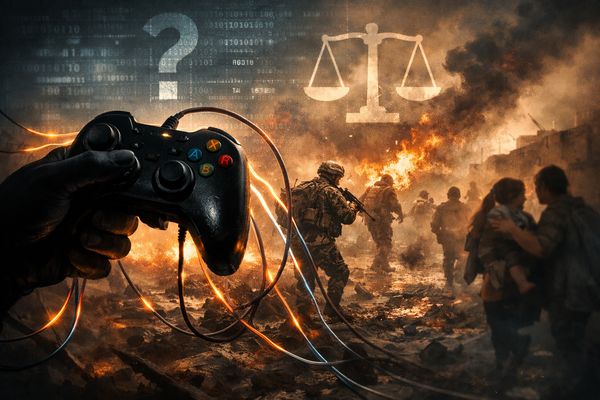 The unseen hand of the game developer shapes our perception of conflict.Image is for illustrative purposes only.
The ethical landscape of interactive entertainment is currently navigating a period of unprecedented scrutiny. As of March 2026, the global gaming industry has become a primary lens through which civilians interact with concepts of modern warfare, blurring the lines between military propaganda, trauma simulation, and consumer play [1]. This complex interplay raises critical questions: Whose responsibility is it to ensure ethical representation in war-themed games? Is it solely the developer's burden, or do regulators, governments, and even players share the load?
Understanding this responsibility requires a deep dive into the historical evolution of war in games, the often-overlooked influence of the military-entertainment complex, the profound psychological effects on players, and the contrasting philosophies of developers attempting to navigate this fraught terrain. It's not merely about what we can show, but what we should show, and the long-term repercussions of those choices.
The Evolving Battlefield: A Historical Perspective on War Game Ethics
The journey of war in video games began with a simplicity that almost entirely sidestepped ethical considerations. Early titles focused on abstract, binary mechanics, stripping conflict of its moral weight. Take 1958's Tennis for Two; it established a foundation for interactive play that completely ignored external context, centering only on the physics of victory [6]. It wasn't until the release of Computer Space in 1971 that the industry introduced the 'kill or be killed' ethical logic, where violence was framed as a neutral prerequisite for survival against an attacking force [6].
This 'defensive violence' trope dominated early arcade and console titles, painting a picture of conflict as a necessary reaction rather than a moral choice. However, a significant shift occurred in 1985 with Ultima IV, which revolutionized player agency by introducing a comprehensive virtue system [6]. Unlike its predecessors, Ultima IV monitored the player's 'net effect over a multitude of independent actions,' rewarding honesty and compassion while penalizing those who ignored individuals in need or fled from honorable combat. This mechanical shift proved that ethical conduct could be gamified as a core success metric, rather than an optional narrative flourish [6].
By the early 2000s, games like Manhunt explored the transgressive opposite, where the brutality of an execution was determined by the duration of a button press [6]. This era highlighted a growing tension between developers who viewed violence as an artistic tool for exploring depravity and those who sought to use games for moral instruction. Today, the framework for analyzing these representations has evolved into a five-lens analytical tool: player perspective, scale and scope, centrality of war, type of military, and authenticity of representation [7].
"While much has been done exploring how ethics and videogames can overlap in interesting ways, there is little work examining the philosophy of war and its relation to videogames."
Technical Nuance: The Multi-Axial Virtue System
A significant edge case in early ethical design was the implementation of 'virtue setbacks' in Ultima IV. If a player performed an 'evil' action, they would lose progress in a specific virtue, requiring a long-term commitment to 'master' all ethical paths to win the game [6]. This system effectively modeled moral character as a cumulative resource rather than a temporary state, a concept rarely seen in modern shooters. It compelled players to consider the ongoing impact of their choices, not just immediate consequences [6].
Implement Cumulative Ethical Trackers
Developers should investigate the use of cumulative ethical trackers (similar to the 1985 Ultima IV virtue system) to force players to live with the long-term social consequences of their in-game actions.
 Early game design explored complex ethical systems, challenging players to live with long-term moral consequences.Image is for illustrative purposes only.
The Shadow of Influence: The Military-Entertainment Complex
The relationship between the United States military and the video game industry is a multi-layered collaboration involving recruitment, public relations, and narrative shaping [8]. Since at least 2018, military branches have paid active-duty personnel to compete in professional 'esports' and interact with the public on platforms like Twitch [8]. This strategic entry into the social world of gamers is designed to make military service feel relatable and to build positive associations with the armed forces, often subtly influencing perceptions without overt propaganda.
'Military realism' in games often functions as an aesthetic mask that omits the social realities of armed conflict, such as non-combatants, children, and the illegality of certain weapons [8]. While game engines can faithfully render the ballistics and recoil of specific rifles, they rarely model the political complexities or the human costs like mental trauma and regret [8]. This aesthetic mode renders weaponry and tactics with high verisimilitude while often casting 'American-led warfare as an inevitable and even natural state of human affairs' [8].
Furthermore, the industry is tied to the military through financial and licensing agreements with firearm manufacturers [8]. Game studios often pay royalty fees to gun companies to include licensed weapons, effectively turning high-definition shooters into interactive marketing tools for real-world firearms [8]. This deep 'web of associations' ensures that the narrative of war remains focused on tactical performance rather than moral accountability, creating a potential common misconception that such realism equates to a full, unbiased depiction of conflict.
"The military's embrace of video games and entry into the social world of video gamers is an attempt to shape players' views, using games that misrepresent the realities of war and the military itself."
Technical Nuance: The Para-social Recruitment Pipeline
An overlooked 'Technical Nuance' is the use of daily conversations on streaming platforms to habituate potential recruits to military life. Unlike traditional television ads, Twitch streams allow active-duty personnel to answer questions in real-time, creating a para-social bond that makes the 'soldier' identity a lifestyle choice rather than a political one [8]. This tactic leverages the popularity of gaming culture to 'blur the lines between civilian and soldier,' making military service appear as an organic extension of a gamer's identity [9].
Increase Transparency on Military & Weapon Ties
Industry analysts recommend that developers publicly disclose any financial ties to weapons manufacturers or military consultants in the game’s 'About' section to enhance transparency and inform consumers.
The Mind Battlefield: Neurological and Psychological Effects of War Simulations
The psychological impact of war games remains a subject of intense academic debate, with research focusing on both desensitization and potential therapeutic benefits. Functional magnetic resonance imaging (fMRI) studies have indicated that playing violent video games appears to desensitize players to real-life violence and the suffering of others [9]. Specifically, researchers observed a reduction in the P3 component of the event-related brain potential when gamers were shown violent images, suggesting a physiological dampening of the stress response [9].
The 'Desensitization Theory' suggests that repeated exposure causes a habituation of negative cognitive and emotional responses, which can manifest as lower activity in the lateral prefrontal cortex [9]. This area is linked to experienced empathy, and its dampening in habitual gamers may lead to a reduced capacity to process the harm of third persons [9]. Conversely, for the military population, this desensitization is often a byproduct of training, resulting in a lower prevalence of depression and anxiety compared to civilians in conflict zones [10].
In conflict zones like Israel, studies conducted in 2024 showed that immediate proximity to traumatic events significantly increases the risk of PTSD, depression, and anxiety, particularly among younger adults and ethnic minorities [11]. While shooters have been criticized for normalizing this violence, they are also being adapted into Virtual Reality Exposure Therapy (VRET) [12]. These clinical tools use the same immersive technologies to help veterans re-experience traumatic memories in a controlled, therapeutic environment, highlighting a fascinating duality in the technology's application [13].
"Our study revealed a significant difference in the levels of depression and anxiety between the civilian and the military groups."
Technical Nuance: The P3 Component Dampening
The 'P3 component' of the brain's event-related potential is a specific neural marker for the processing of emotional information. The reduction of this component in gamers shown violent imagery provides some of the first experimental evidence of a direct link between virtual warfare and physiological desensitization [9]. This suggests that the brain treats virtual violence as a routine, non-threatening stimulus over time, potentially impacting empathy and emotional responsiveness in real-world contexts [9].
Integrate Empathy-Reinforcing Mechanics
Game designers should incorporate 'empathy-reinforcing' mechanics, such as mandatory civilian perspective sequences, to counteract the neural desensitization identified in fMRI studies.
Two Sides of the Coin: Ethical Contrasts in War Games
The ethical divide in war-themed games is best illustrated by the contrasting design philosophies of Six Days in Fallujah and This War of Mine. Six Days in Fallujah focuses on tactical realism and the stories of individual U.S. Marines, but the developer has explicitly stated that they 'don't think we need to portray the atrocities' of the battle [14]. This decision to exclude documented war crimes, such as the use of white phosphorus, has led to accusations of 'sanitizing' history to maintain a focus on tactical heroism [14].
Conversely, This War of Mine reframes the conflict through the lens of a group of civilians attempting to survive in a besieged city [15]. This title enforces difficult ethical choices—such as whether to steal from an elderly couple to feed one's own group—and has been hailed as a landmark 'anti-war' game [15]. While Fallujah has been criticized for being a 'recruitment technology' that reduces the complexity of war, This War of Mine has successfully sold over 9 million copies by forcing players to confront the 'human cost' rather than the tactical thrill [9].
"Are we effectively sanitizing events? I don't think that we need to portray the atrocities in order for people to understand the human cost."
Technical Nuance: Procedural Lethality and Pacing
In Six Days in Fallujah, the gameplay is designed to be 'unforgiving' to convey the lethal reality of urban combat. In one review, the player was defeated within two minutes in 60% of their attempts, a mechanical choice meant to strip away the 'super-soldier' power fantasy found in games like Call of Duty [17]. This level of difficulty functions as a surrogate for the 'tactical anxiety' experienced by soldiers on the ground, creating an intense, albeit specific, form of realism [17].
Audit 'Tactical Realism' for Omissions
Developers should assess whether their focus on 'tactical realism' is being used to elide documented historical atrocities, which can lead to reputational damage and censorship in international markets.
 The aesthetic of military realism often omits the profound human cost of conflict.Image is for illustrative purposes only.
The Watchdogs: Rating Boards and Industry Codes
Regulatory bodies such as the ESRB (Entertainment Software Rating Board) and PEGI (Pan European Game Information) serve as the primary gatekeepers for ethical content, utilizing specific descriptors to warn consumers of 'Intense Violence' and 'Discrimination' [4]. PEGI, which operates in 36 countries, includes a descriptor for 'Discrimination' that is applied to games depicting stereotypes likely to encourage hatred [4]. As of 2026, this descriptor has only been applied to five titles in history, such as expansions for Postal 2, indicating a high bar for regulatory intervention in political narratives [4].
The International Game Developers Association (IGDA) also maintains a Code of Ethics that mandates developers 'strive to create content appropriate for our stated audience' and cooperate fully with regional ratings boards [18]. This includes an obligation to never intentionally hide content from review committees [18]. In 2026, PEGI updated its guidelines to include 'Play by Appointment' for games with daily quest loops, reflecting a shift toward regulating the behavioral ethics of how games are consumed, rather than just their visual content [4].
"The PEGI system is now used in 36 countries and is based on a code of conduct, a set of rules to which every publisher using the PEGI system is contractually committed."
Technical Nuance: The 2026 'Play by Appointment' Mandate
The 2026 update to the PEGI system highlights a growing concern over 'appointment-based' gameplay, such as daily quests that create psychological dependency. This reflects an ethical expansion where regulators are no longer just looking at 'what' the player sees (violence), but 'how' the player is manipulated into continuing play through structural hooks [4]. This addresses an edge case of behavioral ethics, acknowledging that game design can subtly influence player habits in ways that extend beyond explicit content ratings.
Comply with New Behavioral Ethics Standards
Studios must proactively audit their titles for 'appointment-based' mechanics (daily quests) as of July 2026 to ensure compliance with the latest PEGI behavioral ethics standards.
Beyond Bullets: International Humanitarian Law and 'Avoidability Gates'
The integration of International Humanitarian Law (IHL) into game design is an emerging 'Technical Nuance' that challenges the standard shooter loop. The 'Principle of Foreseeable Harm to Innocents' (FHI) suggests that if a commander can see civilians and can spare them, they must do so [19]. This introduces the concept of an 'Avoidability Gate': a design choice where players must exhaust non-kinetic alternatives—different timing, different weapons—before civilian deaths can even be considered 'proportionate' [19].
Modern warfare games often struggle with the 'War is Hell' myth—a conviction that rules cannot apply to the battlefield—which is reinforced when games omit the legal consequences of collateral damage [20]. This common misconception in game narratives can inadvertently normalize actions that would be considered war crimes in reality. However, the 'Just War' theory (comprising jus ad bellum, jus in bello, and jus post bellum) provides a framework for developers to create more nuanced simulations [7]. For instance, a game modeling jus post bellum would force the player to manage the reconstruction of a city after the combat mission is complete, extending the player's ethical engagement beyond the immediate conflict [7].
"If you can see them, and you can spare them, you must spare them."
Technical Nuance: Procedural Reverberating Effects
A 'Secret Knowledge' within the industry is the development of procedural engines that can model the 'reverberating effects' of combat operations. If a player targets a power station (an 'objective'), the engine could procedurally simulate the loss of water and electricity to surrounding civilian hospitals, creating a 'jus in bello' violation that the player must then resolve [21]. This shifts the focus from simple destruction to complex systemic responsibility, pushing players to consider the downstream consequences of their actions in a way traditional shooters rarely do [21].
Integrate Post-Conflict Reconstruction Phases
Designers should incorporate a 'Post-Conflict Reconstruction' phase in mission-based games to force players to witness the long-term impact of their tactical choices on civilian infrastructure.
The Developer's Burden: Secondary Traumatic Stress
Secondary Traumatic Stress (STS) is an emerging crisis in creative professions, particularly for those researching and animating realistic violence or war-themed narratives [22]. STS is distinct from burnout; it arises from 'empathic engagement with trauma survivors' rather than direct exposure [22]. For developers, this can occur when meticulously researching war crimes, interviewing combat veterans, or reviewing graphic archival footage to ensure narrative 'realism,' exposing them to harrowing content [22].
A cross-cultural study found that 65.2% of professionals in Pakistan reported STS symptoms compared to only 20% in Lithuania, highlighting how social support and environmental factors significantly impact resilience [22]. In the media industry, practitioners often score high on depression and burnout because the 'emotionally charged aspects of passion' make it difficult to set professional boundaries with traumatic content [23]. This 'passion tax' means that developers may find themselves reliving virtual trauma in their real lives, feeling helpless or emotionally exhausted, which can be a deeply personal ethical cost of their work [22].
"STS shares core symptoms with Post-Traumatic Stress Disorder (PTSD), such as intrusion, avoidance, and arousal."
Technical Nuance: The 'Intrusion' Symptom in Creatives
A 'Technical Nuance' found in media-specific mental health studies is the 'Intrusion' symptom, where creators of violent content experience unwanted vivid memories of the digital assets they created. This can lead to 'vicarious trauma,' where the developer’s worldview shifts negatively because they have spent years meticulously crafting the worst aspects of human behavior [22]. This insidious effect underlines the hidden ethical burden of creating realistic, sensitive content.
Implement Well-being Check-ins and Debriefings
Studios should implement mandatory 'Well-being Check-ins' and post-stress debriefing sessions for any team members working on narratives involving sexual violence or real-world war crimes.
 fMRI studies reveal a physiological dampening of the stress response in gamers exposed to virtual violence.Image is for illustrative purposes only.
The Bottom Line: Commercial Performance of Ethical War Games
The commercial divide between 'traditional' shooters and 'ethical' war games reveals a massive gap in market share, driven by the popularity of power fantasies. The Call of Duty franchise has sold over 500 million units as of 2024, with titles like Black Ops III reaching 43 million units [25]. These games are aimed at young adults who enjoy high-speed kinetic action, and they have been the best-selling shooters in the U.S. market in 13 of the past 16 years [26]. This dominance highlights a significant industry bias towards commercial viability over nuanced ethical exploration.
In contrast, This War of Mine has sold over 9 million units, a significant figure for an indie title but small compared to AAA juggernauts [16]. Interestingly, This War of Mine maintains a strong player base in China (45%) and the UK (9.8%), demonstrating that there is a global audience for 'empathy-based' survival [5]. However, games that subvert the genre, like Spec Ops: The Line, often suffer commercially; Spec Ops was a financial failure, leading to the effective end of its series despite its critical acclaim for its subversive narrative [27]. This suggests that while critical reception for ethical commentary can be high, it doesn't always translate into comparable commercial success.
"The last shooter game to outsell Call of Duty in the US market over a full year was Gears of War, in 2006."
Technical Nuance: The 'Price Reduction' Sales Spurt
A 'Technical Nuance' in the lifecycle of ethical games is the impact of steep price reductions. In mid-2024, This War of Mine reached the eighth place on trending charts after a price reduction to $1, selling 17,000 copies in a single day—its highest daily total in years [5]. This suggests that 'ethical' content has high latent demand that is unlocked when the financial barrier to entry is removed, indicating a potential market strategy for wider adoption [5].
Prioritize Localization for Ethical Titles
Indie developers should prioritize localization (particularly for the Chinese market) to compensate for the lower domestic sales of 'uncomfortable' ethical war games.
The Propaganda Playbook: Gamifying War in 2026
As of March 2026, the intersection of gaming and government messaging has created a 'disturbing rise of war as entertainment' [2]. Administrative social media feeds have begun blending real footage of missile strikes with visual tropes from Halo, Minecraft, and Grand Theft Auto [1]. One specific 2026 image equated undocumented migrants with 'The Flood'—a parasitic species from the Halo series—effectively dehumanizing real people through the lens of a 'monstrous threat' [1].
This 'gamification of carnage' transforms destruction into a visual performance, inviting the public to admire the 'technological performance of power' while remaining detached from human suffering [3]. Critics, including top clerics of the U.S. Catholic Church, have condemned this 'trivialization of deadly real-life conflict,' arguing that it treats real war like a spectator sport [1]. The use of 'Wii Sports' style edits to describe real-world bombing raids demonstrates a deeper connection where familiarity with games prepares the public to consume war footage in a desensitized manner, reinforcing a dangerous common misconception that real war is just another game [1].
"A real war with real death and real suffering being treated like it's a video game—it's sickening."
Technical Nuance: The 'Poe's Law' of Propaganda
In 2026 political messaging, the use of '4chan memes' and 'Gamer attitudes' creates a state of 'Poe's Law,' where it is impossible to tell if the overt aggression is genuine or performed for 'the lulz' [2]. This ambiguity allows propaganda to circulate widely under the guise of 'ironic' entertainment, bypassing traditional media literacy filters and reaching over 2 billion impressions on social media [2]. This sophisticated manipulation technique makes it difficult for many to discern genuine threats from performative aggression.
Promote Media Literacy Training
Educators and parents must utilize 'Media Literacy' training to help younger generations distinguish between the 'power fantasy' logic of games and the 'geopolitical tragedy' of real-world warfare.
Charting the Course: Future Ethical Frameworks for Game Development
The future of developer ethics is shifting from 'What can we show?' to 'What is our responsibility to the player and the subject?' [29]. Modern game design is increasingly viewed as an outlet for 'real lived human experiences,' where the messiness and politics of a game are what make it memorable [29]. Developers like Emily Mitchell, who created Fractured Minds to explore anxiety, suggest that speaking to 'real people who have gone through this type of thing' is essential for ethical storytelling [30].
Furthermore, the 'Constitutive Function' of games—how they generate meaning through play—is becoming a focus of academic study [31]. It is in the 'playful encounters' where politics and transformation reside, rather than the static narrative [31]. As AI agents begin to coordinate autonomous propaganda campaigns, the role of the human developer as an ethical 'gatekeeper' becomes even more critical in ensuring that interactive media remains a tool for empathy rather than exploitation [28].
"Games are inseparable from their politics, even the most common-place mainstream ones are inherently political. Nothing exists in an isolated bubble."
Technical Nuance: Eudaimonic vs. Hedonic Gaming
A 'Technical Nuance' found in 2026 research is the distinction between 'Eudaimonic' VR games (focused on meaning and insight) and 'Hedonic' games (focused on pleasure and excitement). Studies show that Eudaimonic gaming is more effective for long-term stress reduction and mood management because it provides players with a sense of personal growth and social connection, rather than a temporary 'high' [32]. This highlights a crucial ethical consideration for designers: whether their games contribute to superficial entertainment or deeper, more meaningful experiences.
Prioritize Eudaimonic Design Choices
Lead Designers should prioritize 'Eudaimonic' design choices—mechanics that provide insight into human suffering—to ensure their war games contribute to a more empathetic public discourse.
The scrutiny of game developers' ethical obligations in crafting war-themed experiences reveals a complex hierarchy of responsibility. At the foundational level, the developer is responsible for the 'Authenticity of Representation,' which includes the difficult choice of whether to depict documented atrocities or focus on sanitized tactical skill [7]. The regulator (ESRB/PEGI) provides the ethical guardrails, ensuring that content which encourages hatred or structural manipulation is appropriately gated and disclosed to the public [4]. Finally, the consumer holds the power of market selection, as seen in the 9 million units sold for This War of Mine, indicating a massive demand for narratives that prioritize human empathy over the traditional 'power fantasy' [16].
The future outlook suggests that as military forces continue to leverage games for recruitment and governments use game imagery for propaganda, the industry must develop a 'Collective Ethics' that moves beyond commercial profit [1]. This includes implementing procedural systems like 'Avoidability Gates' and 'Reverberating Effects' to model the true cost of war on civilian infrastructure [19]. By prioritizing the mental health of development teams through the mitigation of Secondary Traumatic Stress, the industry can ensure that it continues to produce 'Legitimate Art' that reflects the messy, political, and profoundly human reality of conflict [22].
Games Ethics: Answering Your Top Questions on War-Themed Experiences
Does playing war games make you more aggressive?
Why are some war games like "Spec Ops: The Line" delisted?
How do game developers protect themselves from trauma?
Are game developers legally required to portray war accurately?
What is the 2026 "Avoidability Gate" in game design?
Disclaimer: This article explores gaming topics for informational purposes only. Strategies, opinions, and experiences are subjective and may not apply universally. Images may be illustrative or inspired and do not represent official game assets or copyrighted material. For additional context, please consult our full disclaimer.