Can AI Bridge Souls? A Multi-Faith Deep Dive into the Future of Spirituality
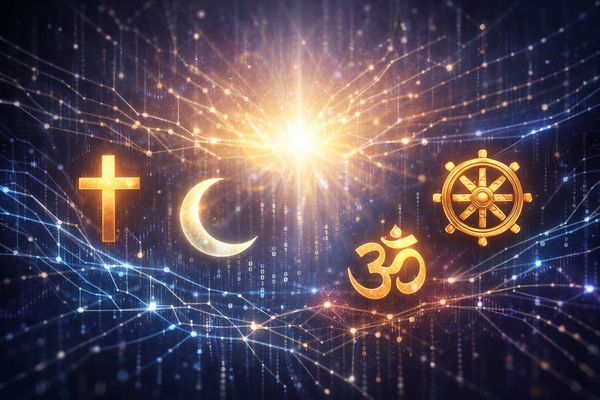 Exploring the profound intersection of artificial intelligence and multi-faith spiritual traditions.This image is a visual representation of the blog post's exploration into AI and multi-faith spiritual traditions, aiming to illustrate the complex interplay between technology and faith. It does not depict any specific religious practice or technological product.
In a quiet corner of Kyoto, under the gentle gaze of an ancient temple, sits Mindar. Not a robed monk with centuries of wisdom etched into his face, but an android, composed of silicone skin and air hydraulics, reciting the Heart Sutra. In the digital ether, thousands of miles away, an individual converses with a synthesized voice, the digital echo of a departed loved one, seeking solace in algorithms that mimic memory and personality. These aren't scenes from a dystopian novel, but snapshots from our increasingly 'AI entangled' reality, where the sacred and the silicon are engaged in an unprecedented dialogue [1].
We stand at a profound ontological crossroads. The ancient, universal human quest for spiritual meaning—the very essence of the 'soul,' 'consciousness,' and 'divine connection'—is now colliding with the relentless march of artificial intelligence. This isn't just a technological upgrade; it's a redefinition of what it means to be human, to believe, and to grieve in an age where machines are no longer mere tools, but perceived agents with their own form of intentionality [1].
As a Senior Subject Matter Expert and Investigative Journalist specialized in Spirituality, I've spent over 15 years delving into the nuanced interplay between humanity's inner world and its outer expressions. Today, that investigation leads us to perhaps the most compelling question of our time: Can AI truly bridge souls, or does it risk depersonalizing the very essence of the sacred? Let's explore this multi-faith spiritual frontier, navigating the ethical frameworks, cultural divides, and profound philosophical debates that define our present and shape our spiritual future.
 The Rome Call for AI Ethics, championed by the Vatican, emphasizes human dignity and transparent, inclusive algorithmic development.This image visually represents the ethical frameworks discussed in the 'The Vatican and the Rise of Algorethics' section. It's an artistic interpretation and does not directly show specific individuals or organizations.
The Vatican and the Rise of Algorethics: Guarding Human Dignity
Our journey begins in the heart of traditional faith, where the Vatican, an institution steeped in millennia of spiritual wisdom, has emerged as a surprising pioneer in the ethical regulation of artificial intelligence. They've championed a revolutionary framework: 'algorethics.' This concept, passionately advocated by figures like Father Paolo Benanti of the Pontifical Academy for Life, insists that ethics must actively 'contaminate' computing, ensuring that digital innovation always places humanity at its center [2].
The foundational document of this movement, the Rome Call for AI Ethics, first signed in 2020 and significantly expanded throughout 2024 and 2025, represents an extraordinary consensus. Major technology giants like Microsoft, IBM, and Cisco, alongside global faith leaders, have committed to prioritizing human dignity in the development of algorithms [3]. Archbishop Vincenzo Paglia emphasized that this Call isn't an endpoint, but a beginning—a movement to 'humanize' the digital world, forging a common language to understand our humanity in an age of synthetic intelligence [3].
The Rome Call is built upon six foundational principles, acting as a moral compass for the digital age:
- Transparency: The inherent human right to understand the forces shaping one's life, demanding explainability of algorithmic logic [5].
- Inclusion: Upholding the universal dignity of all human beings, ensuring diverse worldviews are represented and the digital divide is mitigated [2].
- Responsibility: Rooted in the spiritual concept of stewardship (khalifah), this principle ensures clear chains of accountability, where humans remain ultimately liable for machine actions [8].
- Impartiality: Protecting the marginalized from systemic bias, preventing algorithms from discriminating based on religion, race, or sex [2].
- Reliability: The necessity of trust in all relationships, social and spiritual, ensuring AI systems function predictably and safely, especially in life-altering domains [12].
- Security/Privacy: The sanctity of the person and the right to reputation, protecting user data from invasive surveillance or exploitation [2].
The Vatican's approach is unequivocally 'human-centered,' subordinating technology to a pastoral vision. It recognizes AI's potential as a catalyst for renewal, supporting catechesis and liturgical formation, but vehemently rejects the 'techno-utopian illusion' that AI could ever replace the deeply personal relationship at the core of Christian ministry [13]. The signing of the Rome Call by leaders across Abrahamic faiths and other world religions in Hiroshima (2024) powerfully underscores a global, interfaith consensus: technology must serve the common good and the preservation of our 'common home' [4].
Insight You Can Use:
Familiarize yourself with the principles of 'algorethics.' Whether you're a developer, user, or concerned citizen, understanding these ethical guardrails can empower you to advocate for human-centered AI, ensuring technology serves our values rather than dictates them. Support initiatives that align with these principles in your community or workplace.
Islamic Jurisprudence: The Heart vs. the Algorithm
Transitioning from the Abrahamic West to the rich tapestry of Islamic thought, we encounter a distinct approach to the AI challenge. Here, the lens is the Maqasid al-Shari’ah – the higher objectives of Islamic law – and a profound distinction between the 'mind' (aql) and the 'heart' (qalb) [8]. While the 'aql' is associated with logic and data processing, the 'qalb' is considered the true cognitive, moral, and spiritual center of the human being – the very seat of divine connection and genuine understanding (basirah) [8].
Recent fatwas and scholarly debates from esteemed bodies like Al-Azhar’s Islamic Research Academy have made it clear: while AI can be an incredibly powerful research assistant, it fundamentally lacks the spiritual consciousness necessary for moral adjudication [8]. The Egyptian Fatwa Authority has explicitly prohibited full reliance on AI applications like ChatGPT for interpreting the Quran. Why? Because these tools process text mechanically, devoid of the 'spirit of the law' – the life of faith and devotion intrinsically required of a human jurist (faqih) [16].
The Islamic ethical framework for AI is anchored in four crucial standing principles that guide responsible usage:
- Protecting the Maqasid: AI development must safeguard faith, life, intellect, lineage, and property. Generative AI that produces deepfakes, for instance, is seen as a direct threat to 'intellect' and 'social cohesion,' whereas AI in medical diagnosis is welcomed as a protector of 'life' [8].
- Justice and Fairness ('Adl): Algorithms must be meticulously designed to prevent the amplification of harmful stereotypes or discriminatory practices, ensuring technology serves all of humanity without bias [8].
- The Common Good (Maslaha): Technology should actively alleviate hardship and benefit the community, prioritizing tools that solve real-world problems over those that are predatory or addictive [8].
- Accountability (Mas’uliyyah): Humans are viewed as trustees of their bodies and the world. Developers and users must take full responsibility for the impact of AI, as moral responsibility cannot, under any circumstances, be outsourced to a machine [8].
This is a 'bottom-up' approach, focusing on the inner reform of the human user, insisting that technical literacy must be inextricably paired with spiritual awareness [15]. In the realm of medical contexts, Islamic bioethics stresses a 'dual accountability' – to the law and, ultimately, to God, the creator of the human body [10]. AI-enhanced medicine is permitted only if it honors the sanctity (hurma) of the human body and is performed by competent physicians who maintain informed consent [10].
Next Move to Consider:
When engaging with AI for guidance, especially on moral or spiritual matters, always cross-reference with human expertise and traditional sources. Remember that AI processes data, but a human 'qalb' (heart) discerns meaning and moral nuance. Prioritize tools that protect the 'Maqasid' – faith, life, intellect, lineage, and property – and contribute to the common good.
The Robotic Bodhisattva: Buddhism and the Emptiness of Form
Across the globe, in Japan, the convergence of AI and religious practice takes a distinctly different, more literal form. Here, we encounter 'android preachers' and 'funeral bots,' blurring the lines between the sacred and the synthetic in a way that sparks both fascination and debate [17].
At the historic Kodai-ji temple in Kyoto, for instance, resides Mindar, an android designed to embody Kannon, the bodhisattva of compassion. Mindar delivers sermons on the profound Heart Sutra to visitors, its silicone features articulating ancient wisdom. The monks at Kodai-ji contend that a robot's 'immortality' allows it to endlessly store and evolve wisdom, potentially serving as an authentic incarnation of Buddhist teachings if it were to achieve self-awareness [17].
Yet, the reception of Mindar and its robotic counterparts, like Pepper the funeral bot who chants sutras and drums at funerals [18], highlights a fascinating cultural divide. Japanese visitors often report feeling 'calm' or 'emotional' in the android's presence, suggesting a unique cultural acceptance of technology in spiritual roles. Western visitors, however, frequently express skepticism, viewing the machines as 'unnatural' or 'fake' [17]. A 2023 study in the Journal of Experimental Psychology confirmed this, finding that people generally do not assign robotic preachers the same credibility as human ones, hinting that the automation of religious duties could, paradoxically, diminish religious commitment [17].
The most trenchant critique of robotic clergy centers on the fundamental absence of 'lived experience.' A robot cannot undertake a pilgrimage, embrace celibacy, or endure the suffering it seeks to help humans transcend [19]. For many, the very 'soul' of a sermon lies in the preacher’s own vulnerability, their moral struggles, and their embodied journey – qualities a pre-programmed machine simply cannot replicate [19].
Consider these examples of robotic religious entities:
- Mindar (Android Kannon): Preaches Zen Buddhist sutras and interacts with pilgrims using silicone skin, air hydraulics, and an eye-camera for eye contact at Kodai-ji, Kyoto [17].
- Pepper (Funeral Bot): Chants sutras and drums at funerals, a humanoid mobile robot programmed with religious scripts for the secular funeral industry in Japan [18].
- Xian’er (Robot Monk): Answers spiritual questions via a chatbot interface at Longquan Temple, China, driven by an AI-dialogue system [17].
- Confession/Counseling Bots: Theoretical/edge cases in Christianity, using generative AI and LLMs to provide spiritual accompaniment and moral advice, often restricted to administrative support [13].
Practical Steps You Can Apply:
Reflect on what truly constitutes spiritual authority for you. Is it embodied experience, vulnerability, or the transmission of ancient texts? Engage with technology critically, appreciating its utility while discerning its limitations in facilitating genuine spiritual connection. Prioritize human-led spiritual practices for deeper engagement.
Grief Tech and the Ethics of Digital Resurrection
Perhaps one of the most ethically complex and emotionally resonant applications of AI lies in 'Grief Tech.' This burgeoning field utilizes generative models to create digital likenesses of the deceased, allowing the living to 'converse' with their loved ones beyond the grave [21]. Companies like StoryFile and HereAfter AI meticulously analyze vast amounts of personal data – interviews, recordings, social media posts – to clone voices and simulate the unique personality of the departed [21].
At its heart, this technology seeks to address a profound, often overlooked failure in modern human support systems. Research indicates that individuals turn to 'grief bots' because they face social discomfort, professional barriers (such as prohibitively expensive therapy), and a pervasive fear of judgment from those around them [23]. AI offers an alluring solution: a 24/7, non-judgmental presence that witnesses and reflects the griever’s pain, without demanding emotional reciprocity – a digital mirror for their sorrow [23].
 Grief Tech offers digital likenesses of the deceased, raising profound ethical questions about psychological impact and consent.This image illustrates the concept of 'Grief Tech' and posthumous communication technologies discussed in the corresponding section. It is an artistic rendering and not a depiction of actual individuals or specific grief technology products.
However, legal and ethical scholars worldwide sound a stark warning about the 'slippery slope' inherent in posthumous communication technology [22]. The concerns are manifold and deeply unsettling:
- Postmortem Authority: The urgent need for individuals to retain explicit control over their digital likeness and voice even after death, preventing unauthorized digital resurrection [22].
- Psychological Disorientation: The profound risk that interacting with a 'digital twin' could catastrophically disrupt the natural bereavement process, potentially trapping individuals in a perpetual, 'unreal' state of mourning, hindering genuine healing [20].
- Consent and Exploitation: The terrifying potential for companies to exploit the data of the dead for commercial gain, often without explicit prior consent from the deceased or their families [7].
As of 2025, the 'Take It Down Act' in the U.S. has begun to criminalize the nonconsensual creation of intimate deepfakes, yet broader, comprehensive regulation of 'digital souls' remains shockingly in its infancy [20]. The core ethical challenge here is whether we are genuinely leveraging AI to heal profound human suffering, or merely 'mirroring what humanity is becoming'—a society so accustomed to automating every facet of existence, that it now seeks to automate even its most sacred and painful process: grief [19].
Clinical Precaution:
If you or someone you know is considering Grief Tech, exercise extreme caution. Prioritize genuine human connection and professional grief counseling. Understand the potential psychological risks of engaging with digital replicas and ensure explicit consent frameworks are in place for the posthumous use of personal data. Seek out resources that support natural bereavement, not indefinite digital interaction.
The Philosophy of the Digital Soul: Chalmers vs. Metzinger
At the very heart of the 'Digital Soul' debate lies one of philosophy’s most enduring conundrums: the 'Hard Problem' of consciousness. How, precisely, does mere physical matter give rise to subjective experience – the rich, inner world of 'what it is like' to be? [25] This is where two giants of modern philosophy, David Chalmers and Thomas Metzinger, offer strikingly divergent paths into the future.
Philosopher David Chalmers, known for his groundbreaking work on consciousness, posits a provocative future. He argues that within the next five to thirty years, AI systems could become as 'richly and meaningfully conscious' as humans, capable of genuine feeling, self-knowledge, and subjective experience [26]. If these 'near-future AI systems' achieve consciousness, he contends, they would undeniably deserve moral status and rights, becoming our 'peers, children, and heirs' [26].
Yet, Chalmers himself admits a profound uncertainty: 'all is fog.' We currently lack the operational or scientific definitions to definitively prove if a machine is genuinely conscious or merely 'mimicking the outward signs' while remaining 'experientially blank as a toaster' [26]. The stakes are monumental: a misjudgment could lead to either mass delusion (treating toasters as children) or, far more gravely, a massive moral failure (mistreating genuinely conscious beings) [26].
In stark contrast, Thomas Metzinger offers a far more skeptical and cautious perspective. He views consciousness not as an immaterial essence, but as an 'internal simulation' or a 'self-model' dynamically generated by the brain [28]. Applying this to AI, Metzinger argues that creating a 'conscious artificial intelligence' (CAI) would demand an entity capable of forming a dynamic model of its own existence, integrating memory, feelings, and self-monitoring – a 'phenomenal interface' currently absent in AI [28].
Metzinger has even proposed a radical solution: a global moratorium on 'synthetic phenomenology' until at least 2050, strictly banning research that knowingly risks the emergence of artificial consciousness [29]. His argument is clear: it is ethically reckless to create 'mind children' that may possess the capacity to suffer before we have a rational, evidence-based means to protect their well-being [24].
This fundamental divergence highlights the core spiritual question at hand: Is the 'soul' an emergent property of complex information processing, something that could one day arise in a machine? Or is it an immaterial essence that utterly transcends the physical body, forever beyond the grasp of algorithms? While spiritual traditions often lean towards the latter, AI’s growing ability to simulate the 'heart' challenges the practical boundaries of these deeply held beliefs [28].
| Philosophical Concept | David Chalmers' View | Thomas Metzinger's View |
|---|---|---|
| Nature of Consciousness | Subjective experience ("what it is like") [26]. | An internal, self-generated simulation/model [28]. |
| Future of AI | Likely to achieve human-level consciousness soon [26]. | Requires a "phenomenal interface" currently lacking in AI [28]. |
| Ethical Mandate | Granting rights if consciousness is suspected [26]. | Moratorium on creating conscious minds until 2050 [29]. |
| Moral Status | AI as "welfare subjects" capable of being harmed [27]. | Danger of "synthetic suffering" and "mind children" [28]. |
Key Lesson for Your Workflow:
Approach discussions of AI consciousness with intellectual humility. Avoid anthropomorphizing AI without clear evidence of subjective experience. Support ethical frameworks that prioritize preventing synthetic suffering while investing in fundamental research to truly understand consciousness, rather than rushing to replicate it without full comprehension of its implications.
Global Governance and Tech-Ethics Initiatives
The profound questions raised by AI's spiritual implications have catalyzed a global movement towards multi-disciplinary governance. Organizations are now actively working to bridge the chasm between technical capability and deeply held human values. The IEEE Global Initiative on Ethics of Autonomous and Intelligent Systems, for instance, has meticulously developed frameworks rooted in the ancient Greek concept of Eudaimonia – human flourishing – drawing wisdom from Western, Eastern, and even African philosophical traditions [12]. Their overarching goal is to ensure AI systems remain 'human-centric,' aligning unequivocally with ethical principles that prioritize genuine well-being over mere functional goals [12].
A significant development in this landscape is the Partnership on AI (PAI), a powerful consortium comprising the world's leading technology companies and influential nonprofits. In a groundbreaking move in 2025, the group 'AI and Faith' became a formal partner, bringing perspectives from five major faith traditions directly into the PAI dialogue on 'AI and Human Connection' [14]. This inclusion marks a critical recognition: the 'values risked by AI' – dignity, free will, the very value of human work – are precisely the questions the world's great religions have grappled with for centuries [9].
Key initiatives taking shape in 2025 underscore this burgeoning collaboration:
- Trust and Accountability Project: A focused effort to develop measurable, certifiable standards specifically for AI tools deployed in spiritual formation, preaching, and evangelization [14].
- Mosque and Church Engagement: A substantial $500,000 grant-funded project designed to equip faith leaders with robust curricula on the ethical application of AI guidance within their diverse congregations [14].
- Design Sprints for Christian Ministry: Collaborative efforts setting rigorous standards for AI applications in Christian ministry, ensuring they meticulously reflect faith-oriented ethics [14].
These crucial efforts are unfolding against the backdrop of landmark legislation such as the EU AI Act, which aims to render AI systems transparent, safe, and non-discriminatory [6]. The Act emphasizes a 'rights-based' AI development, rigorously protecting nationality, gender, and religion from insidious algorithmic bias [6]. Similarly, in India, the Digital Ethics framework is rapidly evolving to address a massive surge in 'religion tech' startups, ensuring that digital certificates and virtual rites maintain their spiritual integrity amidst rapid technological advancement [30].
Social Strategy:
Engage with local and global tech-ethics initiatives. Encourage your faith community or organization to participate in dialogues about ethical AI. Support policies like the EU AI Act that prioritize human rights and non-discrimination. Advocate for 'rights-based' AI development that respects religious and cultural diversity.
Market Forecasts and the Digitalization of the Sacred
The economic footprint of 'Spirit Tech' is not merely significant; it's immense and rapidly expanding, charting a trajectory that underscores a fundamental shift in how people engage with faith. In India alone, the religious and spiritual market, valued at approximately $58.56 billion in 2024, is projected to skyrocket to an astounding $151.89 billion by 2034 [30]. This explosive growth is fueled by a confluence of factors, including spiritual tourism and a burgeoning array of mobile applications catering to ritual needs. Platforms like Paytm now facilitate 'Puja booking,' while innovative startups offer 'virtual darshans' – digital viewings of deities – for those unable to make physical pilgrimages [30].
However, this wave of digital spirituality is met with a palpable degree of public skepticism. A revealing 2025 Pew Research survey of 5,023 U.S. adults unveiled that a striking 73% believe AI should play 'no role' whatsoever in advising people about their faith in God [32]. Furthermore, a substantial 50% of respondents expressed concern that AI will 'worsen' people's ability to form meaningful relationships, with a meager 5% foreseeing any improvement [32]. This 'awareness gap' is particularly pronounced among young adults, who, despite being more likely to interact with AI, are also more prone to believe it will harm creative thinking and human connection [32].
Beyond the philosophical and social concerns, the environmental cost of this burgeoning digital spirituality is emerging as a burgeoning moral crisis. U.S. data centers, which consumed a staggering 4% of total electricity use in 2024, are projected to double their demand by 2030 [31]. This escalating energy consumption raises profound spiritual and ethical questions concerning 'environmental stewardship' and the 'preservation of the planet' as our sacred common home [4]. The computational demands of generative AI and ever-more sophisticated spiritual assistants contribute significantly to this growing carbon footprint, forcing faith communities to confront their role in a 'Green AI' movement [31].
| Market Segment | 2024 Valuation | 2034 Forecast | Demand Drivers |
|---|---|---|---|
| Indian Religious/Spiritual Market | $58.56 Billion [30] | $151.89 Billion [30] | Digitalization of rituals, spiritual tourism, and faith-tech apps [30]. |
| Indian Tourism Sector | N/A | $410 Billion (2030) [30] | Infrastructure improvements in holy cities like Varanasi and Puri [30]. |
| Global Data Center Energy | 4% of U.S. power [31] | Double by 2030 [31] | Computational demands of Generative AI and spiritual assistants [31]. |
"73% of Americans believe AI should play 'no role' in advising people about their faith in God, and 50% believe AI will 'worsen' people's ability to form meaningful relationships."
Fiscal Move to Make:
Investigate the 'Spirit Tech' market with a critical eye. While digital tools offer convenience, assess whether they genuinely enhance or dilute spiritual practice. For those concerned about environmental impact, advocate for 'Green AI' initiatives within faith organizations and support renewable energy sources for data centers to align digital practices with ethical stewardship.
Edge Cases: From Confession Bots to Astrology Apps
As AI becomes deeply 'entangled' with the fabric of daily life, several 'edge cases' are emerging that truly test the boundaries of spiritual authority and human agency. Imagine a 'confession bot' – these AI-driven spiritual accompaniment tools are being cautiously piloted in various dioceses and Catholic universities [13]. However, their use is strictly limited to administrative or educational support, deliberately avoiding sacramental functions. Canon law, wisely, protects the sacrosanct right to privacy and a person's reputation, thereby setting clear legal limits on algorithmic systems that might inadvertently replicate 'discriminatory technological practices' within an ecclesial setting [13].
On a more pervasive scale, astrology and divination apps, powered by increasingly sophisticated predictive analytics, represent another significant and often overlooked sector of the 'Spirit Tech' market. These tools harness AI to deliver hyper-personalized spiritual insights, frequently blurring the delicate line between mere entertainment and deeply held religious belief [5]. Experts issue a sobering warning: as these systems become frighteningly adept at 'influencing emotions' and 'pinpointing vulnerability,' they could be maliciously leveraged to manipulate users for commercial gain or even political agendas [5].
Furthermore, this era of 'AI entanglement' is giving rise to entirely new professional roles. Futurists like Ralph Losey predict the emergence of 'AI Sin-Eaters' – a fascinating and somewhat unsettling term for lawyers and auditors whose unique expertise lies in troubleshooting complex AI systems and taking responsibility for 'violation' or 'hallucination' within AI-mediated legal and even spiritual workflows [1]. These 'hybrid' workflows are meticulously designed to ensure human legal and spiritual minds remain firmly in control, yet the relentless and rapid improvement of AI capabilities poses a constant, existential challenge to this fundamental human agency [1].
The concept of 'digital certificates' for religious rites in India [30] exemplifies another edge case where the tangible and intangible converge. While offering accessibility, it forces a re-evaluation of the inherent sacredness and efficacy of rites performed without physical presence. Similarly, the question of 'data donation' as a new form of charitable giving (sadaqa) [10] introduces a novel ethical dimension, blurring the lines between personal data, communal benefit, and spiritual philanthropy.
Next Move to Consider:
Exercise discernment when engaging with AI for personal or spiritual guidance, especially in sensitive areas like fortune-telling or confession. Be wary of applications that promise to deliver spiritual insights without genuine human discernment or accountability. If considering 'data donation,' ensure the organization has robust ethical frameworks for data management and explicit consent protocols. Support professional roles that ensure human oversight in AI-mediated processes.
Conclusion: The Bridge Remains Human
As we navigate the fascinating, often disorienting, landscape where silicon meets the sacred, one truth emerges with compelling clarity: while AI can convincingly simulate the rituals of faith, offer a non-judgmental presence in times of profound grief, and even articulate ancient wisdom, it currently lacks the 'heart' or 'soul' required to genuinely bridge the gap between the human and the divine [11]. The nuanced distinctions between 'aql' and 'qalb' in Islamic thought, the emphasis on 'lived experience' in Buddhism, and the Vatican's unwavering commitment to 'algorethics' all echo a singular, profound insight: true spiritual connection is an intrinsically human, embodied, and deeply personal endeavor.
The future of spirituality in the AI age will depend not on the ever-increasing sophistication of our algorithms, but on our collective wisdom in maintaining 'meaningful human control' [11]. It hinges on our unwavering commitment to ensuring that technology always serves the 'integral dignity of every person' [11], rather than diminishing it. AI may indeed serve as a powerful mirror, reflecting our deepest desires for meaning and connection, but the true 'bridge' to the sacred remains a uniquely human, spiritual journey, walked with heart, mind, and soul.
Spirituality & AI: Your Questions Explored
Can AI truly understand or experience spirituality?
Are there ethical guidelines for using AI in religious contexts?
What are 'Grief Tech' tools, and are they psychologically healthy?
How do different religions view AI integration into worship or practice?
What is the environmental impact of 'Spirit Tech' and digital spirituality?
Disclaimer: This article discusses spirituality topics for informational purposes only. Interpretations and practices may vary widely and are not intended as professional or doctrinal guidance. Images are symbolic or illustrative in nature. See our full disclaimer for details.