
Is the 2026 FIFA World Cup a Unity Game-Changer? I Think So! 🔥
 The 2026 FIFA World Cup: A promise of unity, but what complex realities lie beneath the surface?Image depicts a conceptual representation of the 2026 FIFA World Cup's potential for unity and its underlying complexities. Actual events and conditions may vary.
Here’s what’s blowing up—everyone and their mother is screaming that the 2026 FIFA World Cup is the ultimate global unity vibe. But is it actually a massive canon event for world peace, or are we just coping hard while the gears of logistics and capitalism grind us to dust? 💀 I’m about to spill the real tea on what’s actually happening behind the scenes of this 48-team mega-spectacle. Because, let’s be real, while the dream of three nations co-hosting 48 teams across 104 matches sounds like the ultimate global block party, beneath the shiny marketing lies a chaotic geopolitical landscape where actual borders are hardening [6].
It’s a massive clash, really, between FIFA's utopian narrative and the cold, hard realities of modern foreign policy [6]. So, let's dive into the drama, the tech, the eco-fails, and the seriously wild pricing that make this World Cup a true game-changer—just maybe not in the way everyone’s been manifesting. Are you ready for the truth? Because I am.
The Borderland Bummer: When Unity Hits a Wall 🚧
Okay, so picture this: the world comes together, right? But then, poof—some fans are just… out. The political shadow hanging over this tournament is literally impossible to ignore, especially with past administrations implementing severe travel restrictions [6]. We're talking passionate football fans from Côte d'Ivoire, Haiti, Iran, and Senegal—completely barred from entering the U.S. [7] Unless they held valid visas before January 1, 2026, they can only support their teams from afar, creating a massive aura deficit in the stadiums [7]. That’s a heavy vibe, and not the good kind.
And it gets crazier. Security vetting includes highly intrusive proposals like scanning visitors' social media accounts for "anti-Americanism" [7]. Like, seriously? This completely undermines the "safe, welcoming and inclusive" environment FIFA promised [7]. Meanwhile, the U.S. government deported over 500,000 people in 2025 alone, fueling deep fear among local immigrant communities [7]. Unity? More like intense scrutiny.
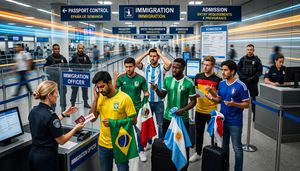 Fans from various nations facing travel bans and visa hurdles, challenging the World Cup's inclusive spirit.Image is a conceptual illustration of travel restrictions impacting fans during large international events like the World Cup. It does not represent specific individuals or real-time events.
Team Transit Trauma: When Even Pros Get Grounded ✈️
You think fans have it rough? Wait until you hear how actual national teams are getting caught in the logistical crossfire [8]. The South African squad, Bafana Bafana, suffered a humiliating 30-hour delay at OR Tambo International Airport [8]. Why? Multiple players and staff lacked the required U.S. transit visas, which are mandatory because several flight routes to Mexico require transiting through American airports [8]. Even after emergency diplomatic meetings, assistant coach Helman Mkhalele and head of security Mdu Mbatha were flat-out denied transit visas [8]. This administrative disaster severely disrupted coach Hugo Broos's acclimatization schedule—talk about a bad start to a "unifying" tournament.
Logistical Survival Tip:
If your World Cup itinerary involves layovers in the United States, you must secure a U.S. transit visa or an approved ESTA immediately [3][8]. Do not assume that staying in the airport transit lounge exempts you from immigration clearance—even professional national teams have been grounded by this rule.
The Ticket Trauma: My Bank Account is Not Feeling the Vibe 💸
Alright, let’s talk about the real heartbreak: getting your hands on World Cup tickets. It has become a dystopian battle of the bank accounts, I kid you not. FIFA has essentially turned the beautiful game into a luxury playground for corporations, influencers, and mega-rich tourists [9]. Fans are rightfully losing their minds as prices hit record highs across all stages [2]. Where's the unity when only the elite can afford a seat at the table?
The Front Zone Fiasco: A Case of Artificial Scarcity 🧐
The financial exploitation got so out of hand that state prosecutors are officially on the warpath [2]. On May 28, 2026, New York and New Jersey Attorneys General served FIFA with subpoenas, investigating allegations of artificial scarcity, deceptive seat mapping, and predatory ticket gouging [2]. The core? A highly suspicious "front zone" seat manipulation scheme [2]. FIFA marketed "Zone 1" as premium, then created an even better "front zone" with higher prices, effectively downgrading what loyal early buyers thought they were getting [2]. That’s not just a misstep; it’s a betrayal of fan trust.
Dynamic Pricing and the Seven-Figure Resale Nightmare 🤯
This is the first World Cup to deploy dynamic pricing—adjusting ticket costs in real-time based on fluctuating demand [2]. The results? Completely absurd. Category 1 tickets for the final at MetLife Stadium reached a face value of $10,990 [2]. That's a stunning seven-fold increase over the peak price of the 2022 Qatar final [2]. On secondary markets, the greed peaked when four final tickets were listed for a staggering $2.3 million EACH [10]. FIFA's president, Gianni Infantino, joked about personally delivering a hot dog for that price, but for the average supporter, paying $1,000 for a basic Category 3 seat is no laughing matter [4][10]. This isn't just about money; it's about pricing out genuine football culture.
The Blue Dot Bust: Empty Seats and Panicked Resellers 📉
But guess what? The bubble is bursting. A severe case of "blue dot fever" is sweeping Ticketmaster, highlighting empty seats [5]. FIFA vastly overshot the mark with their pricing strategy, and real demand is collapsing [5]. Tickets for lower-tier matches like Cape Verde vs. Saudi Arabia have plummeted to $164 as panicked resellers dump inventory [5]. Economists confirm that while empty stadiums look bad, FIFA's high-ticket strategy still guarantees massive profits—they’d rather sell 30,000 seats at $400 than fill 60,000 at $100 [5]. To pacify locals, NYC offered 1,000 citizens $50 tickets, calling it "the cost of five lattes" [2]. Talk about tone-deaf!
Scalping Defense:
Do not panic-buy marked-up tickets from third-party resellers 💀. Instead, monitor the official FIFA resale platform where prices are correcting by roughly 6% every three weeks as panic sets in among scalpers holding empty seats [5].
The AI Aura & Surveillance State: Your Data, Their Game 🤖
Walking into a 2026 World Cup stadium feels less like a football match and more like a high-tech sci-fi movie, no joke [11]. To protect 7 million fans across three nations, organizers are deploying an unprecedented digital shield [1]. But, and this is a big BUT, this massive security operation has also sparked serious concerns about privacy and data exploitation [13]. Is this a new era of safety, or just mass surveillance with a football filter?
Spot the Robot Dog & Autonomous Patrols 🐕
If you're at AT&T Stadium in Arlington, get ready to meet "Spot," the quadruped robot dog [13]. These autonomous security robots patrol the grounds, monitoring crowd activity [13]. While developers wanted them to look cute and curious to ease fans, critics call it a mask for mass biometric surveillance [13]. Meanwhile, the security apparatus is also taking to the skies to counter modern airborne threats, with the U.S. government investing $115 million into state-of-the-art counter-drone technologies [14]. Host cities like Kansas City also bagged $80 million in federal funding to beef up local police presence [14]. It’s a lot.
Offline Biometric Face-Scanning & Mobile App Rules 📱
To keep things flowing at high-volume entry points, stadiums are integrating biometric facial recognition with electronic tickets [12]. The kicker? Cellular networks will likely be saturated, so these systems must operate entirely offline [12]. They secure fan data by converting physical traits into encrypted mathematical representations rather than storing actual photos [12]. Fans also need to adapt to strict digital ticketing mandates: only official tickets on the FIFA World Cup app will scan at the gates—no printed copies or screenshots allowed [15]. Security personnel will conduct random ID checks to match app registration with your passport [15]. It's a whole new world, whether we like it or not.
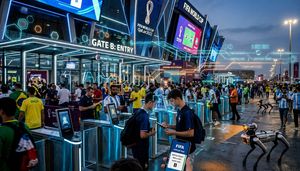 Entering a 2026 World Cup stadium means navigating advanced biometric security and autonomous patrols.This image is an artistic rendering of advanced security technologies that may be present at the 2026 FIFA World Cup venues. Its purpose is illustrative and not an exact depiction of specific security measures.
The AI Phishing & Public Wi-Fi Threat Landscape 🚨
While physical security is tighter than ever, the digital landscape is a hot mess [12]. Cybersecurity firms have detected a surge in advanced phishing campaigns powered by Generative AI [12]. These fake emails, mimicking FIFA updates with flawless grammar, bypass standard spam filters to steal banking credentials [12]. Plus, hackers are targeting temporary wireless networks at airports, hotels, and fan zones with Man-in-the-Middle (MitM) attacks on public Wi-Fi to snag VPN passwords, corporate emails, and banking data [12]. Alejandro Romero, CEO at Cyberpeace, warned that "mass interconnection across public wireless networks exposes corporate data streams to interception" [12]. And users downloading unofficial streaming apps? Their private databases are getting exfiltrated [12]. This digital wild west definitely isn't a unity vibe.
Cyber Security Protocol:
Absolutely restrict all financial transactions and corporate emails when using public Wi-Fi networks in World Cup fan zones 🚀. Always use an encrypted VPN connection or rely on your cellular data to block Man-in-the-Middle exploits [12].
The Human Rights Huddle: Where's the Fair Play? ✊
Here’s the thing: the glittering spectacle of football's biggest tournament is clashing violently with a human rights crisis [7]. Behind the scenes, marginalized communities, stadium workers, and local residents are paying a heavy price [7]. Activists are sounding the alarm, warning that the event risks becoming a highly polished platform for authoritarian practices [7]. Is this truly a game for everyone, or just for those in power?
ICE Collaboration and Paramilitary Policing 🚔
The domestic security environment in the United States is raising serious alarms [7]. Host cities like Dallas, Houston, and Miami have signed controversial agreements, allowing local police to collaborate directly with ICE [7]. This has triggered systemic racial profiling and arbitrary arrests of immigrants of color near schools and workplaces [7]. And it doesn't stop there. The U.S. government deployed 4,000 California National Guard troops in Los Angeles to respond to protests [7]. This heavily militarized presence threatens fans' freedom of expression and peaceful assembly [7]. LGBTQI+ advocacy groups in Europe have already warned it's not safe for them to have a visible presence [7]. This is a far cry from the inclusive spirit FIFA claims to champion.
Stadium Construction Labor Audits: A Step, But Is It Enough? 👷
To address historical labor abuses—and thank goodness for this—FIFA has signed a groundbreaking collaboration agreement with Building and Wood Workers' International (BWI) [17]. This five-year accord establishes a formal framework for joint, confidential inspections of construction worksites [17]. The goal? To enforce health standards, ensure fair wages, and limit grueling working hours [17]. If violations are found, FIFA must engage with third parties for corrective action and publish annual progress reports [17]. However, civil rights groups note that most host cities still haven't published their human rights protection plans [7]. So, a step forward, but with major questions remaining.
Media Restrictions and Civil Rights Retreats 🤐
Even journalists covering the tournament are facing unprecedented professional challenges [16]. Reporters Without Borders warns that press representatives are seeing their visas threatened and stadium access severely restricted [16]. This raises fears that critical stories off the pitch will be actively suppressed [16]. Simultaneously, civil rights groups are criticizing FIFA's retreat from anti-discrimination messaging [16]. The cancellation of diversity campaigns at major tournaments sends a chilling signal to communities of color [16]. Amnesty International's Steve Cockburn states that "the record-breaking surge of unlawful arrests and deportations has only been possible because of the erosion of due process safeguards, undermining the rights to liberty and security of hundreds of thousands of migrants and refugees" [7]. This highlights a worrying gap between corporate slogans and actual progressive action [16].
Safety Briefing:
Due to high levels of ICE collaboration in cities like Miami and Dallas, international visitors and vulnerable individuals should always carry physical copies of their passports and legal entry documents [7].
The Carbon Canon: An Eco-Crisis in the Making 🌍🔥
Okay, let’s talk about FIFA’s eco-friendly marketing, which is officially getting wrecked by the hard laws of physics [18]. Independent scientific studies have revealed that the 2026 World Cup will be the most polluting mega-event in sporting history [19]. The carbon math of moving millions of people across three massive nations? Simply staggering [18]. Where’s the "global mood" lift when our planet is taking a hit?
Air Travel Carbon Budget and Player Fatigue 😴
Scientists conservatively project that the tournament will generate an incredible 9.02 million tonnes of CO2 equivalent [19]. That’s almost DOUBLE the historical average of typical World Cups between 2010 and 2022 [19]. The primary driver is a massive reliance on air travel, comprising a staggering 7.72 million tonnes of the total carbon budget [19]. The travel distances for teams and fans are bordering on the ridiculous [20]. Bosnia and Herzegovina, for example, must travel over 5,000 km from Toronto to Los Angeles and then to Seattle [20]. Algeria? Racking up 4,800 km flying back and forth between Kansas City and San Francisco [20]. This isn't just an environmental concern; it’s causing immense physical fatigue for players, which could impact game quality.
Extreme Heat Stress and Turf Interventions 🥵
The warming planet is also threatening player safety on the pitch [19]. Scientific analyses warn that six of the sixteen World Cup stadiums face extreme heat stress during the summer months [19]. Eight venues require immediate, aggressive environmental intervention to prevent serious heat-related injuries [19]. To combat this, all 16 stadiums are replacing synthetic turf with hybrid natural grass fields [18]. Currently, eight stadiums (seven in the U.S. and BC Place in Canada) have artificial surfaces that trap heat [18]. The new hybrid grass fields are designed to sequester carbon, boost biodiversity, and mitigate the urban heat island effect [18]. It's a critical intervention, but it doesn't solve the core problem of massive travel emissions.
The Saudi Aramco Sponsorship Contradiction 💰
FIFA's environmental defense is completely undermined by their financial partnerships [19]. The governing body recently signed a high-profile commercial sponsorship deal with Aramco, the Saudi state-owned oil giant [19]. This single deal is estimated to induce an additional 29.95 million tonnes of CO2e in 2026 alone [19]. It highlights a massive systemic conflict between commercial greed and environmental responsibility [19]. While local venues like Seattle’s Lumen Field boast about diverting 95% of waste from landfills, it does nothing to offset the massive aviation emissions [18]. The World Cup's carbon footprint remains driven by movement, not infrastructure [21]. "Given the tournament's expansion from 32 to 48 teams, and the decision to host it across three countries, the 2026 World Cup Finals is estimated to generate approximately 9.02 million tonnes of carbon dioxide equivalent," according to FIFA's Climate Blind Spot: The Men's World Cup in a Warming World [19]. That's a canon event for climate change, not unity.
Eco-Fan Guide:
If you are traveling to multiple matches, restrict your itinerary to regional clusters (e.g., West Coast, East Coast) rather than cross-country flights [20][21]. Utilize city-provided public transit networks, like Vancouver's Advance Declaration shuttle systems, to reduce your personal emissions footprint [18][22].
The Fan ID Files: Unlocking the Digital (and Data) Experience 🔑
Released on May 22, 2026, the brand-new FIFA Fan ID is being hyped as the ultimate game-day accessory [23]. It's a free, physical NFC-enabled card available to every single ticket holder across all 104 matches [23]. Sounds cool, right? But don't be fooled by the slick marketing—this card is a massive data collection engine, and I'm here to unpack that [24]. It's about bridging the physical and digital, but at what cost to your privacy?
Near Field Communication and Gamified Rewards 🎮
Fans can snag their physical Fan ID cards from information booths inside any of the 16 host stadiums [23]. Tap the card against your smartphone, and boom—you unlock a rich digital environment [23]. This includes personalized tournament merchandise, stadium logistics, and augmented-reality video messages [23]. FIFA's urging fans to wear the card on a lanyard throughout the tournament [24], and stadiums are opening gates three hours early to encourage early collection and engagement [23]. This early bird policy also helps ease transportation congestion and, you guessed it, boosts food and beverage sales [24]. It's a win-win for FIFA's bottom line.
The Corporate Data Harvest: Your Moves, Their Profits 📈
The real value of the Fan ID lies in its ability to bridge the gap between offline and online fan behavior [24]. FIFA is utilizing those NFC taps to acquire comprehensive data on spectator movement and purchasing choices [24]. This stadium data is then paired with digital profiles built from their FIFA+ streaming app and online games [24]. Rights holders are investing heavily in these smart stadium solutions to justify skyrocketing ticket prices [24]. They want to ensure the live, in-stadium experience far exceeds what’s possible on a home television, making you feel special while collecting your every move [24]. The Fan ID? It's the blueprint for future high-tech fan engagement across all professional sports [24]. "Your FIFA Fan ID is your door into an entire world of exclusive content, unforgettable experiences and memories that are yours to keep and share. Wear your FIFA Fan ID with pride!" says Gianni Infantino, President at FIFA [27]. Sounds amazing, until you realize you're the product.
Digital Privacy Hack:
Collect your free physical Fan ID card to access the stadium promotions and souvenirs, but disable precise background location permissions on the official FIFA World Cup app to limit corporate data tracking [24].
The Raw Data Reveal: Mega-Scale Madness Under the Microscope 📊
To truly grasp the sheer magnitude of this tournament, we HAVE to zoom in on the hard statistics [4]. The scaling of this event is completely unprecedented, dwarfing all previous sports tournaments [1]. Let’s look at the operational, environmental, and financial metrics that define the 2026 cycle—because the numbers don't lie, even when the marketing does.
Historical Carbon Footprint Comparison: A Sobering Reality 📉
The environmental impact of this co-hosted setup is a major talking point for climate scientists [18]. The 2026 tournament will emit almost double the greenhouse gases of any previous modern World Cup [19]. This is primarily driven by the massive expansion of domestic flights across three host nations [18].
Check out the raw data on emissions:
- Typical World Cup (2010–2022) [19]: Total Emissions 4.71 Million tCO2e, Air Transport Emissions 1.82 Million tCO2e.
- 2026 World Cup (North America) [19]: Total Emissions 9.02 Million tCO2e, Air Transport Emissions 7.72 Million tCO2e.
The difference is staggering, and it's a stark reminder that scale often comes with a hefty environmental price tag.
Financial Growth and Revenue Projections: FIFA's Goldmine 💰
The commercial expansion of the 2026 cycle is equally staggering [4]. FIFA has dramatically revised its budget to capture billions in ticketing and broadcasting revenues [4]. The 48-team expansion is a literal goldmine for the organization, driving up its financial reserves to record levels [4].
- Projected Total Revenue (2023-2026) [4]: Initially $11.0 Billion, revised to $13.0 Billion. Primary driver: Ticketing and Broadcasting.
- Ticketing Revenue Budget [4]: $3.1 Billion. Primary driver: Larger Stadiums & Dynamic Pricing.
- Average Ticket Revenue Per Match [4]: Budgeted $30.0 Million (compared to $14.5 Million previously). Primary driver: High Demand and Dynamic Pricing.
These numbers scream profit, but do they also scream accessibility and unity for the global fanbase? Not so much.
The Ticket Price Escalation: Pricing Out the Passion 💔
Finally, the direct cost to the average fan highlights a severe pricing-out effect [2]. Dynamic pricing has shattered the baseline for affordable tournament seating [2]. The contrast between local resident pricing in 2022 and 2026 is a massive point of public anger [2].
- Category 1 Group Stage Ticket [4]: 2022 Qatar was $220. 2026 North America is $1,000+. That’s a ~4.5x price multiplier.
- Category 1 Final Ticket (Baseline) [2]: 2022 Qatar was $1,600. 2026 North America is $10,990. A ~6.8x price multiplier.
- Supporter Entry Tickets [4]: $11 for Qatari residents in 2022. For 2026, it's $60, and fewer than 600 per match available. A ~5.4x multiplier, and severely limited access.
Victor Matheson, an Economist at College of the Holy Cross, bluntly stated, "Although the visual looks bad, you'd rather sell 30,000 tickets at $400 than 60,000 at $100. The math is just the math" [28]. This isn't about fostering unity through shared experience; it’s about maximizing revenue, plain and simple.
Fan Budget Plan:
Avoid buying higher-tier tickets early in the sales cycle. If your budget is tight, actively apply for the $60 Supporter Entry Tickets through your national football association, though prepare for extremely low allocation rates [4].
The Verdict: A Game-Changer, But For What? 🤔
So, is the 2026 FIFA World Cup a unity game-changer? My take? It’s absolutely a game-changer, but perhaps not in the utopian, feel-good way FIFA wants us to believe. It's a monumental shift because it's exposing the raw, unfiltered realities of modern mega-events—the logistical nightmares, the ethical tightropes, the environmental hypocrisy, and the unbridled pursuit of profit over fan accessibility.
We're seeing a "Canon Event" for how global sports intersect with geopolitics, advanced surveillance tech, and stark economic disparities. It's forcing us to ask tough questions: Is global unity truly possible when borders harden, prices skyrocket, and privacy becomes a commodity? Or is the beautiful game, in its biggest iteration yet, merely reflecting the complexities and divisions of our world back to us, amplified?
I believe it's both. The aspiration for unity is there, championed by groups like the "Group of Friends of Football" [1]. But the execution is a wake-up call, spilling the tea on the compromises and contradictions inherent in hosting such a colossal event. It's a vibe, alright—a deeply complex, often unsettling, but undeniably transformative vibe that demands our critical attention. Because understanding these challenges is the first step towards truly changing the game, for real.
Trending Now: Your Top Questions on the 2026 FIFA World Cup
What is the FIFA PASS and who is eligible to use it?
Are fans from travel-banned countries allowed to attend the World Cup?
Why are 2026 World Cup ticket prices falling on secondary markets?
How do the new hybrid natural grass fields protect World Cup players?
What human rights concerns are tied to the 2026 World Cup?
Disclaimer: This article addresses trending topics and current events for general informational purposes only. The content may reflect public interest or opinion and has not necessarily been independently verified. Images and visuals are illustrative and may not depict real or official events. For complete details, please review our full disclaimer.