Conflict Zones: Play It Safe! 💀 | Your 2026 Tech Survival Guide for Solo Travel
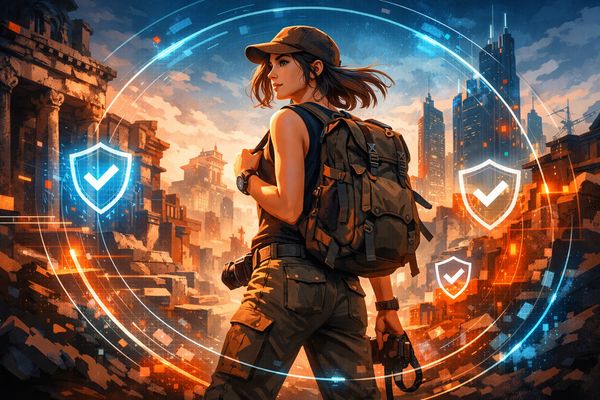 Navigating the unknown with cutting-edge tech. Your adventure, secured.Image for illustrative purposes only, depicting a conceptual representation of travel safety and technology, not actual events or locations.
Alright, squad, gather 'round! Here's what's blowing up in 2026: that insatiable urge to explore, to go solo, to find those 'undiscovered corridors' that scream 'main character energy' 🔥. We're talking about a whopping 41% of global travelers itching for entirely new destinations, especially my queens and non-U.S. nationals who are absolutely owning the cultural novelty game [1]. But let's be real, the world out there? It's giving 'persistent unpredictability' 💀. Geopolitical chaos, next-level digital surveillance, and autonomous cyber threats are making old-school safety tips look like dial-up internet.
So, for all you fearless solo travelers eyeing those 'urban conflict zones of Eastern Europe' or 'digitally restricted environments of the Middle East,' safety isn't just a vibe anymore; it’s an active, tech-dependent discipline. This isn't your grandma's travel guide. We're diving deep into the tech that turns you from a potential jumpscare victim into an unshakeable, secure legend. Let's get it!
The AI Shield: Your Proactive Intelligence Co-Pilot
Listen up, fam! The biggest glow-up in traveler safety over the last 24 months is the move from waiting for disaster to strike to proactively dodging it with AI-driven resilience 🚀. Back in the day, security was a total 'break glass in case of emergency' situation. Now? We’re talking 'Combined Intelligence' – AI brings the speed and scale, and human experts drop the strategic insights and execute complex extractions when things get spicy [4].
Industry heavyweights like GeoSure and Sitata aren’t just giving you country-level warnings anymore. Nah, their tech architecture is rocking 'agentic AI' – systems that don't just dump data on you but actively manage workflows and safety protocols [5]. These platforms are basically scanning millions of data points across news, social media, and official government feeds to give you safety scores that are 'globally calibrated but locally meaningful' [6]. Imagine getting intel on safety conditions down to your specific neighborhood or even the street corner! GeoSure 5.0's AI Safety Assistant is truly next-level, offering hyper-local advice tailored to your exact coordinates [6].
But hold up, there's an important edge case here: 'algorithmic bias' 😬. Security experts are flagging that subtle biases in the data—often reflecting the cultural or financial status of the source—can mess with AI recommendations. This could create a 'false sense of security,' accidentally sending you into a zone with an emerging, unreported, or super localized threat [7]. So, always use your brain and cross-reference! Think of AI as your super-smart co-pilot, not the only one flying the plane.
Mastering Your AI Co-Pilot:
Use AI safety apps like GeoSure and Sitata for granular, hyper-local risk assessment, but always engage critical thinking. Cross-reference AI alerts with multiple sources and local insights to avoid algorithmic bias, especially in rapidly evolving situations.
Digital Deception: The Invisible Battleground
Okay, let's talk about the dark side of this tech revolution: digital deception. As travel platforms get more AI-integrated, the threat landscape is evolving faster than your favorite TikTok trend. The 2026 International AI Safety Report is screaming about a sharp rise in AI-powered deception, with threat actors using autonomous agents to launch hyper-personalized phishing attacks and deepfake-based fraud [8]. Seriously, imagine a deepfake voice clone of your mom or a trusted embassy official trying to lure you into danger or extort cash 💀. It's a Canon Event for your digital security!
Technically, these threats are lightning-fast. AI agents can now chain exploits and map your digital attack surface in minutes, slashing the 'dwell time' of a breach to mere hours [3]. This means you need a 'zero-trust' architecture for your personal security tech. Every single connection—from that sketchy hotel Wi-Fi to a local mesh network—needs to be treated as potentially compromised until it's verified by hardware-level encryption [3]. No trust, all verify. That’s the 2026 motto.
Fortifying Your Digital Fortress:
Adopt a "zero-trust" mindset for all digital connections. Utilize hardware-level encryption and assume every network is compromised until proven secure. Be hyper-vigilant against AI-powered deepfakes and phishing attempts, especially concerning requests for personal information or funds.
Off-Grid Lifelines: Hardware for the Harshest Zones
When the internet goes dark or gets snatched by the state, your lifeline isn't an app—it's hardware independence. We’re talking about next-gen satellite messengers and off-grid mesh networks that are ruggedized, everyday essentials for 2026 [11]. Forget those clunky, niche products; these are your emergency comms, designed to deliver high-bandwidth resilience when everything else fails.
Satellite Messengers: Your Unbreakable Link
Okay, let's break down the satellite messenger scene: Iridium vs. Globalstar. For real-deal conflict zones, Iridium is the undisputed GOAT 🐐. Its constellation of 66 Low Earth Orbit (LEO) satellites forms a true 'mesh' architecture, meaning satellites talk to each other to route your data efficiently to the nearest ground station [9]. This makes Iridium devices like the Garmin inReach series and the ZOLEO communicator the gold standard for anyone trekking through deep canyons, dense urban environments, or extreme latitudes [9].
Edge Case Alert: The Garmin inReach Mini 3 Plus is absolutely eclipsing the competition in 2026. Why? Standalone functionality! Older models needed a smartphone to send messages, but the Mini 3 Plus lets you do full two-way communication directly on the device [10]. Critical feature if your primary phone goes MIA, gets snatched, or seized at a checkpoint. Seriously, this is a must-have.
On the flip side, Globalstar devices like the SPOT Gen4 are cheaper, but they're technically limited by a 'bent-pipe' architecture. This means the satellite needs a direct line of sight to both you and a regional ground station [9]. Hello, 'dead zones' in parts of Africa, South Asia, and the open ocean – which can be catastrophic in a crisis [9]. Don't cheap out on your life, fam.
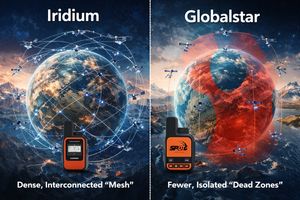 Iridium (left) offers superior global coverage with its mesh network, crucial for reliable communication in remote and volatile regions compared to Globalstar's more limited bent-pipe architecture.Image for illustrative purposes only, depicting a conceptual representation of satellite network technologies and their coverage characteristics.
Decentralized Mesh Networks: The Local Lifeline
Here’s another total game-changer for 2026: off-grid mesh networking tools like HydraMeshnet [11]. These are your 'second channel' of communication when the internet gets taken down by the state or blown up by kinetic action [11]. Using LoRa (Long Range) radio technology, they create secure, encrypted messaging across ad-hoc networks of user-owned nodes [12]. HydraMeshnet’s ĦConnector hardware can support up to 128 'mesh hops,' theoretically letting your message or even a crypto transaction hop thousands of kilometers until it hits a working internet gateway outside the conflict zone [11]. That's serious resilience.
But here’s the edge case to watch out for: the 'Tragedy of the Commons' effect in dense urban areas 💀. If node density goes over 50 nodes per square kilometer, default 'flooding' protocols (like those used by Meshtastic) can cause massive packet collisions, crashing the network [13]. That's why systems like Meshcore, with 'managed flooding' or 'shortest-path' variants, are scaling more gracefully in chaotic city centers [13].
Building Your Comms War Chest:
Prioritize an Iridium-based satellite messenger (e.g., Garmin inReach Mini 3 Plus) for primary off-grid communication due to its mesh network reliability and standalone features. Supplement with a LoRa-based mesh node (e.g., Meshcore compatible) for localized, community-level resilience during internet blackouts.
The Legal Labyrinth: VPNs, Encryption, and Border Control
Okay, this is where it gets really spicy, and your 'main character' vibe needs to be backed up with serious intel. The legal landscape for travelers in 2026 is getting tangled with 'transnational repression' – states trying to flex their control beyond their borders through digital means [14]. For you, the solo explorer, this means intense scrutiny of your devices and even the criminalization of privacy tools.
VPNs and Encryption: A Legal Minefield
Using a Virtual Private Network (VPN) isn't just a 'best practice' for security anymore; it's a potential legal liability 😬. In 2026, many countries have moved from simply 'regulating' to outright 'criminalizing' unauthorized encryption [15]. China, Russia, Iran, Belarus, and Turkmenistan? VPNs are restricted or illegal, with penalties ranging from fines to imprisonment and even enforced disappearance [24]. Even in 'gray areas' like Egypt, accessing 'blocked' content via a VPN can get you detained during unrest [15]. Myanmar's junta now views unauthorized VPN use as 'weapons of the resistance,' with severe prison sentences [14]. India even mandates 5-year data logs, basically nuking your privacy rights [18]. Know before you go, legends!
Edge Case Alert: The '2026 Iran "Stealth Blackout"' was a masterclass in state-level network control [19]. Unlike previous chaotic throttles, this was a 'hermetic seal' via their National Information Network (NIN). It created a 'Signal-to-Noise Ratio (SNR) Inversion' [19]. Normally, state cyber activity is hidden in the 'noise' of millions of users. During the blackout? That noise was GONE, leaving only the 'signal' of the state visible to global network monitors. So, any attempt to communicate with the outside world—satellite phone, mesh node—became a glaring anomaly, instantly geolocatable [19]. That's some scary stuff.
The Automated Border: Extreme Vetting is the New Norm
Crossing an international border in 2026 is no longer a chill experience; it's a high-stakes data exchange. Automated entry systems mean 'compliance exposure' for everyone, especially if you're from a 'high-risk' nation [20].
The EU's Entry/Exit System (EES) and European Travel Information and Authorization System (ETIAS), along with the UK’s Electronic Travel Authorization (ETA), are fully live, replacing passport stamps with biometric data capture (facial, fingerprint) and pre-travel security screenings [20]. Designed for speed, these systems are showing 'zero-tolerance' for data discrepancies, causing major delays during rollout [20].
Edge Case Alert: The U.S. has gone full 'Extreme Vetting' 💀. Presidential Proclamation 10998 expanded travel bans to 19 countries, and if you're applying for a U.S. visa (or even ESTA), you're mandated to provide social media IDs for the last five years, IP addresses and metadata from cloud photos, ten years of email addresses, and even your full family tree [21]. This 'social media mining' lets border agents use AI to sniff out 'unlawful activity' or anything that could be misconstrued as a national security threat. It’s led to a 120% increase in U.S. Customs and Border Protection scrutiny [21]. Your digital footprint is now your visa application, basically.
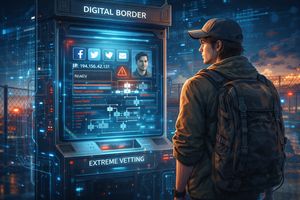 The future of border control involves 'Extreme Vetting,' where your digital footprint becomes a key part of the entry process.Image for illustrative purposes only, depicting a conceptual representation of advanced border control procedures and data scrutiny.
Navigating the Digital Minefield:
Research VPN legality for every destination. In countries where VPNs are restricted or illegal, consider physical SIMs and alternative communication. For border crossings, assume 'extreme vetting.' Maintain a 'clean' digital profile by minimizing sensitive data on devices and being prepared to disclose social media and email history.
Wearable Guardians: Biometric Safety on the Go
As physical and digital threats merge, your personal safety tech is literally moving from your pocket to your wrist. In 2026, wearables aren’t just step counters; they're 'personal safety hubs' with medical alerts, fall detection, and global SOS capabilities [22]. This is giving us major 'futuristic spy' vibes, but it's totally practical.
Medical Alert Watches and Global SOS
Modern safety watches are engineered for high-stakes environments. Take the Medical Guardian MGMove: it operates on the AT&T cellular network, boasts an average emergency response time of 29 seconds, and has an 'AI Fall Detection' algorithm that can tell the difference between you dropping your bag and an actual physical assault or medical collapse [22]. That's some serious peace of mind.
Edge Case Alert: For solo travelers in conflict zones, the UnaliWear Kanega watch is a total boss. Why? Swappable battery system 🔋! Unlike the Apple Watch Ultra 2, which needs to be on a charger daily, the Kanega offers continuous 24/7 protection because you never have to take it off your wrist [23]. That's uninterrupted security, fam.
Smart Rings and 'Silent' Alarms
Need to keep a low profile? Essential when crossing checkpoints where flashy smartwatches might make you a target. The Oura Ring Gen 4 is becoming the preferred secondary device [24]. While it's mainly a wellness tracker, the 2026 Oura ecosystem includes 'silent alarms' and 'travel recovery scores' that use AI to monitor the physical effects of jet lag, altitude, and stress [24]. Eight-day battery life and titanium construction make it an unobtrusive yet vital part of your health and safety kit. Discreet, yet powerful – a true 'quiet luxury' for security.
Equipping Your Personal Guardian:
Invest in a medical alert watch with AI fall detection and extended battery life (like the UnaliWear Kanega). For discreet monitoring, consider a smart ring (e.g., Oura Ring Gen 4) offering silent alarms and health insights, especially in sensitive areas.
Corporate-Grade Protection for Every Explorer
Here’s the plot twist of 2026: 'democratization' of corporate-grade security. Tools that used to be strictly for multinational execs – think real-time threat intelligence feeds and extraction services – are now accessible to us solo leisure travelers through advanced insurance platforms and apps like Global Rescue’s GRID [25]. You're basically getting CEO-level protection without the corporate headaches.
Global Rescue GRID: Your Unified Safety Portal
The Global Rescue GRID platform is basically the ultimate integrated approach to travel risk management in 2026. It combines GPS-enabled tracking, mass communication (email, text, phone for emergency alerts), and intelligence delivery with real-time event monitoring and expert analysis of global disruptions [27]. Through the GRID mobile app, you can 'Check-In' to create a location history, making you traceable even if you're incapacitated [28]. Plus, those 'Destination Reports' give you detailed medical and security ratings for 215 countries and territories [27]. Talk about being informed.
Proactive Risk Mitigation and Insurance Integration
Adam St. John, the visionary CEO of Sitata, has been championing the integration of these technologies directly into travel insurance policies [26]. This 'in-path' insurance model uses your booking data to tailor real-time alerts and telemedicine support to your exact itinerary. For example, if you book a flight to a city with a transit strike, you’ll automatically get a push notification with alternative transportation options and an updated safety assessment for your arrival neighborhood [26]. It’s like having a personal security detail that knows your every move before you do.
Leveraging Professional Power:
Subscribe to a comprehensive travel risk management platform like Global Rescue GRID for GPS tracking, mass communication, and expert intelligence. Opt for 'in-path' travel insurance that integrates with your itinerary to provide proactive, real-time alerts and telemedicine support.
The Future of Solo Safety: Resilience in the 'Discovery Frontier'
As we hustle further into 2026, one truth rings louder than a K-pop concert: 'complacency is the primary driver of risk' [29]. Thinking a destination is safe just because 'it was safe last year' is a dangerous myth. Political climates and infrastructure stability can flip in a matter of hours [29]. That's a hard nope.
The successful 2026 solo traveler isn't just lucky; they're strategic. They operate with a 'layered defense' strategy that is the ultimate cheat code for navigating the unknown:
- Hardware Independence: Always pack an Iridium-based satellite messenger. It's your VIP pass around fragile local networks [9].
- Digital Hygiene: Embrace 'zero-trust' principles and keep your digital profile squeaky clean for border inspections [3].
- Algorithmic Literacy: Use AI safety scores as a filter, not gospel truth. Always cross-reference with human intelligence [4].
- Community Resilience: Leverage decentralized mesh networks to stay connected locally when the grid goes down [11].
Yeah, 2026 is unpredictable, but it's also more navigable than ever for those with the right tech and the strategic foresight to use it. The 'Golden Age of Travel' might be complicated by the 'Digital State,' but for the well-prepped solo traveler, discovering the unknown remains an attainable—and safe—resolution [2]. Go forth, explore, and stay secure! You got this. 🔥
Games: Solo Travel Safety in Conflict Zones: Your Burning Questions Answered
Are VPNs always illegal in conflict zones, and what are the risks?
What is 'algorithmic bias' in travel safety apps, and how does it affect solo travelers?
Which satellite messenger is superior for communication in deep canyons or urban conflict zones?
How can solo travelers protect themselves against AI-powered deepfake scams and phishing attacks?
What is 'Extreme Vetting' at international borders, and what information might I need to provide?
Disclaimer: This article explores gaming topics for informational purposes only. Strategies, opinions, and experiences are subjective and may not apply universally. Images may be illustrative or inspired and do not represent official game assets or copyrighted material. For additional context, please consult our full disclaimer.