
Elon Musk's Trillion-Dollar Aura: SpaceX IPO Lessons 🔥 | Unlock Innovation Secrets!
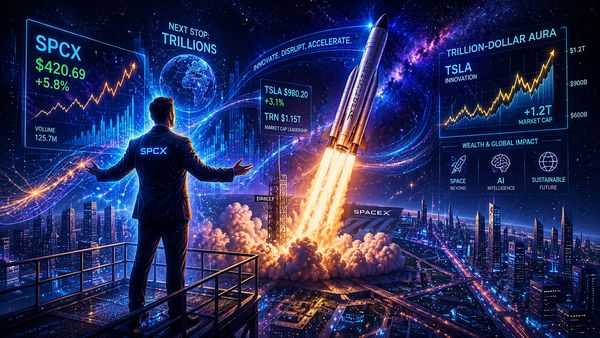 Elon Musk's trillion-dollar aura illuminates the financial cosmos as SpaceX launches its historic IPO.This image is an artistic representation and does not depict actual events or financial figures.
Here’s what’s blowing up in global markets: Elon Musk’s trillion-dollar aura just broke the financial space-time continuum with the Nasdaq debut of SPCX on June 12, 2026 [1]. It was an absolute Canon Event for anyone holding capital, looking for retail allocations, or simply wondering how a rocket maker became the most valuable technology entity on the planet [3].
I mean, seriously, we're talking about a company that built digital monuments to pure capital accumulation, tearing down the old Wall Street architecture to build something entirely new. Let’s dive straight into the raw mechanics of how this historic float went down—and why the traditional Wall Street valuation playbook is officially cooked [3]. Are you ready to unlock the secrets behind this financial supernova?
How Did SpaceX Construct the Largest IPO in Global Financial History?
SpaceX didn't just go public; it rewrote the damn rulebook. The listing of SPCX on the Nasdaq on June 12, 2026, isn't just another IPO—it represents a permanent, irreversible shift in corporate flotation history, a masterclass in market disruption [2]. As Gwynne Shotwell, President and Chief Operating Officer at SpaceX, put it, "Not everything has to get done the first day. We're really looking for investors who want to stick with us for the long term" [6]. It’s a vibe.
This wasn't some quiet, insider-trading-esque debut. No, this was a statement, a declaration that the old ways are obsolete. It’s like, why play chess when you can just invent a whole new game and win on your own terms? That’s the Elon Musk aura in full effect, and we're all just living in its glow.  SpaceX's IPO shattered traditional Wall Street expectations, marking a new era of market dynamics.This image is an artistic representation and does not depict actual events or financial figures.
The Fixed-Price Game-Changer
SpaceX completely skipped the standard Wall Street playbook. Think about it: no price ranges, no quiet negotiations behind closed doors, and absolutely zero cautious discounts [3]. Instead, they hit us with a hard, uncompromising pricing anchor of $135 per share [3]. This wasn’t just bold; it was a power move.
By bypassing the tentative valuation bands that traditional investment banks usually employ to hedge their risks, Goldman Sachs led a bold syndicate of twenty-one major underwriting institutions to market a colossal $75 billion primary offering [3]. This immediately locked in the highest initial public offering valuation in global history—raising nearly three times the capital of Saudi Aramco's record $29.4 billion raise in 2019, completely altering how global asset managers calculate liquidity pools [3]. Cooked, I tell you!
Earmarking the Retail Float
Okay, this is where it gets spicy. Musk deliberately prioritized his retail army over institutional sharks. He demanded that underwriters allocate an unprecedented 30% to 33% of the public float directly to everyday investors [3]. This isn't just a move; it's a movement!
This massive retail carve-out completely bypassed the standard mega-cap institutional norm of just 10%, letting retail fans secure a historic stake in the space economy [3]. Despite warnings from traditional fundamental analysts, this high-energy retail demand drove over $250 billion in total bid volume, proving that the public appetite for Musk's aura is completely unmatched [3]. It’s like, who needs a VIP pass when you're already part of the main event?
Underwriting Dynamics on the Street
The underwriting syndicate, led by Goldman Sachs, had to manage a historic capital rush. Twenty-one elite global institutions coordinated the placement of 555.6 million shares [3]. Can you even imagine the spreadsheets? The volume on the debut day was staggering, surpassing 500 million shares and translating into an unprecedented $80 billion in absolute trading volume in a single session [2]. Talk about a glow-up!
This massive cash flow quickly positioned SpaceX as the sixth-largest U.S. public company, showing that retail and institutional enthusiasm can comfortably coexist at a trillion-dollar scale [2]. It’s a testament to the fact that when the vision is clear, and the hype is real, everyone wants a piece of the pie.
Fast-Track Index Inclusion Battle
Passive indexing funds are currently facing a massive scramble. While S&P Dow Jones Indices refused to relax their strict guidelines, blocking fast-track inclusion, Nasdaq, the real MVP here, altered its framework to allow SpaceX fast-track entry into the Nasdaq 100 within just 15 trading days [2]. A total Canon Event for index trackers, am I right?
This fast-track mechanism will trigger automatic, non-discretionary buying from passive mutual funds and exchange-traded funds tracking the index, creating a continuous buying pressure that will support the stock's valuation [2]. Concurrently, MSCI confirmed that its early inclusion rules would apply to its Global Standard Indexes, guaranteeing global passive capital flows directly into SPCX [4]. It's almost too easy, almost.
Comparative Metrics of Historic Global Flotations
| IPO Ticker (Exchange) | Listing Date | Absolute Capital Raised | Debut Session Market Cap | Underwriting Structure | Fast-Track Index Inclusion |
|---|---|---|---|---|---|
| SPCX (Nasdaq) | June 12, 2026 | $75.0 Billion [3] | $2.10 Trillion [1] | Goldman Sachs (Lead Left) [3] | Nasdaq 100 (15 Days) [2] |
| Saudi Aramco (Tadawul) | Dec 11, 2019 | $29.4 Billion [4] | $1.88 Trillion [4] | National Commercial Bank | Retrospective Entry |
| BABA (NYSE) | Sep 19, 2014 | $25.0 Billion | $231 Billion | Credit Suisse / Deutsche Bank | Standard Cycle |
| FB (Nasdaq) | May 18, 2012 | $16.0 Billion | $104 Billion | Morgan Stanley | Standard Cycle |
Optimize Your Trading Strategy:
For retail and institutional asset allocators, anticipate highly mechanical index-driven accumulation over the next 15 trading days. To mitigate the risk of paying inflated listing premiums, utilize strict limit orders rather than market orders during high-volume intraday trading sessions [2].
Why Is SpaceX's $1.75 Trillion Valuation Under Scrutiny by Fundamental Analysts?
Okay, let's get real. While the hype is undeniable, traditional fundamental analysts are currently experiencing a complete breakdown over the financial metrics. SpaceX's public valuation has created a massive disconnect between speculative asset pricing and trailing balance sheet reality [4]. It’s like everyone’s on a wild ride, but some people are still checking their seatbelts.
As Michael Field, Chief Equity Strategist at Morningstar, pointed out, "We believe the business has real strengths, particularly in Starlink, but with so many unknown and untested technologies underpinning much of the valuation price, particularly within the AI business, we think the valuation is extremely speculative" [4]. So, is it innovation or just a really good story?
The Chasm Between Revenue and Deficit
Here’s an edge case that's wild: the underlying financial disclosures in the S-1 prospectus are highly unusual. While SpaceX reported a whopping $18.7 billion in total revenue during the 2025 fiscal year, the company simultaneously posted an enormous GAAP net loss of $4.94 billion over the same period [3]. That's not just a gap; it's a chasm!
This negative trajectory accelerated in the first quarter of 2026, with the company reporting a single-quarter net loss of $4.28 billion on revenues of $4.69 billion, driving its accumulated deficit to a historic $41.3 billion [3]. At its fixed IPO price of $135, SpaceX trades at an unprecedented multiple of approximately 92 to 94 times its trailing annual sales, far exceeding any Big Tech peer [3]. Common misconception? High revenue equals high profit. Not always, my friends!
EBITDA Profits vs GAAP Reality
SpaceX’s management has chosen to highlight adjusted EBITDA metrics to paint a more positive picture. The company reported an adjusted EBITDA profit of $6.6 billion for 2025, a figure highly publicized by bullish underwriters [3]. Sounds great, right? But here’s the technical nuance.
Fundamental analysts, always the party poopers, point out that the massive gap between adjusted EBITDA and GAAP losses is driven by persistent depreciation on the Starlink constellation, stock-based compensation, and massive AI capital expenditures [3]. These are tangible cash costs that represent real wealth dilution for incoming public shareholders, rather than simple non-cash accounting adjustments [3]. It's like trying to put a filter on a financial statement – it might look better, but the raw data is still there.
Morningstar’s Intrinsic Value Disconnect
Independent equity research is flashing warning signs, and honestly, who can blame them? Morningstar calculated that SpaceX’s actual fair value is only $63 per share, representing a conservative intrinsic valuation of approximately $780 billion [1]. That's a serious markdown!
This conservative calculation highlights a massive 56% markdown from the IPO price, with analysts warning that the gap is built on untested technological assumptions [4]. If Starlink fails to capture its self-proclaimed $1.6 trillion total addressable market—which Morningstar models at a more realistic $129 billion—the current trading price could face a severe correction [4]. Are we in for a rug pull, or is this just market jitters?
Warren Buffett’s Investment Philosophy Barrier
Value investors are largely sitting this one out, and honestly, I get it. Financial analysts argue that the $1.77 trillion valuation and the company's financial profile make it highly unlikely to meet the conservative investing principles of Warren Buffett [5]. It's like trying to fit a square peg in a round hole.
Buffett’s preference for understandable businesses with predictable cash flows and clear economics stands in stark contrast to SpaceX’s highly speculative capital reinvestment cycles [5]. With capital expenditure doubling to over $20 billion, the company remains structured as a high-risk venture fund wrapped in a public listing [7]. This isn't your grandma's mutual fund, that's for sure.  A visual breakdown of SpaceX's IPO compared to other major global market debuts, highlighting its unprecedented scale.This image is an illustrative comparison based on historical data and not a direct photographic representation.
Key Balance Sheet and Multiples Comparison
| Metric Indicator | FY2024 Balance Sheet | FY2025 Balance Sheet | Q1 2026 Run-Rate | Morningstar Fair Value Model |
|---|---|---|---|---|
| Total Global Revenue | $14.10 Billion [3] | $18.70 Billion [3] | $4.69 Billion [7] | $18.70 Billion (Base) |
| GAAP Net Income (Loss) | $791 Million (Profit) [5] | ($4.94 Billion) (Loss) [3] | ($4.28 Billion) (Loss) [3] | Not Disclosed |
| Accumulated Deficit | $32.08 Billion (Est) | $37.02 Billion (Est) | $41.30 Billion [3] | Not Disclosed |
| Implied Price-to-Sales | ~56.7x | ~94.0x [3] | ~91.0x (Annualized) | 41.7x (At $63/Share) [1] |
| Capital Expenditure | $11.20 Billion (Est) | $20.00 Billion+ [7] | $7.70 Billion (AI Only) [9] | Normalized Reinvestment |
Navigate Volatility:
For conservative and value-focused portfolio managers, avoid initiating long positions at the current listing multiples. Instead, wait for a technical correction toward the $63 to $80 split-adjusted range, where historical private-market anchor valuations match underlying asset values [1].
How Does Starlink Fund the Speculative AI and Deep-Space Moonshots?
Okay, let's talk about the real money maker. SpaceX operates a highly complex financial structure where Starlink serves as the ultimate cash generator [3]. This profitable connectivity business essentially subsidizes the massive cash burn of the rocket launch and artificial intelligence divisions [9]. It’s like having a side hustle that makes enough to fund your wildest dreams.
Gwynne Shotwell gets it. "100%. We are builders... We are building data centers on the ground and in space. I look at us as an infrastructure company," she said [6]. She’s not just talking rockets; she’s talking about building the literal backbone of the future. A total Canon Event for infrastructure, no cap.
The Operational Supremacy of Starlink Connectivity
Starlink's financial growth is seriously impressive, to say the least. In fiscal year 2025, Starlink generated $11.4 billion in revenue, accounting for over 61% of SpaceX’s entire $18.7 billion revenue base [3]. This dominance grew even further in the first quarter of 2026, with Starlink generating close to $3.3 billion, or approximately 69% of the $4.7 billion quarterly total [10].
By scaling its low-Earth orbit constellation to over 9 million global subscribers, Starlink has become the sole division capable of generating positive net operating cash flow [9]. This is a game-changer, essentially funding all the other epic, albeit money-losing, ventures. It’s like the reliable older sibling keeping the family afloat while the younger ones chase their wild dreams.
The Heavy Financial Drain of Rocket Launches
In stark contrast to Starlink, SpaceX's highly visible rocket division—the one everyone sees launching epic missions—actually operates at a loss [9]. While the launch services segment conducts roughly 85% of all US orbital launches, it generated only $4.1 billion in revenue in 2025 and $619 million in Q1 2026 [9]. Talk about an unexpected twist!
Due to massive ongoing development outlays for the Starship heavy-lift launch system, the launch segment posted a net divisional loss of $657 million for 2025 [9]. This reveals a key technical nuance: the launch business is a critical loss leader designed to deploy Starlink's hardware rather than a standalone profit center [9]. It's a strategic sacrifice for a bigger, bolder future.
xAI Integration and the Colossus Infrastructure
Edge Case Fact #1: The xAI Merger Integration
In February 2026, Elon Musk executed a vertical merger of xAI with SpaceX at a combined valuation of $1.25 trillion, where xAI was valued at approximately $80 billion. This structural merger allows SpaceX to directly integrate AI infrastructure into its Starlink fleet, optimizing autonomous satellite operations and orbital processing units while offsetting terrestrial power limitations.
This structural merger has placed a massive capital burden on SpaceX's balance sheet [3]. The artificial intelligence segment posted losses exceeding $6 billion in 2025 and burned another $2.5 billion in Q1 2026 [3]. To offset these losses, SpaceX is scaling its AI Compute as a Service business [6]. By leasing computing capacity to Anthropic and Google for a combined $24 billion a year ($2.16 billion monthly), SpaceX is leveraging its data center footprint to build a massive new high-margin revenue stream [8]. Talk about a glow-up for their balance sheet!
Orbital Data Centers: Bypassing Terrestrial Energy Grids
Edge Case Fact #2: Orbital Data Centers as a Solution to Terrestrial Energy Bottlenecks
Following warnings from Nvidia CEO Jensen Huang that AI processing could soon require 1,000 times more energy, Elon Musk positioned SpaceX's proposed space-based data centers as a key solution. By launching orbital processing units directly powered by unfiltered solar energy, SpaceX bypassed the strict terrestrial grid constraints and cooling limitations that currently hinder land-based data infrastructure.
This space-based data center strategy could fundamentally redefine the global cloud computing market [6]. By utilizing Starlink's laser backhaul network, SpaceX can route massive computing tasks through space, avoiding terrestrial regulatory bottlenecks [6]. This operational integration is why underwriters are modeling a massive acceleration in the company's growth [8]. Goldman Sachs projects SpaceX's AI-driven revenues will surge 100 times to $322 billion by 2030, transforming the company into a space-based cloud giant [8]. Are we living in a sci-fi movie? Because it feels like it!
Segmented Capital Allocation and Operating Losses
FY2025 Capital Expenditures (Total: $20.0 Billion+)
- AI Infrastructure (xAI / Colossus): $12.7 Billion (63.5%)
- Starlink Network Deployment: $4.5 Billion (22.5%)
- Rocket Launch: $2.8 Billion (14.0%)
FY2025 Segmented Net Income / (Loss)
- Starlink Connectivity (Profit): Highly Profitable
- Rocket Launch Division Loss: ($657 Million)
- Artificial Intelligence Loss: ($6.40 Billion)
Monitor AI Contracts:
For high-growth tech investors, closely monitor the quarterly run-rate of the Anthropic and Alphabet AI contracts [8]. If these contracts achieve their $26 billion annual run-rate without a corresponding increase in operational expenses, it will mark a major turning point for the company's path to profitability [11].
What is the Strategic Significance of the EchoStar Spectrum Deal and FCC Gen2 Approvals?
The structural framework of Starlink’s next-generation global expansion is shaped by two major regulatory milestones achieved in early 2026 [13]. These approvals are a total Canon Event for connectivity, removing the critical regulatory risks surrounding direct-to-cell (D2C) communications [13]. We're talking about a future where your phone just works anywhere, no matter what.
As the official statement from the FCC put it, "President Trump is restoring America's technology leadership. And this FCC authorization is a game-changer for enabling next-generation services. By authorizing 15,000 new and advanced satellites, the FCC has given SpaceX the green light to deliver unprecedented satellite broadband capabilities" [14]. It’s not just a green light; it’s a superhighway to the future.
The 15,000 Gen2 Satellite Expansion
On January 9, 2026, the FCC issued a major authorization allowing SpaceX to construct, deploy, and operate 7,500 additional Gen2 Starlink satellites, expanding its authorized global constellation to a mind-blowing 15,000 spacecraft [14]. That’s a lot of satellites, and it means serious business for global coverage.
This expansion is optimized to operate across Ku-, Ka-, V-, E-, and W-band frequencies, supporting both Fixed Satellite Services and Mobile Satellite Services [14]. To maximize network capacity, the FCC even waived obsolete rules that had previously blocked overlapping beams, allowing the next-generation constellation to deliver low-latency broadband globally [14]. Talk about a glow-up for global internet access!
The $17 Billion EchoStar Spectrum Acquisition
Edge Case Fact #3: The EchoStar Contiguous Spectrum Advantage
The 65 MHz block acquired from EchoStar is structured to support a theoretical throughput capacity increase of more than 100 times over SpaceX's first-generation shared spectrum direct-to-device architecture. This is enabled by the "exclusive-use" and "contiguous" nature of the spectrum, which eliminates the need to coordinate signal interference with terrestrial mobile operators, allowing direct, high-speed 5G data links to unmodified handsets.
This acquisition is highly significant for the mobile market [13]. By acquiring approximately 65 MHz of nationwide, contiguous mid-band spectrum from EchoStar on May 12, 2026, SpaceX secured exclusive rights to AWS-3, AWS-4, and H-Block bands [13]. This transaction provides the dedicated frequencies Starlink needs to establish direct-to-cell 5G cellular services without relying on shared carrier bandwidth [13]. This is pure innovation, making seamless connectivity a reality.  Starlink's direct-to-cell technology is poised to revolutionize global mobile connectivity by bypassing terrestrial limitations.This image is an artistic representation of Starlink's direct-to-cell technology and does not depict actual network coverage.
Bypassing the Cellular Handset Limitation
Starlink Direct-to-Cell technology bypasses standard hardware limitations [15]. By using advanced phased array antennas that function like cell towers in space, Starlink can connect directly to unmodified 4G LTE and 5G smartphones [12]. Imagine that – no special phone needed, just your everyday device connecting directly to satellites.
This system acts as a standard roaming partner, allowing users to experience voice, data, and messaging services in remote areas without requiring a traditional satellite dish [12]. Global partnerships across six continents—including T-Mobile in the US and One NZ in New Zealand—are already live, laying the groundwork for a ubiquitous mobile network [12]. This is the future, folks, and it’s already here.
The Stringent Regulatory Compliance Obligations
However, the regulatory path forward requires careful management. The final transfer of the EchoStar spectrum licenses is scheduled for November 30, 2027, after which SpaceX must meet strict deployment and performance milestones [13]. This isn’t a free pass; there are serious strings attached.
These requirements include mandatory metrics for downlink quality, uplink user throughput, and overall spectral efficiency over a nine-year period [13]. If SpaceX fails to meet these milestones, the FCC retains the right to revoke its exclusive spectrum licenses, creating a significant regulatory risk for the direct-to-cell roll-out [13]. It’s a high-stakes game with big rewards and big risks.
EchoStar Spectrum Configuration and Bandwidth
| Frequency Band | Acquired Bandwidth | Regulatory Allocation | Target Capacity Impact | License Transfer Effective Date |
|---|---|---|---|---|
| AWS-3 | 15 MHz [13] | Exclusive Nationwide | Up to 100x system capacity [13] | November 30, 2027 [13] |
| AWS-4 | 40 MHz [13] | Contiguous Mid-Band | High-throughput data links [13] | November 30, 2027 [13] |
| H-Block | 10 MHz [13] | Exclusive Mid-Band | High-throughput control paths [13] | November 30, 2027 [13] |
| Unified Spectrum | 65 MHz [13] | Dedicated 5G D2C | True Space-Based 5G [13] | November 30, 2027 [13] |
Prepare for Telco Shifts:
For telecommunications and infrastructure analysts, terrestrial telecommunications companies should prepare for a shift in market share starting in 2028. Mobile operators who secure early roaming partnerships with Starlink’s Gen2 network will gain a major competitive advantage, allowing them to offer 100% geographic coverage without the heavy capital expense of building rural cellular towers [12].
How Should Employees Navigate the Complexities of SpaceX Equity and Capital Gains Taxes?
The rapid appreciation of SpaceX’s stock has created massive personal wealth for its workforce, which is, like, totally amazing, but it has also introduced highly complex tax challenges [16]. Employees must navigate a complex tax landscape to avoid major capital gains and income tax liabilities [16]. It’s not just about getting rich; it’s about staying rich.
As Kris Barney, Wealth Manager at 3040 Wealth, wisely advised, "At SpaceX, however, if any portion of an ISO exercise becomes a disqualifying disposition, the entire grant loses its favorable ISO status and is treated as a Non-Qualified Stock Option (NSO), resulting in a severe tax disadvantage" [16]. Talk about a major financial curveball!
Navigating Vested RSUs and the Tax Bill
Vested Restricted Stock Units (RSUs) represent an immediate, non-discretionary tax event for employees [16]. The moment RSUs vest, their full fair market value is classified as ordinary income, which is reported directly on the employee's W-2 [16]. This triggers an immediate income tax liability, regardless of whether the employee chooses to sell the shares or hold them for future appreciation [16].
While SpaceX allows employees to garnish a portion of their vested shares to cover the withholding tax, this automatic share reduction can significantly limit an employee's long-term equity upside [16]. It’s a classic tax conundrum: pay now or pay even more later? The stakes are high when you’re dealing with this kind of wealth.
The Dangerous SpaceX ISO Tainting Trap
Edge Case Fact #4: The SpaceX ISO "Tainting" Rule
Unlike standard corporate equity plans where disqualifying dispositions are tracked on an individual share basis, SpaceX utilizes a strict "all-or-nothing" rule. If an employee sells a single share from an exercised ISO grant before meeting the mandatory holding periods—one year from exercise and two years from grant—the entire underlying option grant is immediately retroactively reclassified as a Non-Qualified Stock Option. This reclassification triggers immediate, back-dated ordinary income tax liabilities.
This structural trap has created massive financial challenges for employees [16]. Because of the stock's rapid growth, exercising ISOs often triggers Alternative Minimum Tax (AMT) liabilities exceeding $1 million [16]. To fund these massive AMT bills, employees are often forced to execute partial sales during private tender offers [16]. However, doing so immediately triggers the "all-or-nothing" reclassification, converting their remaining ISOs into NSOs and subjecting them to immediate ordinary income tax rates [16]. It's a real financial tightrope walk!
Post-IPO Diversification with Exchange Funds
For employees seeking post-IPO diversification, Exchange Funds offer a highly effective solution [16]. By contributing concentrated SPCX shares into a diversified limited partnership, employees can transition into a diversified stock basket without triggering immediate capital gains taxes [16]. This is a smart move for those who want to spread their wealth without taking a huge tax hit right away.
However, this strategy requires a strict seven-year holding period, during which the assets remain locked and illiquid [16]. Additionally, participation is typically restricted to "qualified purchasers" who hold an investment portfolio exceeding $5 million, limiting this option to senior executives and early hires [16]. So, while it’s a great option, it’s not for everyone.
Box Spread Loans: Tax-Loss Harvesting and Liquidity
Edge Case Fact #5: Box Spread Borrowing as a Tax Loss Harvesting Engine
High-net-worth SpaceX employees are leveraging Section 1256 SPX options to construct "box spread" loans as a highly tax-efficient alternative to traditional margin loans. This strategy allows employees to borrow cash against their concentrated equity at rates between 3.75% and 5.0%. Crucially, the implied interest paid on these options transactions is legally classified as a capital loss. These losses are not subject to the strict deductibility caps of traditional personal debt, allowing employees to offset capital gains from tender offers dollar-for-dollar.
This strategy offers highly competitive rates compared to traditional securities-backed lines of credit, which typically carry interest rates up to 13% [16]. Under Section 1256 of the tax code, SPX options are automatically split under the 60/40 rule, classifying 60% of any realized marked-to-market loss as a long-term capital loss and 40% as a short-term capital loss [16]. For high-earning individuals in the highest tax brackets, utilizing these capital losses to offset tender-offer gains can provide up to 1.1% in additional tax savings, making box spread borrowing a highly competitive financing option [16]. This is next-level financial engineering, truly.
Comparison of Tax Mitigating Vehicles for SpaceX Employees
| Strategy | Tax Classification | Required Lock-Up | Target Financial Need | Specific Constraints |
|---|---|---|---|---|
| Exchange Funds | Deferred Capital Gains [16] | 7 Years [16] | Stock Diversification [16] | $500k minimum; qualified purchaser status required [16] |
| Charitable Remainder Trusts | Deferred Capital Gains [16] | 2 to 20 Years [16] | Structured Income Streams [16] | Irrevocable asset transfer; must meet IRS 10% remainder rule [16] |
| Box Spread Borrowing | Realized Capital Losses (Sec 1256) [16] | Flexible (Up to 5 Years) [16] | AMT Funding & Liquidity [16] | Subject to active options margin maintenance requirements [16] |
| Donor-Advised Funds | Eliminated Capital Gains [16] | Immediate Irrevocable [16] | Charitable Gifting [16] | Deduction limited to 30% of Adjusted Gross Income [16] |
Optimize Employee Equity:
For vested SpaceX employees, to preserve the favorable long-term capital gains tax treatment on your option grants, avoid executing partial sales of your exercised ISOs [16]. Instead, secure necessary liquidity for your AMT liabilities by utilizing low-cost box spread loans or tendering non-ISO equity blocks [16].
What Are the Core Structural Risks and Regulatory Challenges Facing SpaceX?
Despite its historic market debut and that undeniable trillion-dollar aura, SpaceX operates within a highly complex web of corporate governance and regulatory challenges [4]. These governance dynamics have drawn sharp criticism from institutional investors and federal regulators alike [4]. It’s not all rockets and glory; there are some serious hurdles to clear.
U.S. Senator Elizabeth Warren didn't hold back, stating, "Given the unprecedented threats to investor protection and market integrity posed by the biggest IPO in history, you must delay any eventual acceleration of the registration statement's effectiveness accordingly" [4]. When a senator is throwing shade, you know things are getting real.
The 85% Dual-Class Voting Control Monopoly
SpaceX's corporate governance structure is highly consolidated, and this is a major technical nuance. Through a dual-class share structure, public investors buy Class A shares that carry one vote per share, while Elon Musk retains Class B shares that carry ten votes per share [7]. This isn't just a slight advantage; it's a full-on monopoly.
This structure ensures that Musk controls 85.1% of the total voting power while holding only 42% of the company's actual equity [3]. This absolute voting monopoly leaves public shareholders with virtually no voice in corporate decisions, exposing them to significant key-man risk [7]. Common misconception: owning stock means having a say. Not always in this playground.
Senator Warren's Campaign Against SEC Accelerated Approval
On June 9, 2026, U.S. Senator Elizabeth Warren sent a formal letter to the Securities and Exchange Commission (SEC), urging the regulator to delay the SpaceX IPO [4]. Senator Warren raised serious concerns regarding the company's massive valuation and corporate governance structure [4]. She's not one to back down, and this is a clear signal of ongoing scrutiny.
She argued that Musk's simultaneous leadership of Tesla, xAI, Neuralink, and his active role in the federal administration created unprecedented conflicts of interest, threatening market integrity and investor protection [1]. This regulatory spotlight could lead to ongoing SEC scrutiny, creating a persistent headwind for the stock's post-IPO performance [4]. It’s like a legal drama unfolding in real-time.
Operational Failures and Orbital Congestion Risks
As SpaceX scales its satellite fleet, the risk of orbital accidents increases [14]. Under its FCC Gen2 satellite authorization, SpaceX must adhere to strict performance and safety standards to prevent orbital collisions [14]. A major collision in low-Earth orbit could result in the revocation of its operational licenses, immediately disrupting Starlink's global network capability [14]. Talk about a potential Canon Event of the worst kind.
Furthermore, if SpaceX fails to meet the strict deployment milestones associated with its EchoStar spectrum acquisition, it could lose its exclusive rights to the AWS mid-band frequencies, severely damaging its direct-to-cell commercial prospects [13]. This isn't just about launching rockets; it's about maintaining a complex, interconnected ecosystem in space.
Key-Man Risks and Multi-Entity Strategic Conflict
Musk's multi-company responsibilities create a unique corporate risk [1]. Wall Street is closely watching the strategic overlap between SpaceX, Tesla, and xAI [6]. It’s like, how many main characters can one story have?
If Musk reallocates key engineering talent or computing resources from SpaceX to fund other ventures, SPCX shareholders could face significant asset dilution with no regulatory recourse [7]. This lack of independent board oversight represents a structural risk that traditional analysts believe warrants a permanent governance discount on the stock [4]. It’s a classic case of too much power in one person's hands.
Corporate Governance and Infrastructure Risk Assessment
| Operational Risk | Core Trigger Event | Potential Financial Impact | Key Regulatory Mitigation |
|---|---|---|---|
| Voting Power Monopoly | Class B dual-class voting concentration [7] | Direct exclusion of public shareholder input [7] | None; structure is permanently locked by corporate charter |
| Multi-Entity Conflict | Musk's simultaneous leadership of Tesla and xAI [1] | Resource diversion and talent dilution | SEC disclosure requirements on related-party deals |
| Spectrum License Loss | Failure to meet FCC Gen2 deployment milestones [13] | Revocation of exclusive AWS spectrum licenses [13] | Strict adherence to the 9-year FCC milestone plan [13] |
| Orbital Congestion | High satellite density in low-Earth orbit [14] | Orbital collision risk and potential service disruptions [14] | Strict compliance with NTIA and FCC safety guidelines [14] |
Assess Governance Risks:
For institutional risk officers, value SPCX with a permanent governance discount. Portfolios should be structured to limit exposure to SPCX, ensuring that sudden key-man disruptions or regulatory enforcement actions do not cause undue systemic damage to the broader portfolio [4].
Trending Now: SpaceX IPO FAQs – Your Guide to the Trillion-Dollar Aura!
What is the impact of the SpaceX ISO "tainting" rule on employee stock options?
How does the EchoStar spectrum transaction enable next-generation direct-to-cell 5G connectivity?
Is SpaceX expected to be included in the S&P 500 shortly after its Nasdaq listing?
How does the xAI vertical integration affect SpaceX’s financial valuation and infrastructure?
What are the primary tax benefits of using box spread loans for SpaceX employees?
Disclaimer: This article addresses trending topics and current events for general informational purposes only. The content may reflect public interest or opinion and has not necessarily been independently verified. Images and visuals are illustrative and may not depict real or official events. For complete details, please review our full disclaimer.